
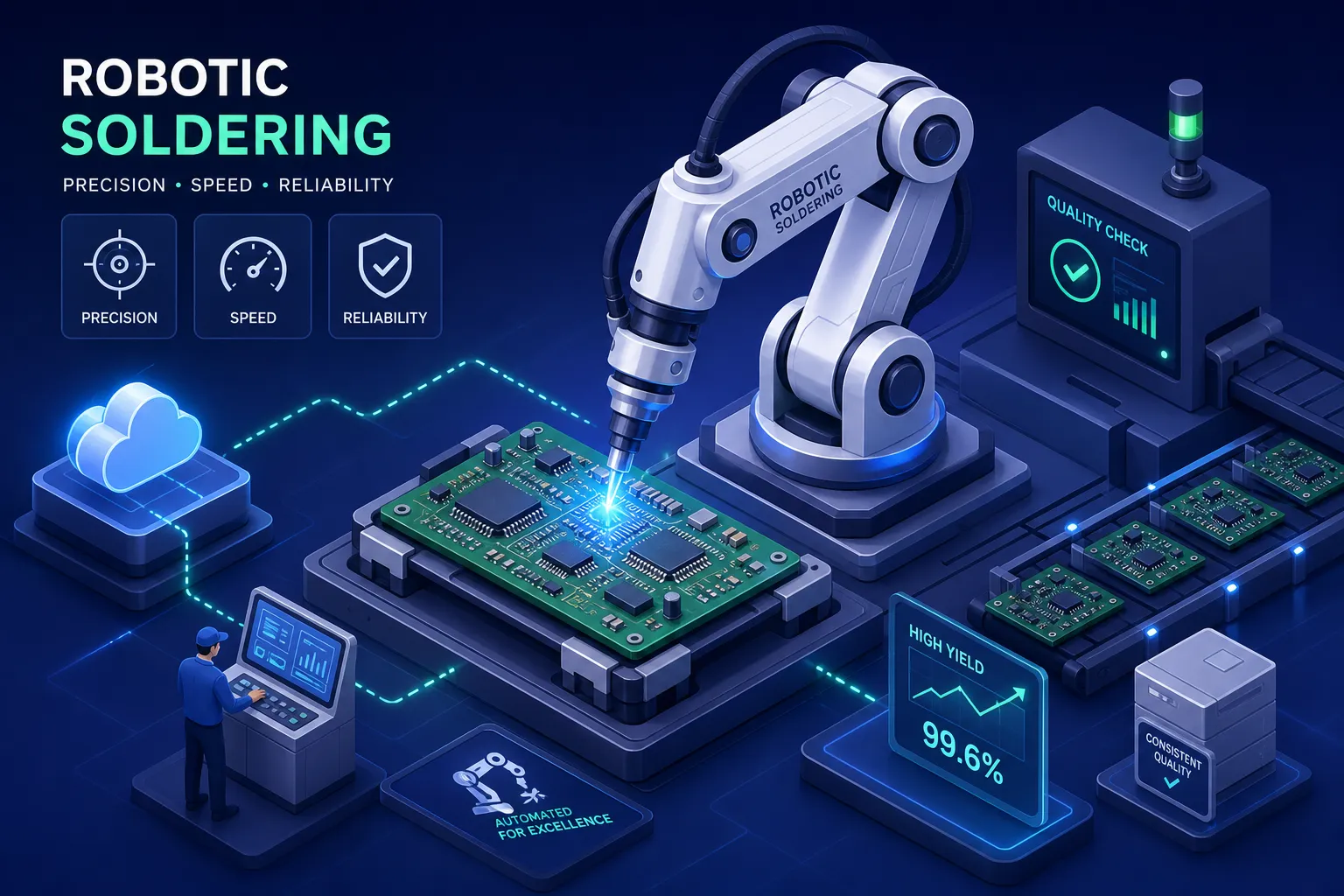
Robotic soldering solutions for electronics contract manufacturers address the quality ceiling that manual processes simply cannot overcome at scale. Technician variability, inconsistent joint geometry, and throughput gaps that compound across a high-mix line are symptoms of a process that doesn’t scale. Hand-soldering DPMO typically runs between 1,000 and 5,000 defects per million opportunities, a gap that training and inspection alone cannot close as board complexity rises and OEM quality requirements tighten.
We didn’t wait for that ceiling to become a crisis. At Amtech, we invested in robotic soldering capabilities as part of a broader automation strategy built specifically for a mid-size U.S. contract manufacturing operation. That investment delivered measurable improvements in yield, traceability, and labor efficiency, results that demonstrate this level of automation is achievable and economically defensible without being a Tier-1 operation.
This guide gives you the framework to evaluate robotic soldering for your own line. You’ll find a breakdown of system types, real ROI benchmarks, cost modeling with specific figures, integration scope by phase, and a vendor evaluation checklist grounded in IPC compliance requirements.
Why Contract Manufacturers Are Turning to Robotic Soldering Right Now
The business case for PCB soldering automation has been building for years, but three converging pressures have brought mid-size EMS operations to an inflection point in 2026: a structural labor shortage, deteriorating high-mix economics, and tightening OEM quality mandates.
The Skilled Technician Shortage Is Real and Not Improving
Qualified hand solderers capable of consistent IPC Class 2 and Class 3 work are increasingly hard to recruit and harder to retain. The pipeline of experienced technicians hasn’t kept pace with demand, and the problem isn’t regional. It’s structural. When your throughput ceiling is tied to how many skilled solderers you can put on the floor, you’ve built a capacity constraint that no amount of overtime or temp staffing fully resolves.
Robotic soldering doesn’t eliminate the need for human expertise. It shifts the dependency from skilled joint-making to skilled cell operation and programming oversight. That’s a more sustainable labor model because the skills needed to run a soldering cell are trainable and transferable in ways that hand-soldering dexterity often isn’t.
High-Mix Production Makes Manual Soldering Economically Unsustainable
When your shop is running a high mix of active part numbers, hand solderers spend a disproportionate share of their time on setup, inspection, and touch-up rather than productive joint-making. Every board changeover costs time. Every new product type introduces variability. The economics of manual soldering in a high-mix environment deteriorate quickly because overhead per joint rises as batch sizes shrink.
Automated soldering systems with quick-changeover programming cut per-board overhead and let the same cell handle multiple product lines without the same setup penalty. The cell works from a locked recipe. The process doesn’t change because the shift changed or because an experienced technician called in sick.
OEM Quality Requirements Are Tightening, Not Loosening
Industrial, automotive, and medical-adjacent customers increasingly treat documented process control, IPC compliance, and traceability as baseline requirements rather than premium differentiators. They want locked programs, logged process parameters, and inspection records during audits. Manual soldering produces skilled-trade outputs; it doesn’t naturally generate the data trail that quality-driven OEMs now expect from their manufacturing partners. Robotic soldering cells generate that data as a byproduct of normal operation, which means your quality documentation is built in rather than bolted on.
The Main Robotic Soldering System Types and Where Each Fits
Choosing the wrong system class wastes capital and creates integration headaches that take months to resolve. Here’s a clear map of the five classes and what drives the selection decision.
Cartesian and SCARA Robots for Flat, Repetitive Layouts
Cartesian systems move in X, Y, and Z only, which makes them highly repeatable for through-hole or mixed boards presented in a fixed flat plane. They’re typically lower cost and simpler to program than six-axis systems, making them a natural entry point for CM shops new to soldering automation. SCARA robots add speed for point-to-point tasks where joints are arranged across a flat board and the robot works mostly from above. Both are strong choices when repeatability matters more than dexterity and the board geometry is straightforward.
Articulated Six-Axis Robots for Complex Access and Dense Assemblies
Six-axis articulated robots offer human-arm-like motion, allowing the soldering tip to approach from unusual angles and reach around obstructions, dense component fields, or enclosure features that block straight-down access. When the PCB has confined solder locations or angled joints, this is the right class. The tradeoff is real: cost is higher, programming is more complex, and setup time per new board type is longer. Justify this class only when board geometry genuinely demands it, not as a default choice.
Selective Soldering Cells for Mixed-Technology PCBs
Selective soldering is less about robot arm geometry and more about a dedicated process cell: flux application, preheat, and a controlled solder fountain or nozzle that hits only the specified through-hole joints. This protects SMT components on the same board from the thermal stress a full wave solder process would create. For contract manufacturers building mixed-technology assemblies for industrial or automotive customers, robotic selective soldering systems are consistently among the highest-ROI investments per cell deployed, and often the workhorse of the line.
Hot-Bar Soldering for Flat Interconnects and FFC/FPC Connections
Hot-bar systems use a heated bar to press and solder flat flexible connectors, ribbon cables, and FFC-to-PCB terminations under controlled heat and pressure. This is a specialized process suited to wearables, display-intensive designs, and other products that call for flat flexible interconnects, not a general-purpose PCB jointing method. If your boards don’t include FPC connections, hot-bar is outside your scope and shouldn’t factor into your system evaluation.
What ROI Actually Looks Like After Deployment
Theoretical ROI arguments are easy to construct. The data from actual deployments is more useful and more sobering in the right ways.
Defect Rates Drop from Thousands of DPMO to the Low Hundreds
Hand soldering in a production environment benchmarks at 1,000 to 5,000 DPMO. Robotic selective soldering systems running in steady-state production routinely achieve 50 to 200 DPMO. That’s a 95 to 98 percent improvement in defect rate, which translates to first-pass yield moving from roughly 91 percent to 99.5 percent or better. For a contract manufacturer, that improvement directly reduces non-billable rework hours, board scrap, and warranty exposure on programs where you’re absorbing rework cost.
Throughput and Labor Savings: What the Data Shows
A documented case study reported 49.7 percent productivity improvement and 43.5 hours of time savings over a comparable manual production run. The ROI in that study came in at 12.6 months, and it assumed one operator handling load/unload and touch-up throughout the run. That’s a realistic single-operator model for a mid-size CM line, not an optimistic zero-labor scenario.
Industry-level benchmarks for mid-volume soldering lines report 50 to 70 percent reduction in soldering-related labor hours and 40 to 60 percent fewer dedicated soldering operators. Even a conservative 40 percent labor-hour reduction on soldering tasks recaptures meaningful capacity across a multi-shift operation, without depending on recruiting technicians who are increasingly unavailable.
What It Costs to Own a Robotic Soldering Cell
Budget conversations go sideways when CM buyers use vendor marketing numbers instead of full TCO models. Here’s what the real cost structure looks like.
CapEx Ranges from Entry-Level Stations to Fully Integrated Cells
Entry-level robotic soldering machines start around $4,000 to $6,300 for bench-top configurations. These are functional for low-volume work but limited in throughput and line integration capability. Midrange branded systems like the Hakko HU-200 are priced at approximately $30,900, while fully integrated robotic cells average approximately $55,000 with a realistic CapEx range of $45,000 to $75,000 per cell. For most CM operations running a real production line, the integrated cell range is the correct planning figure.
The Hidden Costs That Blow Up a Budget: Fixturing, Vision, and Programming
Vision add-ons for joint verification or guided placement run approximately $3,700 on top of the base machine (based on Hakko camera unit pricing; costs vary by vendor and configuration). Monthly operating costs for tips, solder wire, and maintenance run around $3,500 per cell. Multiply that by 12 before you calculate payback, and your first-year operating cost adds roughly $42,000 to the TCO picture. That changes the payback math significantly compared to CapEx-only analyses.
Programming and changeover time is the hidden cost most shops underestimate. Every new board type requires a verified program, and operators need training to manage recipe creation, collision-avoidance setup, and first-article sign-off. Plan for this labor before signing a purchase order. Our robotic soldering integration at Amtech required deliberate investment in both tooling and programming infrastructure, not just equipment acquisition. That up-front investment is what makes the system defensible at scale for a mid-size EMS operation.
From Installation to Production-Ready: What Integration Actually Involves
Vendor sales timelines are optimistic by design. Here’s an honest engineering picture of what robotic soldering integration actually requires.
Physical Footprint, Conveyor Compatibility, and Utility Requirements
A properly sized robotic soldering cell needs a minimum 400mm x 400mm working envelope to handle the largest PCBAs expected on the line, with additional reach margin near board edges for angled approach paths. The cell must interface cleanly with upstream and downstream conveyors, pallet handling, or rotary tables. Not all cells ship with standard conveyor interfaces, so verify this explicitly before purchase. Site prep should include a power capacity review, floor load and vibration control assessment, fume extraction planning, and any utility upgrades. This work happens before the cell arrives, not after it’s sitting on your floor.
Programming, Qualification, and Realistic Timelines
Physical installation for a pre-engineered cell can take three to five days. Integration, programming, collision-avoidance logic, PLC coordination, and process qualification typically extend the full deployment to four to eight weeks for a customized setup. Three to four months is a realistic planning horizon for first stable production on complex board types. Lean manufacturing benchmarks target software changeovers of five minutes and workstation reconfiguration of ten minutes once the cell is fully operational, but reaching that target requires significant upfront programming investment.
IPC-J-STD-001 and IPC-A-610 compliance must be verified as part of qualification, not assumed. Lock down program version, solder alloy, flux type, thermal profile, and first-article inspection results before releasing the cell to production. For high-reliability programs, IPC Class 3 workmanship verification and process records for customer audits need to be built into the qualification protocol from the start.
Building Your Vendor Shortlist: The Checkpoints That Matter
The evaluation questions most CM buyers ask are too generic to be useful. Here are the specific checkpoints that reveal whether a vendor and system can actually perform in a professional CM environment.
Standards Compliance and Traceability Requirements to Verify Upfront
Any robotic soldering system deployed in a professional CM environment must support IPC-J-STD-001 process documentation, IPC-A-610 acceptance criteria, and lead-free/RoHS-compliant solder alloy and flux handling. For medical-adjacent or high-reliability programs, the system must support IPC Class 3 workmanship expectations and produce the process records needed for customer audits: program version, thermal profile, lot traceability for solder and flux, and rework history per IPC-7711/21. Ask vendors directly how their system handles recipe locking, change control, and process parameter logging. Your OEM customers will ask for exactly that documentation during a quality audit.
Questions to Ask Suppliers Before Shortlisting
These five questions should go to every soldering robot supplier you’re evaluating seriously:
- What is the changeover time from recipe to first joint on a new board type, and what does that process require from the operator?
- Can your system export process data to a third-party MES or quality system, and in what format?
- What does your qualification protocol look like, and who owns the first-article sign-off?
- What is included in initial training, and what does the ongoing support model look like after the warranty period?
- What is the realistic all-in timeline from delivery to stable production for a shop running 15 or more active part numbers?
The answers to those questions will quickly separate vendors who understand CM production environments from those selling into single-product OEM lines. If a supplier can’t give you specific answers to the changeover and data export questions, that’s a signal worth taking seriously before you commit capital.
The Bottom Line for Mid-Size EMS Operations
Robotic soldering is no longer exclusive to high-volume Tier-1 manufacturers. The investment is justifiable for mid-size and smaller EMS operations when you select the right system class, model TCO honestly, and plan integration as a real engineering project rather than an equipment purchase.
Three decision anchors drive the evaluation: board type determines system class, throughput and quality goals determine your ROI timeline, and integration complexity determines deployment scope and capital risk. Get those three anchors right and the business case follows directly from the benchmarks in this guide.
If you want to evaluate robotic soldering solutions for electronics contract manufacturers against your current line’s actual performance, we’re ready to benchmark your DPMO, labor, and ROI figures together. We’re a U.S.-based contract manufacturer that has embedded robotic soldering into production as part of a deliberate automation strategy. For OEMs who want the quality, traceability, and throughput advantages of robotic soldering without building the capability in-house, a manufacturing partnership with Amtech is a direct path to those results. Reach out to our team to start the conversation.