The edge AI market isn’t a future concept. Companies are deploying inferencing hardware on factory floors, in ambulances, at substations, and across retail aisles right now. The devices running those workloads share almost nothing in common with the cloud servers that dominated the last decade of AI development. They’re smaller, built for harsh environments, thermally constrained, and purpose-built for one job: process data where it’s generated and act on it immediately.
AI edge computing is the model that makes this possible. At its core, it means running AI inference close to the data source rather than routing everything to a distant data center. The result is faster decisions, lower bandwidth costs, and the ability to operate in conditions where a cloud round trip would be too slow or too unreliable to matter. U.S.-based contract manufacturers like Amtech are seeing a steady increase in design and build requests for ruggedized, compute-intensive edge AI assemblies, and the hardware complexity behind these products is consistently underestimated until production realities hit.
This article covers what AI edge computing actually is, how it compares to cloud, where it’s delivering measurable results, and what it genuinely takes to design and manufacture edge AI hardware at a production level.
What AI edge computing actually is (and where inference raises the complexity)
The core model: compute where data lives
Edge computing is a distributed computing model that processes and analyzes data at or near its source instead of sending it to a centralized cloud or data center. The architecture has three functional layers. Edge devices at the bottom, sensors, cameras, and embedded modules, generate data and handle initial processing. Edge servers and gateways in the middle take on heavier local compute workloads. Cloud or central systems at the top handle long-term storage and broader analytics, receiving only the data that needs to travel that far. For a concise primer on the basic model, see what is edge computing.
The practical benefit of this architecture is latency. Real-time industrial edge environments achieve 1 to 10 ms processing times, compared to the 30 to 60 ms typical of centralized cloud round trips. For any workload where timing determines whether a decision is useful or irrelevant, that gap is the entire argument for edge deployment.
How AI inference changes the hardware equation
Adding AI inference to an edge device means running neural network models locally, which changes every major hardware design parameter. The device needs dedicated compute in the form of NPUs, mobile GPU accelerators, or integrated neural processing blocks. It generates significantly more heat than a standard IoT node. And the PCB design must handle high-speed signal integrity, dense power delivery, and controlled-impedance routing that basic embedded hardware was never engineered to support. For a deeper look at the chip and accelerator choices that shape these designs, consult AI Hardware Explained: Chips, Accelerators, and Edge AI.
A simple IoT sensor node and an edge AI inference device look nothing alike in terms of design requirements. The inference device is a fundamentally different product: more silicon, more thermal load, and far more demanding manufacturing specifications at every stage.
AI edge computing vs. cloud: making the right call for AI workloads
Where edge wins the latency and bandwidth argument
The decision between edge, cloud, and on-premises computing for AI workloads comes down to latency, bandwidth cost, connectivity reliability, and data sensitivity. Edge is the clear choice when a decision must happen in under 10 ms, covering autonomous systems, industrial safety interlocks, and real-time quality inspection. It’s also the right call when streaming raw sensor or video data to the cloud is economically unworkable, because bandwidth costs scale directly with data volume.
Data sovereignty adds another dimension. Keeping sensitive operational data or patient records local reduces compliance exposure and keeps information within its required jurisdiction. For healthcare and regulated industrial sectors, this isn’t a preference; it’s a hard requirement. In those environments, it often drives architecture selection before latency enters the conversation at all.
When cloud or hybrid architecture still makes sense
Cloud remains the better option for model training, large-scale analytics, and workloads that require elastic compute. No edge deployment replaces that capability. What most production deployments actually use is a hybrid pattern: process latency-sensitive data at the edge, push only aggregated or flagged data upstream, train and update models in the cloud, and deploy those updates back to edge devices on a managed cycle.
The hybrid model is practical, but it adds integration complexity. Edge hardware must be designed and validated with the assumption that it will receive firmware and model updates over time, communicate with upstream systems through potentially unreliable connections, and continue operating correctly in between. These requirements shape hardware architecture decisions from the earliest design phase.
Where AI edge computing is already delivering results
Industrial and manufacturing applications
Predictive maintenance is one of the clearest edge AI wins in manufacturing. Sensors on production equipment analyze vibration, temperature, and acoustic signatures locally to detect anomaly patterns before failures occur. Real-time quality inspection uses vision systems on the production line to catch defects the moment they appear, enabling immediate correction rather than downstream scrap. Process control applications use aggregated machine data to drive fast local adjustments that a cloud-mediated loop would be too slow to execute. For more industry-specific examples, see these edge computing manufacturing use cases.
Every one of these applications is latency-critical. A 50 ms delay to the cloud makes real-time inspection or safety interlock control functionally impossible. The value of edge in manufacturing isn’t theoretical; it’s the architecture that makes the use case viable at all.
Healthcare, smart infrastructure, and beyond
In healthcare, bedside patient monitoring devices analyze vitals locally and generate immediate clinical alerts without waiting for a cloud round trip. Edge servers process radiology scans on-site to triage urgent cases faster, before full cloud analysis is complete. Hospital asset tracking systems run through edge gateways that process location and usage data without creating bandwidth pressure on hospital networks.
Smart city traffic management follows the same pattern at scale. Thousands of edge nodes at intersections and along transit corridors process camera and sensor data locally, sending only summaries and exception events to central platforms. Fleet optimization uses real-time road conditions rather than delayed cloud-only analytics. What connects all of these deployments is a common constraint: the hardware running these workloads must survive conditions that enterprise rack servers were never designed for.
The hardware challenges that make AI edge computing devices genuinely hard to build
Ruggedization and thermal management
Edge AI devices are deployed across demanding physical environments: factory floors with vibration, dust, and temperature swings; vehicles with shock, humidity, and EMI; and outdoor infrastructure with UV exposure and moisture ingress. Ruggedization to standards like MIL-STD-810H for environmental stress, MIL-STD-461G for EMC, and IEC 60529 IP ratings for ingress protection isn’t an optional add-on. It’s a baseline design requirement that needs to be built into the architecture from the first schematic review.
Thermal design is where edge AI hardware most often creates production problems. NPUs and mobile GPU accelerators generate significant heat in form factors that typically preclude traditional fan cooling. Passive conduction to the aluminum chassis, heat pipes or vapor chambers for hotspot spreading, and high-performance thermal interface materials are the standard toolkit for fanless industrial edge devices. For a discussion of thermal management approaches in AI environments, consider this resource on thermal management in AI data centers.
The critical point is that thermal interface material selection, heatsink geometry, and heat spreader design must be engineered alongside the PCB layout, not retrofitted after the board is laid out. Getting this sequencing right at the prototype stage is what determines whether a device can pass environmental qualification before production begins.
Low-latency hardware requirements and silicon selection
Achieving sub-10 ms inference latency requires more than a fast processor. It requires matched memory bandwidth, low-latency interconnects, and PCB trace routing that doesn’t introduce signal integrity issues under load. Controlled-impedance routing for high-speed interfaces like PCIe and DDR, return-path continuity across layer changes, and very low-impedance power delivery networks for the accelerator core are PCB-level requirements that separate edge AI boards from standard embedded designs.
Edge-optimized silicon, including mobile AI accelerators, vision processing units, and MCUs with integrated neural processing blocks, represents a specialized sourcing challenge. These are not commodity components. The supply base is narrower, the design requirements are more demanding, and the consequences of getting component selection wrong at the design stage compound through every phase of the program.
Supply chain complexity: sourcing chips for AI edge computing hardware
Why edge-optimized silicon is a different procurement problem
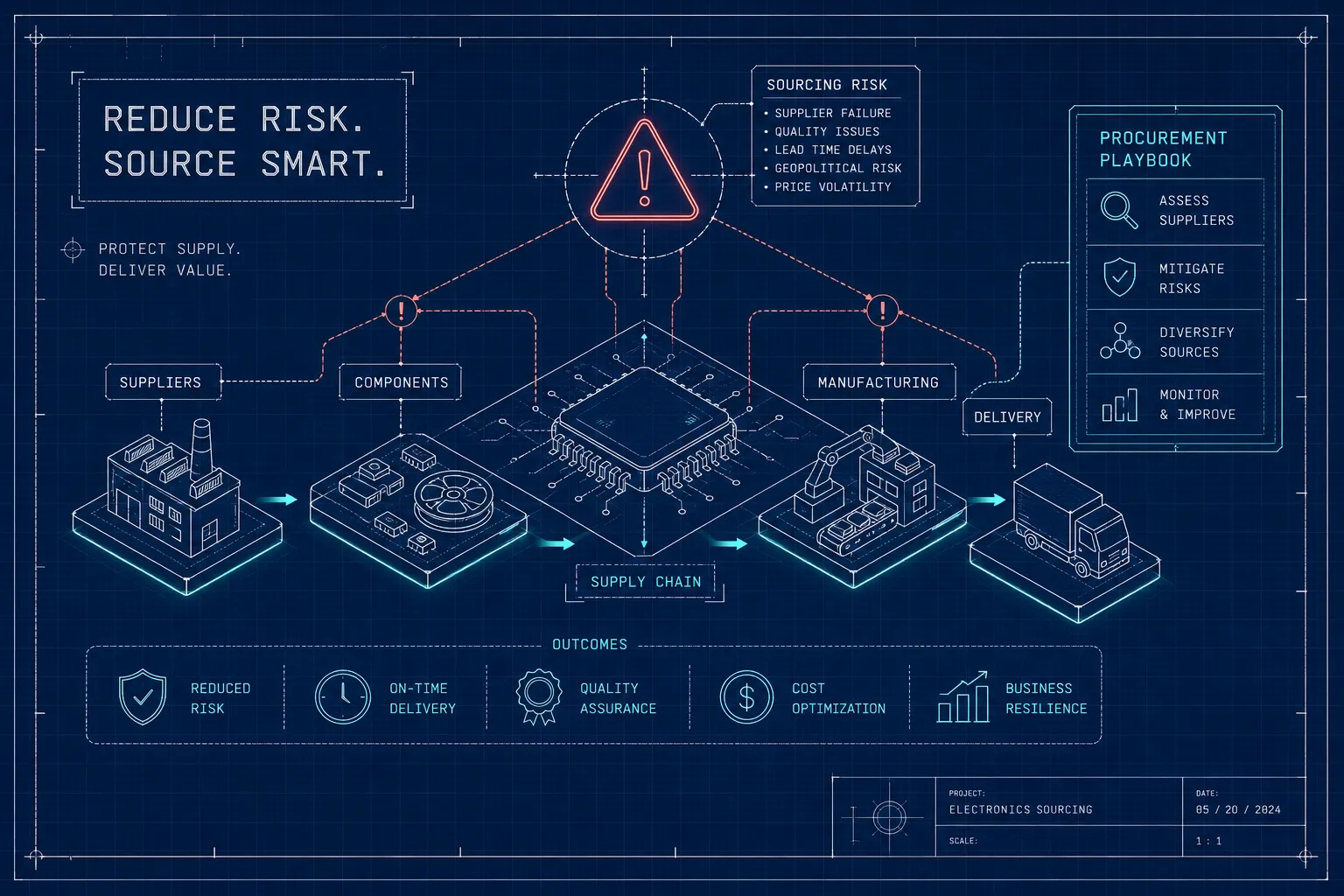
Edge AI processors are produced by a small number of fabless vendors with limited secondary sourcing options. Designing around a single source for an edge-optimized chip creates real program risk: if that part hits end-of-life or goes on allocation during a demand surge, the entire product is exposed. The AI chip allocation squeezes seen repeatedly since 2021 have made this a scenario product teams now need to plan around from the beginning, not treat as an edge case.
For companies onshoring or reshoring edge AI production to North America, tariff exposure on imported components adds another layer of procurement complexity. Section 301 tariffs and evolving U.S.-China trade dynamics make component country of origin a financial variable that can materially affect program economics. Building a tariff-mitigating approved vendor list from the start of the design process, rather than after the BOM is locked, is one of the most direct ways to protect margin and schedule.
How Amtech approaches edge AI supply chain risk
Amtech addresses component risk through its Design for Volatility program, which integrates alternate sourcing strategy, AVL development, and lifecycle planning during the design and DFM phase. The program is built specifically for hardware programs where component availability, tariff exposure, and EOL timing are active risks from day one, which describes nearly every edge AI product being developed for production in 2026. Read more about How Amtech’s AI Strategy Future-Proofs Manufacturing for context on the company’s approach.
Getting a manufacturing partner involved before silicon is finalized is one of the highest-leverage decisions an edge AI product team can make. Early engagement means component risk analysis happens while design choices are still open, not after the architecture is locked. That timing difference can determine whether a program ships on schedule or stalls waiting for an allocation release.
How to evaluate a manufacturing partner for edge AI hardware
What the full build stack for edge AI devices actually requires
A typical edge AI device requires multilayer PCB assembly with controlled-impedance traces, thermal interface material application, wire harnessing and connector management for sealed enclosures, low-pressure overmolding for environmental protection, functional test at both board and system level, and final box build. Each step requires specific process capability, and failure at any stage creates rework costs and schedule risk that compound quickly in a low-to-medium volume program. For best practices on board-level validation and test, see this guide on functional testing of PCBs.
Most contract manufacturers are optimized for high-volume production with predictable BOMs. Edge AI hardware combines high-mix production requirements with strict reliability standards and custom test fixtures. That combination requires a CM with genuine engineering depth, flexible production capability, and in-house test development, not just assembly throughput. For additional perspective on how AI is changing electronics manufacturing, review AI in Electronics Manufacturing: What’s Really Changing.
A short checklist for evaluating your manufacturing partner
Before you commit to a CM for an edge AI program, verify these five capabilities directly:
- Can they support DFM review before the design is frozen, not after?
- Do they have demonstrated experience with thermal management at both the board and system level?
- Do they build and manage custom functional test fixtures in-house?
- Do they have active alternate sourcing and AVL management capability?
- Can they scale from low-volume prototype builds to production volumes without requiring you to change partners?
Amtech meets all five of these criteria. As a U.S.-based contract manufacturer with end-to-end capability from PCBA through functional test and box build, Amtech is specifically structured for complex, reliability-critical hardware programs including edge AI devices. The combination of in-house engineering, proprietary test development, and the Design for Volatility program means the manufacturing partner stays engaged as a technical contributor from prototype through production scale, not just as an assembler.
The teams that build edge AI right treat manufacturing as a design constraint
AI edge computing is a genuinely transformative architecture, but the hardware that enables it is far more complex to design and manufacture than a standard embedded or IoT product. The engineering challenges of ruggedization, thermal management, high-speed PCB design, and edge silicon sourcing don’t become easier to solve as a program advances. They become more expensive to fix.
The edge vs. cloud calculus is clear: AI edge computing wins on latency, bandwidth cost, and data locality, with proven results across every major industry vertical. Hybrid architectures are the practical norm, and they add integration requirements that must be reflected in how the hardware is designed and validated from the start.
The manufacturing implications follow directly: thermal design, ruggedization qualification, and edge-optimized silicon sourcing all need to be addressed at the design stage. Waiting until prototypes fail environmental testing is a costly way to learn that lesson. For additional reading on edge/cloud latency trade-offs, see this analysis of edge computing vs cloud latency impact.
The teams that get edge AI products to market reliably and on schedule treat manufacturing as a design constraint from day one. Amtech is built for exactly that kind of program. Contact Amtech to discuss your program requirements and put the Design for Volatility program and end-to-end build capability to work from your first design review. Learn more about How Amtech’s AI Strategy Future-Proofs Manufacturing or review the firm’s perspective on AI Hardware Explained: Chips, Accelerators, and Edge AI.