
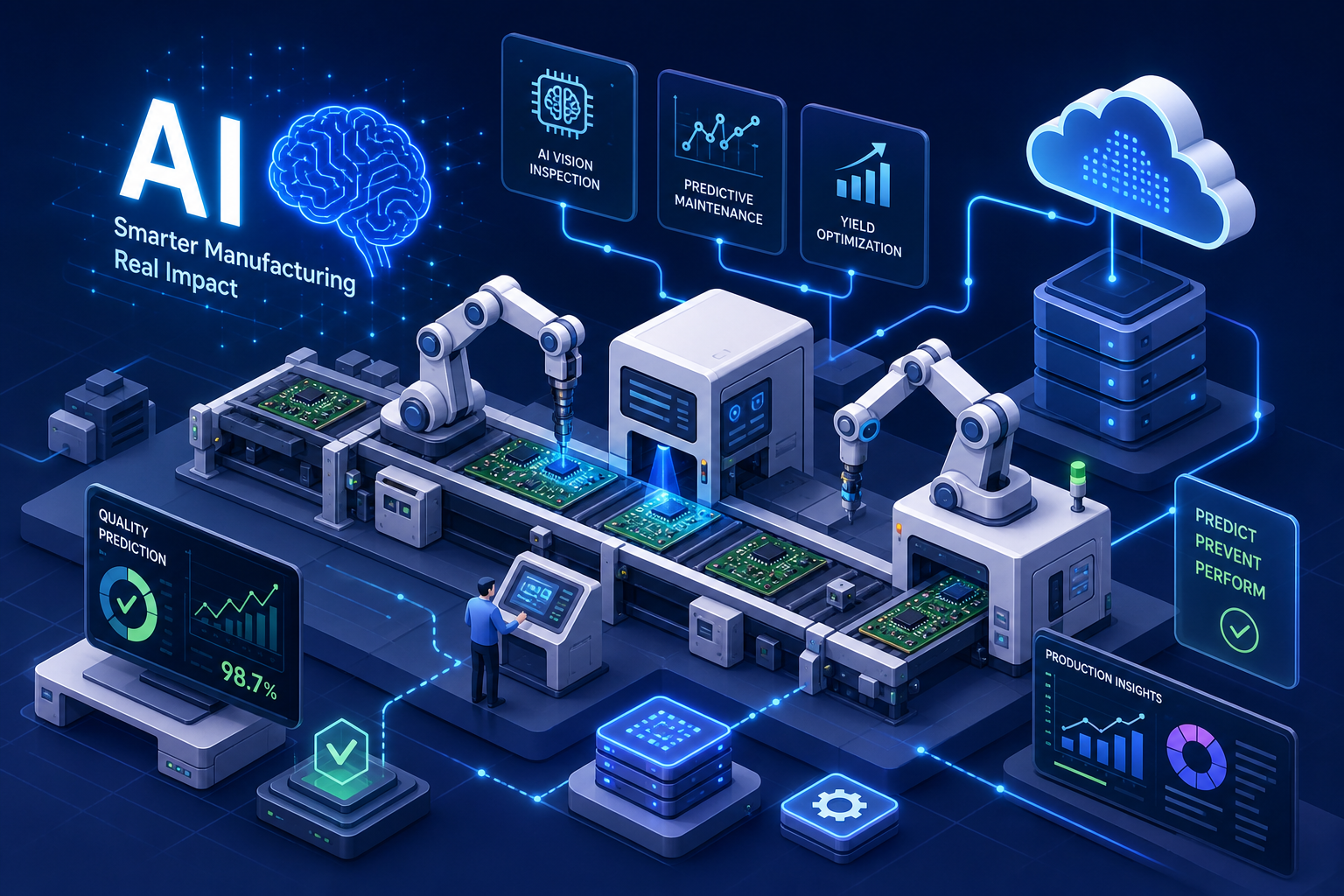
Most coverage of artificial intelligence in electronics focuses on design tools: automated schematic generation, AI-guided PCB layout, BOM optimization engines. These capabilities are real and worth understanding. But the manufacturing floor is where AI electronics technology is delivering measurable, production-level results right now, and that story gets far less attention.
The distinction matters because manufacturing AI is a fundamentally different category. It doesn’t sit upstream of production helping engineers make decisions before the line runs. It operates inside the production process itself, embedded in inspection systems, maintenance monitoring, scheduling engines, and process feedback loops. That’s where chronic cost drivers live, and that’s where AI generates compounding returns.
At Amtech, we built proprietary tools trained on our own production data and integrated directly into our assembly processes, rather than evaluating off-the-shelf AI platforms and layering them onto existing workflows. This article covers what that looks like in practice across quality control, predictive maintenance, yield optimization, and adaptive scheduling, and what it means for engineers and operations leaders choosing their next manufacturing partner.
How AI electronics technology is moving from the design lab to the factory floor
Engineers working in AI-assisted EDA tools operate in a well-defined upstream space: requirements go in, design artifacts come out. AI PCB design tools like CircuitMind, Quilter, and Flux accelerate schematic generation and AI-powered PCB layout, then hand off to the manufacturing floor once the design is locked. Manufacturing AI picks up from that point and deals with a different class of problem entirely.
Production variability doesn’t follow design intent. Components arrive with lot-to-lot inconsistency. Reflow profiles drift as ovens age. Pick-and-place systems develop mechanical wear that shows up as placement shift before any alarm triggers. These are continuous, real-world sources of defect and yield loss that no amount of upstream design optimization fully eliminates. AI systems trained on real production data can identify patterns in these variables faster and more accurately than rule-based inspection or manual review, a distinction well-supported by comparative AOI studies across multiple production environments.
The shift happening now is from reactive operations to intelligent ones. Manufacturers that previously responded to defects after they appeared are using AI for electronics testing and debugging to surface problems earlier in the process. This isn’t about replacing technicians. It’s about giving them better information, faster, so they can act on it before it compounds across a production run.
AI-powered quality control: fewer defects, faster detection
Modern AI inspection systems analyze images from automated optical inspection cameras in real time, using trained models to identify soldering defects, component misplacement, polarity errors, and surface anomalies. The key difference from traditional rule-based AOI is specificity. Traditional systems flag everything outside a fixed tolerance window, generating high false-positive rates that slow production and desensitize operators. AI systems learn from production history and distinguish genuine defects from acceptable variation with dramatically higher accuracy.
Production deployment data from AOI vendors and contract manufacturers is compelling. Mature AI AOI implementations report 98 to 99 percent defect detection accuracy with under one percent false positives, according to vendor-reported case studies from suppliers including Jidoka Tech and comparable AOI integrators. In one Tier 1 automotive electronics application, false call rates dropped from five percent to 0.4 percent within three months of deployment. Across modern production lines, AI inspection generates 30 to 40 percent fewer false calls than traditional AOI. That reduction matters operationally: fewer false positives mean less unnecessary rework handling, less operator fatigue, and faster throughput.
The deeper value is what better inspection data does to root cause analysis. When an AI inspection system catches a defect at station three and logs the defect type alongside process parameters from the preceding stations, engineers can determine whether the cause is solder paste volume, a reflow profile drift, or a component tolerance issue. Without that data linkage, the same investigation becomes a manual hunt across production logs. That’s not just faster; it’s qualitatively different in how quickly a process correction can be implemented.
AI-enabled inspection also builds a data record tied to each unit: which components, which batch, which machine, which operator, which inspection result. For industrial and automotive customers, that level of traceability and serialization is often a contract requirement. It also becomes critical infrastructure for warranty analysis and recall response when problems surface in the field.
Predictive maintenance: stopping failures before they stop the line
Reflow ovens, pick-and-place systems, wave solder equipment, and test fixtures all generate operational data: temperature profiles, vibration signatures, motor current draws, cycle times. AI systems trained on this data learn what normal operation looks like for each machine and flag anomalies that precede failures, often days before any human operator would notice a symptom.
The ROI case for predictive maintenance in electronics manufacturing is well-documented across industry studies and manufacturer deployments. Published benchmarks from aggregated industry reports show 30 to 50 percent reductions in unplanned downtime and 18 to 25 percent lower maintenance costs, with typical payback periods of 12 to 18 months. These findings align with broader analyses of predictive maintenance ROI across manufacturing sectors.
Those numbers reflect a structural advantage: predictive maintenance converts unpredictable line stops into scheduled maintenance windows. In a contract manufacturing environment, a single unplanned line stop doesn’t just cost repair time. It compresses lead times for every program behind it and triggers rush procurement situations that drive cost and create supplier relationship pressure.
The transition from calendar-driven to condition-based maintenance is the practical outcome. Traditional maintenance replaces parts on a fixed cycle regardless of actual equipment condition. AI-driven maintenance services equipment when the sensor data says it’s necessary. For high-utilization lines, this eliminates both the cost of over-maintaining equipment in good condition and the risk of running machinery past its safe operating window. Both failure modes are expensive in different ways, and both are avoidable with the right monitoring in place.
Yield optimization: how machine learning finds what humans miss
Yield optimization requires connecting data across the full production sequence: solder paste inspection, placement accuracy, reflow profile adherence, post-reflow AOI results, and functional test outcomes. AI systems that connect these data streams can identify correlations that manual process engineering rarely surfaces in time. A specific solder paste lot interacting with a marginal reflow profile to produce bridging defects on fine-pitch components is the kind of multi-variable relationship that statistical process control misses until the evidence accumulates across enough boards.
The speed of the feedback loop matters as much as the accuracy of the analysis. An AI system that flags a process drift at the beginning of a production run prevents yield loss across the full build. A weekly engineering review of the same data catches it too late to prevent the defects already built into completed assemblies. Real-time feedback is the structural advantage AI provides over traditional SPC. In practice, this means per-board analysis at production speed rather than end-of-shift or weekly reporting cycles, and that latency difference determines whether a process correction prevents 10 defects or 500.
High-mix environments create an additional challenge. When product variety changes frequently, baseline data for each product is thinner, which makes yield stabilization harder. AI systems that transfer learning across similar component families, process characteristics, or board topologies can accelerate baseline establishment on new builds without waiting for statistically significant volumes on each individual product. For contract manufacturers running dozens of active programs simultaneously, that capability compounds across the entire portfolio.
How generative PCB tools and EDA with AI connect upstream design to downstream yield
It’s worth noting that generative PCB tools and EDA with AI create structured design data that downstream manufacturing AI systems can use as baseline references. When a board arrives on the floor with AI-generated layout data and explicit tolerance models, the inspection and yield systems have a richer starting point. That upstream-to-downstream data continuity is an underappreciated leverage point in AI electronics manufacturing programs; see our discussion of how to use AI to develop better electronic products for practical examples of this handoff.
Adaptive production and intelligent scheduling for high-mix builds
Standard scheduling tools work well when volumes are predictable and product variety is limited. High-mix, low-volume electronics manufacturing breaks those assumptions constantly. Priorities shift mid-run. Components arrive late. Engineering changes come in while a build is active. Customer expedite requests are routine, not exceptional. Static scheduling in these conditions creates line stoppages, missed commits, and inventory imbalance that manual planners spend significant time managing reactively.
AI-based production scheduling systems continuously re-optimize the production sequence based on live inputs: WIP status, incoming material availability, machine capacity, labor allocation, and customer priority. When a component shortage creates a hold on one job, the system reschedules around it automatically, moves jobs with complete material to the front of the queue, and recalculates downstream delivery dates so the team can respond before the customer asks. The planner retains override authority, but the system handles the continuous re-sequencing work that would otherwise consume hours of daily effort.
The more advanced implementations connect production planning directly to supply chain signals. Component lead times, inventory levels, and supplier risk flags feed into the scheduling model, allowing manufacturers to proactively front-load critical builds, pre-kit components for programs at risk, or flag supply constraints before they reach the production floor. In a component environment where availability changes faster than traditional planning cycles can accommodate, that connection between supply chain intelligence and production scheduling is a significant operational advantage.
What separates proprietary AI from off-the-shelf tools in contract manufacturing
Many AI platforms available to contract manufacturers are general-purpose. They connect to standard data outputs, provide dashboards, and generate alerts based on models trained on generic production data. These tools have real value, particularly for manufacturers starting from no AI capability at all. But they’re built on assumptions about data structure, defect taxonomy, and process relationships that don’t always match the specific conditions of a given production environment.
A manufacturer running high-mix production across multiple assembly technologies, test methods, and component families needs AI trained on its own production history. The defect signatures, process drift patterns, and yield relationships in one facility won’t necessarily generalize from a model trained on data from a different facility with different equipment, materials, and processes. Generic platforms improve over time, but they start from a different baseline than a system built on the facility’s actual operating data.
Amtech’s approach has been to build proprietary AI tools developed around the specific data generated by our assembly processes, inspection systems, and test workflows. The models are trained on Amtech production data. The outputs connect directly to process controls rather than feeding into a separate reporting layer, and the systems continue to improve as production data accumulates. For customers, this translates to tighter defect detection thresholds, more reliable yield performance, and faster response when a process variable shifts during a build, outcomes we track across active programs.
When you’re evaluating a manufacturing partner for a complex or high-reliability electronics program, the right question isn’t whether they use AI. The question is where it lives in their workflow. Is it a reporting tool that generates weekly summaries, or is it embedded in real-time inspection, scheduling, and process control? That distinction is a reliable proxy for how the manufacturer handles variability, yield pressure, and schedule risk on your program. Generic dashboards and embedded production intelligence are not the same thing, and the difference shows up in results.
The gap is growing, and it compounds over time
The compounding effect is the real competitive dynamic in AI electronics manufacturing. A manufacturer who built and deployed these capabilities three years ago has three years of production learning that a manufacturer starting today simply doesn’t have. That gap is not static. It grows with every production cycle, because AI systems improve as they accumulate data.
Quality control, predictive maintenance, yield optimization, and adaptive scheduling are all areas where AI electronics technology is delivering measurable results in active production environments, not in pilot programs or proof-of-concept demonstrations. Representative deployments across contract manufacturers and OEM facilities confirm this, though it’s worth noting that the strongest published metrics are often vendor-reported rather than independently audited, and results vary meaningfully by implementation depth.
For engineers and operations leaders evaluating manufacturing partners, the differentiator isn’t access to AI tools. It’s whether those tools are built into the production process or sitting beside it. If you’re evaluating your next AI electronics manufacturing partner, ask specifically how AI is embedded in their inspection, maintenance, and scheduling workflows, and ask to see production data that demonstrates the results. At Amtech, that conversation starts with production data, not a product sheet. Learn more about practical approaches to implement AI in electronics manufacturing and contact us to discuss your program requirements and see how our infrastructure maps to your quality and reliability standards.