
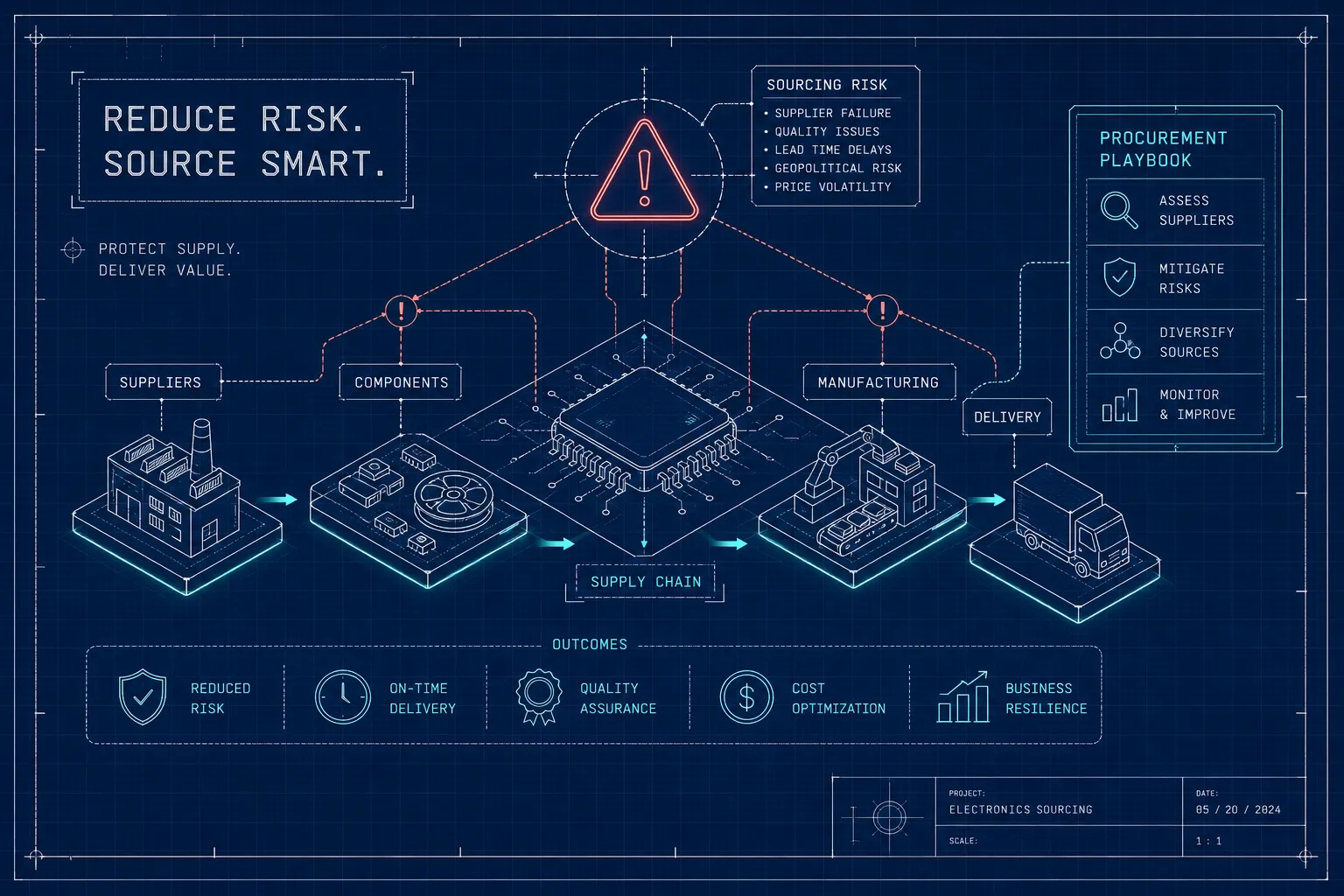
Electronics sourcing risk is the force that turns a scheduled production run into a line-down crisis, and it rarely announces itself in advance. McKinsey research puts the average interval between major supply chain disruptions lasting longer than a month at 3.7 years. For electronics procurement teams, that statistic undersells the real exposure. A disruption doesn’t have to be global to shut down your production line. One missing microcontroller, one supplier allocation, one counterfeit lot that slips through incoming inspection, any of those can halt a build that took months to schedule. The risk isn’t theoretical. It shows up as a line-down call at the worst possible moment.
This playbook is built around four electronic component sourcing risk categories that cause real production stoppages: single-source dependencies, geopolitical and trade concentration, counterfeit component exposure, and obsolescence blind spots. The mitigation steps that follow reflect patterns the team at Amtech observes repeatedly when mapping customer BOMs for supply chain exposure, across industries, build sizes, and product types. By the end, you’ll have a clear framework to identify and score these risks, plus a concrete 30/90-day action plan your procurement team can start on immediately.
Electronics Sourcing Risk: The Four Categories That Damage Production Most
Single-source dependencies and supplier concentration
The core danger of single-source reliance is straightforward: one approved supplier, zero alternatives. When that supplier faces a fab shutdown, enters allocation, or gets caught in an export restriction, your program stops. What makes this worse is that many procurement teams don’t know the full depth of their single-source exposure until a build is already at risk. The BOM gets reviewed for cost and compliance, not for supplier concentration. By the time a shortage notification arrives, the options are expensive.
BOM risk scoring is the starting point for fixing this. Every component needs a source count attached to it, not just how many distributors carry it, but how many approved manufacturers produce it. Single-source parts with long lead times sit at the top of any mitigation priority list, and that list needs to exist before you need it.
Geopolitical exposure and trade concentration
Geographic concentration in your supply base creates systemic vulnerability that individual supplier relationships can’t offset. Taiwan dominates logic chip production. China is a major global supplier of passive components including MLCCs, resistors, and capacitors. Southeast Asia handles significant assembly capacity. When trade policy shifts through Section 301 tariffs, export controls, or sanctions, the disruption hits an entire category at once. In 2026, this is an active cost driver, not a strategic planning exercise for some future scenario.
Procurement teams need a clear answer to one question: what share of our BOM originates from high-exposure regions? Without that data, you’re managing electronics supply chain risk you can’t see. The goal isn’t to eliminate geographic exposure overnight; it’s to know where you’re concentrated so you can build contingency for the highest-risk positions.
Counterfeit components and gray-market sourcing
Counterfeit risk peaks exactly when shortages are worst. When lead times stretch and authorized channels run dry, buyers turn to brokers and independent distributors. That’s when counterfeit exposure enters the supply chain at scale. ERAI reported a 25% increase in counterfeit part reports in 2024 compared to the prior year, a direct reflection of tight market conditions pushing buyers into less controlled channels.
Counterfeit components don’t just fail in the field. They introduce liability exposure and traceability breaks that are difficult and expensive to unwind. A lot of relabeled parts that passes incoming inspection under visual-only checks can move through production, reach end customers, and surface as field failures months later, with no clear chain of custody to trace back through.
EOL events and obsolescence blind spots
Obsolescence isn’t a sudden event. It’s a slow accumulation of lifecycle risk that most teams don’t track at the BOM level. Gartner research indicates that nearly 40% of components reach end-of-life earlier than manufacturers originally project. A product with a five-year commercial lifecycle may have a key MCU that goes EOL in year three, with 18 months of notice from the manufacturer. That’s enough time to respond if you’re monitoring lifecycle status. It’s catastrophic if you’re not.
The problem compounds during long development cycles. A component selected during early design may already be in the declining phase of its lifecycle by the time the product ramps. Without BOM-level lifecycle tracking, procurement teams find out about EOL events the same way they find out about shortages: too late to avoid the expensive options.
Why Most Procurement Teams Catch Electronics Sourcing Risk Too Late
Reactive BOM management vs. proactive risk mapping
Most procurement workflows are structured around ordering and expediting, not monitoring. Risk shows up as a shortage notification or a distributor lead-time alert, not as an upstream signal weeks earlier when response options are still reasonable. Proactive BOM-level monitoring looks different: each component is mapped against single-source status, geographic origin, lifecycle stage, and lead-time trend. The gap between those two approaches is where most production disruptions originate.
A BOM that functions as a living risk register, updated as market conditions change, not just when a redesign happens, gives procurement teams the lead time they need to act on alternatives before costs escalate. That shift requires a monitoring cadence and clear ownership, not just better software.
The real cost of late-stage supplier failures
When a sourcing risk surfaces during a production ramp instead of during design or procurement planning, every available option is expensive. Emergency sourcing fees, air freight premiums, schedule slippage penalties, and the very real pressure to accept gray-market parts under time constraints, these costs add up fast. Industry data puts electronics line-down costs in the range of $30,000 to $100,000 per hour for typical manufacturing operations, with high-volume semiconductor-dependent plants running materially higher depending on product value and throughput.
The cost of a proactive alternate qualification is generally far lower than the cost of a reactive line-down event. That math holds across almost every component category and every production volume. The mitigation steps below are structured around acting before the pressure is on, not scrambling after it hits.
Mitigating Electronics Sourcing Risk: A Practical Playbook
Step 1: Score your BOM by risk category
Assign each component a risk tier based on four variables: source count, geographic concentration, lifecycle stage, and lead-time variability. Single-source parts with long lead times and high geopolitical exposure sit at the top of the mitigation priority list. This is not a one-time exercise, it’s a living document that updates as market conditions shift, and right now those conditions are volatile. Current MCU lead times from Texas Instruments run 20, 40 weeks. STMicroelectronics automotive-grade parts can hit 55 weeks. NXP sits around 12, 20 weeks. A BOM risk score should reflect that variability, not last quarter’s assumptions. For market-wide lead-time context, see the electronic component lead times 2025 reporting that tracks current supplier timelines and trends. electronic component lead times 2025
Steps 2 and 3: Dual sourcing and approved vendor list discipline
Supplier diversification requires concrete structure to be effective. Primary/secondary volume splits of 70/30 or 80/20 for critical components give you a functioning alternate relationship before you need it. The key is proactive alternate part qualification, not reactive scrambling when the primary source enters allocation. Component Shortage Strategy: 9 Tactics That Actually Work, Amtech outlines practical tactics procurement teams can apply to create those alternate pathways. Tesla pivoted to alternative microcontrollers during the semiconductor shortage because alternate qualifications were already in progress. Intel expanded manufacturing across the U.S. and Europe to reduce regional concentration. Companies with diversified supply chains saw 20% fewer disruptions during COVID-19 than those concentrated in single regions or suppliers.
AVL management needs to function as an ongoing discipline rather than a one-time event at program launch. That means reviewing alternate qualification status at least quarterly, updating the AVL when lifecycle or sourcing changes occur, and treating the AVL as a procurement tool rather than an engineering document. The broader market shows how supplier strategy shifts signal a global push toward supply chain diversification, a useful benchmark when defining your own diversification targets. supplier strategy shifts signal a global push toward supply chain diversification
Steps 4 and 5: Safety stock strategy and contractual protections
Safety stock calculations need to reflect actual lead-time variability by part number, not category averages. Use the high end of the current lead-time range for constrained components when setting buffers. Service level targets should be tied to component criticality: 90, 95% for non-critical, easier-to-substitute parts; 95, 98% for constrained or long-lead parts; 98% or higher for single-source or line-stopping components. Recalculate these numbers frequently, lead times for MCUs and power devices change quickly enough that last year’s safety stock calculation may significantly underrepresent current exposure.
Contractual protections deserve equal attention. The following provisions are risk management tools with measurable impact, not legal formalities:
- Enforceable on-time delivery SLAs (95% or better, with defined penalties for misses)
- Vendor-managed inventory programs with audit rights
- Pricing terms that account for tariff and currency exposure on internationally sourced components
- Required disclosure of subcontractors and third-party suppliers
- Clear termination and remediation conditions tied to SLA performance
Steps 6 and 7: Logistics contingencies and continuous monitoring
Pre-defined logistics contingency plans are the step most procurement teams skip until they need them urgently. Identify secondary freight routes, bonded inventory options, and pre-qualified freight forwarders before a disruption requires them. When a primary route is disrupted, having a contingency activated in hours instead of days materially changes the outcome. This is operational preparation, not strategic planning.
Monitoring means tracking lead-time signals, distributor allocation alerts, lifecycle notifications, and geopolitical developments against your specific BOM, not waiting for a stockout notification. Set a formal cadence: weekly lead-time reviews for constrained parts, monthly supplier health checks for high-concentration suppliers, and quarterly full BOM risk rescores. Electronics sourcing risk shifts continuously. The teams that maintain visibility are the ones that reduce disruption frequency.
Counterfeit Prevention Controls That Actually Catch Fakes
Authorized distributor policy and AVL discipline
The first line of defense against counterfeit components is sourcing policy, not inspection. Restrict purchasing to original component manufacturers, authorized OEMs, and franchised distributors as the default. Maintain a formal preferred-source list and require documented approval for any broker or independent distributor purchase. When a shortage forces alternate sourcing, chain-of-custody documentation, Certificates of Conformance, original purchase records, and lot traceability, must accompany the lot through receiving and into your inventory system.
Align your program with AS6081 and AS6171 standards. AS6081 structures the counterfeit-control program across sourcing policy, supplier controls, and documentation requirements. SAE AS6171 improves identification of suspect counterfeit EEE parts defines the standardized test methods for suspect-part inspection, from external visual checks through destructive physical analysis. These aren’t aspirational standards; they define the accepted framework for counterfeit detection and handling in defense-adjacent and high-reliability electronics environments.
Incoming inspection protocols that go beyond visual checks
For any part not sourced through an authorized channel, visual inspection alone is insufficient. Effective programs layer 2D/3D X-ray, parametric testing, and functional electrical testing to identify relabeling, resurfacing, or internal inconsistencies that visual checks miss. Higher-risk parts warrant SAM (acoustic microscopy) or destructive decapsulation to confirm die identity and internal structure. Cross-reference suspect parts against ERAI and GIDEP watchlists before acceptance; these databases track known-risk part numbers and suppliers with confirmed counterfeit activity.
Quarantine suspect parts immediately and treat them as nonconforming until authenticity is confirmed. Production pressure is the most common reason counterfeit parts escape incoming inspection and reach the line. That pressure can’t override the process. One escaped lot of relabeled components can generate field failures, recall exposure, and traceability investigations that cost orders of magnitude more than a delayed build. For concrete program-level approaches, see proven counterfeit mitigation guidance that outlines layered controls and supplier requirements. counterfeit mitigation
What a Risk-Aware Contract Manufacturer Does Differently
BOM-level sourcing risk as a built-in service at Amtech
The choice of manufacturing partner is a direct electronics sourcing risk variable. At Amtech, supply chain risk monitoring is embedded in how the team manages every customer program from the start, not a separate consulting engagement bolted onto production services. Amtech’s Design for Volatility program maps each customer BOM for single-source exposure, geographic concentration, lifecycle stage, and tariff sensitivity. That mapping doesn’t happen once at program launch. It’s updated continuously as market conditions evolve, because the risk profile of a BOM changes whether or not the BOM itself does. Read more on Why Supply Chain Resilience Matters in Electronics Manufacturing for the rationale behind continuous BOM monitoring.
For procurement teams managing complex BOMs with lean internal resources, this is the operational difference between catching an EOL event 18 months out, with enough time for a lifetime buy or alternate qualification, versus two weeks before a scheduled build when every option is expensive and schedule impact is unavoidable.
Early warning and mitigation options before disruption hits
The practical value of Amtech’s supply chain intelligence approach is speed of response. When a component enters allocation, when a supplier lifecycle change is announced, or when a geopolitical event creates regional exposure for a component category on your BOM, the Amtech team surfaces the risk and presents mitigation options: alternate sourcing from pre-qualified suppliers, AVL expansion, lifetime buy analysis, or a redesign recommendation. The goal is to get those options in front of customers early enough that they still have real choices.
For hardware startups, IoT companies, and industrial OEMs managing lean internal teams, this early-warning capability functions as a direct extension of their procurement function, closing the gap between when a risk becomes visible and when it becomes a production problem.
Your 30/90-Day Electronics Sourcing Risk Action Plan
30-day priorities: visibility first
Start with three concrete actions. Pull a complete BOM and run every part through a basic risk screen: single-source flag, lead-time check against current market data, and lifecycle status from the manufacturer. Then identify the top 10% of components by risk exposure, these are your line-stopping candidates, and assign ownership for mitigation on each one. Finally, audit your current sourcing policy: do you have a formal preferred-source list, and is it enforced consistently across all buyers and programs?
These three actions give procurement teams more structured visibility into their electronic component sourcing risk than most organizations have built over years of reactive procurement management. Visibility doesn’t solve the risk, but it’s the prerequisite for everything that follows.
90-day goals: from visibility to action
By day 90, the target is a live risk mitigation program. That means at least one alternate source qualified for each high-risk, single-source component. Safety stock buffers recalculated using current lead-time data, not last year’s distributor quotes. Supplier contracts reviewed for enforceable SLAs, audit rights, and tariff adjustment language. A monitoring cadence established with weekly lead-time reviews for constrained parts and quarterly full BOM risk rescores. For teams looking to formalize these practices into a sustained program, consider referencing broader supply chain resilience strategies for electronics OEMs that align governance, monitoring cadence, and supplier diversification into a single operating model.
Electronics sourcing risk doesn’t disappear, it shifts. Component families that are stable today enter allocation cycles. Geopolitical conditions that seem distant become active cost drivers. Lifecycle phases that look comfortable compress when suppliers consolidate product lines. The procurement teams that consistently reduce disruption frequency are the ones that track risk continuously, act before pressure forces their hand, and choose manufacturing partners who treat supply chain intelligence as a core service rather than an optional add-on.