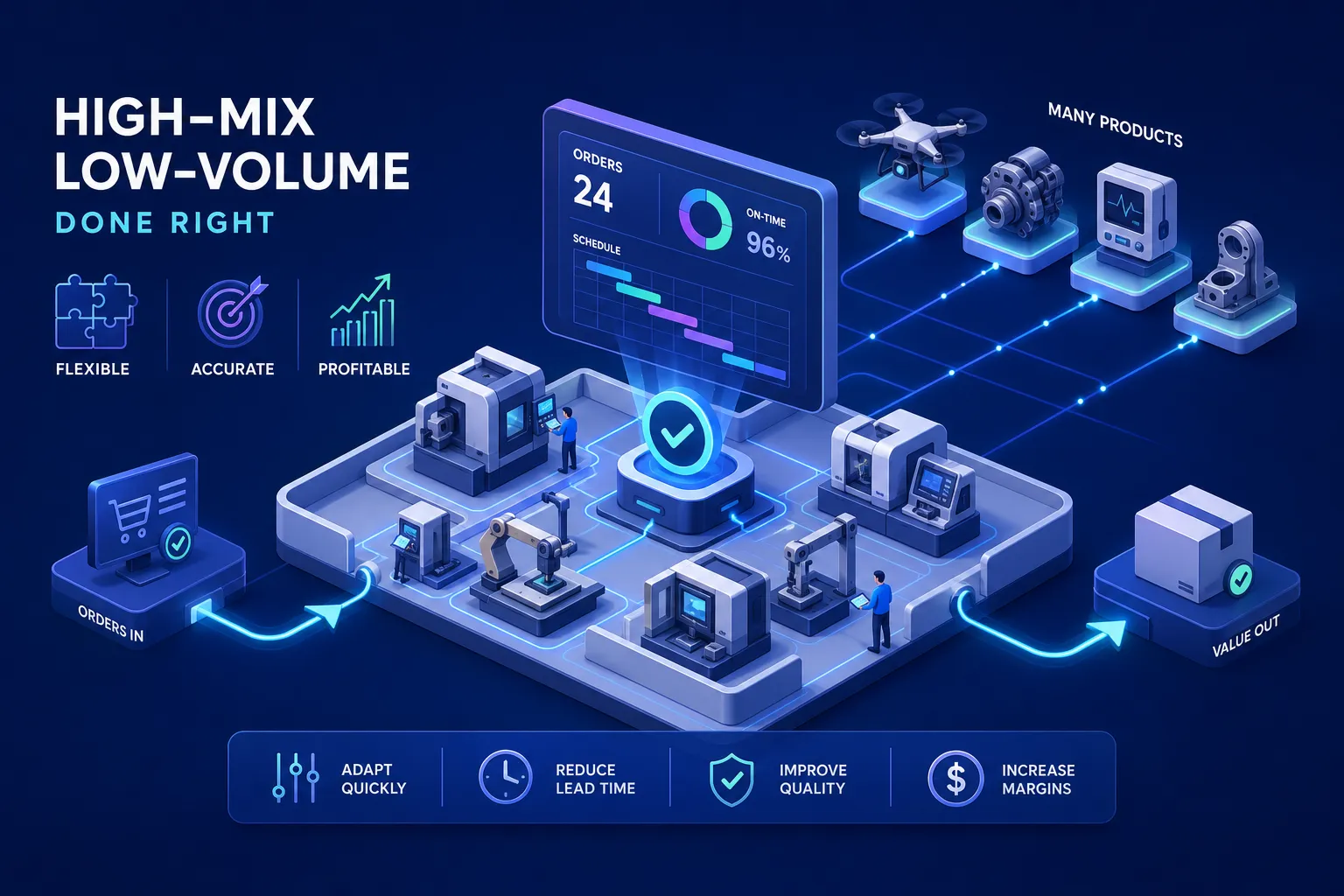
Low volume PCB assembly is a fundamentally different challenge than high-volume production. Ordering 50 boards and ordering 5,000 boards are not the same problem. High-volume assembly lines are optimized for throughput: fixed setups, full reels, and production schedules measured in thousands of units per shift. When your project calls for 25 or 100 boards, that entire model works against you. Setup fees hit harder, sourcing gets messier, and finding a partner with genuine low-volume infrastructure takes real effort.
This article gives engineers and product managers a clear map of what small-batch PCB assembly actually costs in 2026, what lead times to expect, which sourcing model to use, and how to prepare your design and BOM before you ever contact a vendor. Where useful, we’ll reference how Amtech approaches low-volume production as a real-world example of a U.S.-based contract manufacturer built to handle short runs and scale from there.
What low volume PCB assembly actually means
Defining the volume tiers: prototype, pilot, and small production
Most contract manufacturers recognize three distinct tiers. Prototype runs cover 1, 10 units, with the primary goal being engineering validation rather than cost efficiency. Flexibility matters more than repeatability at this stage. Pilot or small-batch runs fall in the 11, 50 unit range, where pre-production validation is the goal and cost sensitivity starts to matter. Short-run production covers 51, 250 units, where commercial intent is real and DFM optimization directly affects your margin.
Each tier carries different expectations around lead time, setup fee amortization, and process repeatability. The tier your project falls into shapes every downstream decision, from which sourcing model to use to which test strategy makes economic sense.
Who relies on small-batch PCBA and why
Hardware startups validating a first design before committing to inventory are the most common buyers at this volume range. IoT companies running regional pilots, R&D teams building test instrumentation, and industrial OEMs producing specialty equipment in limited quantities round out the picture. What these buyers share is a need for speed, flexibility, and transparency from their assembler. They don’t need the production-line optimization that dominates high-volume shops. They need a partner who treats 25 units with the same process rigor, the same quality standards, documentation, and traceability, as 2,500.
What small-batch PCB assembly costs in 2026
Per-unit pricing across common quantity tiers
The figures below are representative estimates based on 2026 market pricing across U.S. contract manufacturers; your actual costs will vary by board complexity, component availability, and vendor. For simple 2-layer boards, per-unit pricing runs $20, $80 at 1, 10 units, $10, $40 at 11, 50 units, and $10, $30 at 51, 250 units. Moderate complexity boards range from $80, $150 at prototype quantities, dropping to $20, $80 at small-batch volumes. A wearable device PCB is a useful benchmark: at 5 units, you’re paying roughly $100 per board; at 100 units, that same board drops to around $35. Board size, layer count, and component density drive significant variance within those ranges. For additional context on common cost drivers and benchmarks, see this PCB assembly cost overview for further reading: PCB assembly cost.
High-complexity boards with 8+ layers or HDI features can exceed $150 per unit even at low volumes. If your design falls into that category, the ranges above don’t apply directly. Get a specific quote based on your Gerber files and BOM before building any budget assumptions.
Setup fees and the NRE cost reality
Setup fees are the dominant cost driver at low volumes, and they’re often underestimated. U.S. contract manufacturers typically charge $600, $1,750 in non-recurring engineering (NRE) fees per job, covering solder stencil fabrication, machine programming, and first article inspection. These fees are fixed regardless of how many boards you order. The amortization math makes the impact clear: a $600 setup fee adds $120 per board at 5 units, $12 per board at 50 units, and $1.20 per board at 500 units. This is why per-unit prices compress so dramatically as quantity increases. Depending on board complexity and total setup fees, jumping from 5 to 50 units can cut your per-board cost by 40, 70% or more.
U.S. vs. Asia pricing: the honest tradeoff
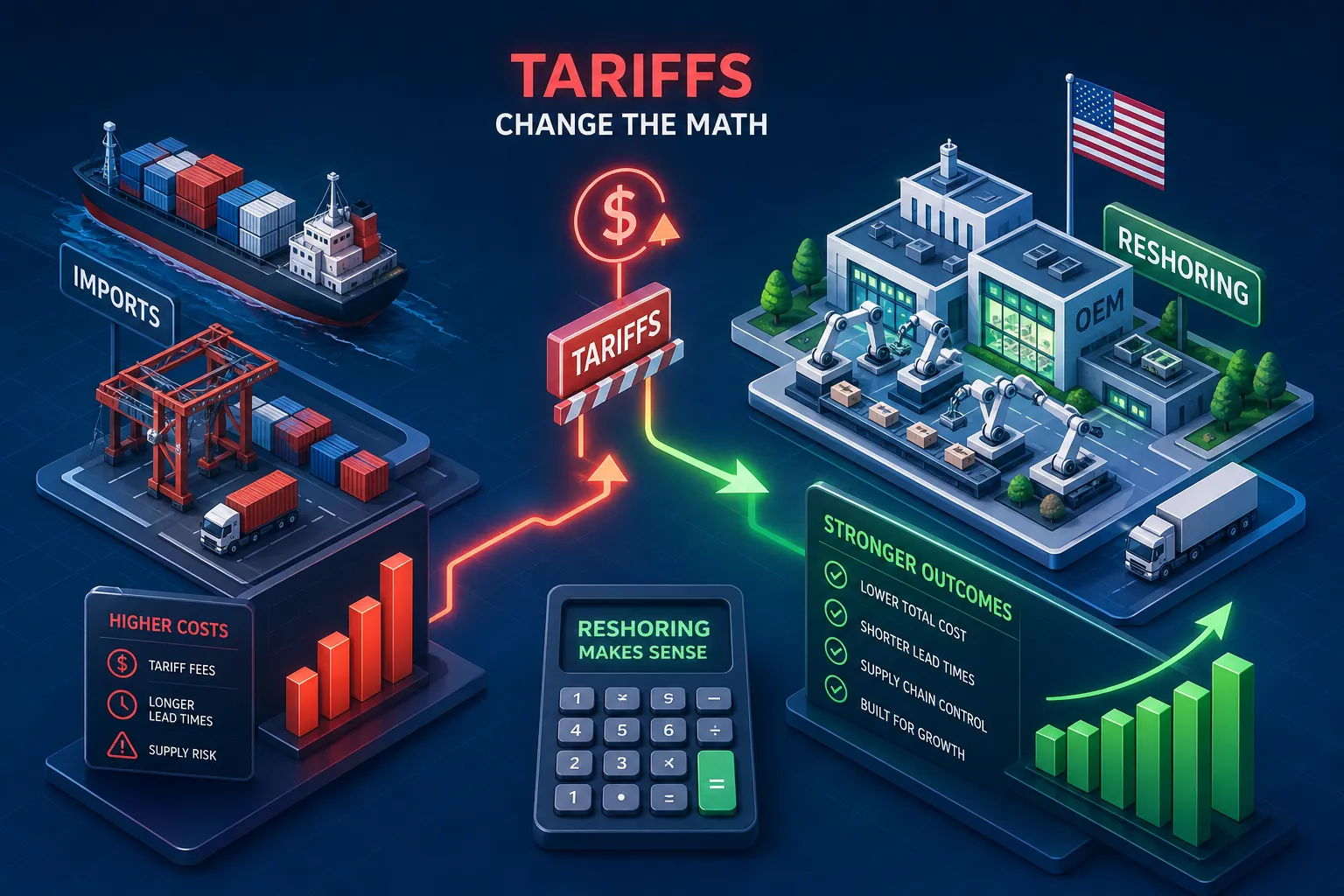
Offshore assemblers can produce 30 boards for roughly $750 all-in, including shipping and tariffs, which works out to around $25 per board. Domestic U.S. providers may charge $300 or more per board for a single unit. That gap is real and shouldn’t be dismissed. Offshore wins on unit economics for non-urgent runs where a 10, 14 day total lead time is acceptable. Domestic wins when speed, IP protection, supply-chain visibility, or tariff complexity makes overseas production a liability rather than a savings. Neither answer is universal; the right choice depends on your program’s actual constraints.
Lead times for low volume PCB assembly: what to actually expect
Domestic quick-turn timelines for prototype and small runs
U.S.-based assemblers can deliver fully assembled prototype boards in 24, 72 hours when parts are in stock and your files are complete. Small production panels can ship in 1, 3 working days under the same conditions. The phrase “when parts are in stock” is doing real work in both of those sentences. Component sourcing adds 1, 3 days to any timeline, and it’s the variable that buyers most consistently overlook when requesting a quick-turn quote. File completeness is equally critical: a missing centroid file or an incomplete BOM will pause any quick-turn order regardless of what the turnaround schedule says. For more on what to expect and how quick-turn processes work, see this primer on quick-turn PCB assembly.
Offshore timelines and the hidden shipping variable
Overseas manufacturers can fabricate bare boards in 24 hours, but full assembly with component sourcing takes 5, 10 business days. International shipping adds 4, 7 days, and customs clearance adds another 1, 7 days on top of that. The practical result: the fastest realistic offshore door-to-door is 6, 10 days, and delays can push that to two weeks. For any prototype need under five days, domestic assembly is the only reliable option. Offshore becomes competitive when your timeline allows 10+ days and cost-per-board is the primary driver.
What actually delays most small runs
Incomplete Gerber files or missing BOM data are the most common culprit, they force a hold before production can start and often surface only after the order is placed. Non-stocked components that require spot-buy procurement add days that didn’t appear in the original timeline quote. Design complexity that triggers DFM holds introduces a review cycle that buyers rarely budget time for. Address all three of these upstream, before you make first contact with your assembler, and quick-turn becomes genuinely reliable.
Turnkey vs. consigned: which model fits a small run
Why turnkey dominates small-batch production
In a turnkey arrangement, the assembler handles fabrication, component sourcing, assembly, and testing under one invoice. For low-volume buyers, this eliminates the inefficiency of sourcing small quantities from multiple distributors at cut-tape pricing premiums. Many reputable low-volume assemblers maintain in-stock libraries of common passives included at no charge on turnkey orders, which reduces both cost and sourcing delays. For quantities under 250 units, turnkey is almost always the more efficient model. The single-owner model also concentrates accountability: when something goes wrong with a 20-board build, you want one partner responsible for the outcome, not a three-way conversation between you, the assembler, and your distributor. For an overview of low-volume assembly approaches and what to expect from a turnkey arrangement, this low-volume PCB assembly guide is a useful reference.
When consigned or hybrid sourcing makes sense
Consigned assembly makes sense when your design uses proprietary, long-lead, or customer-negotiated parts that the assembler doesn’t carry. A hybrid model, where you supply specialty ICs and the assembler sources passives, balances control with convenience. Both options transfer component quality, lead time, and kitting accuracy responsibility back to you. That’s a worthwhile tradeoff when you have the supply chain infrastructure to manage it. For most hardware startups and early-stage product teams, turnkey removes a burden they’re not equipped to carry efficiently at low volumes.
How to prep your design and BOM for a small-run build
DFM changes that cut cost and reduce rework
Minimizing layer count is the highest-leverage change available: removing one layer can save 20, 30% on fabrication cost. Standardizing to common component footprints, using 0805 passives instead of custom sizes, eliminates special procurement and reduces placement errors. Aligning all polarized components and resistors in a uniform direction cuts assembly time by up to 15%. Maintaining trace widths above 0.15 mm and component spacing above 0.5 mm prevents solder bridging and reduces yield failures. None of these require a design overhaul. They’re checklist items that reduce rework costs and speed up turnaround every time a board goes through production.
Many U.S. low volume PCB assembly vendors provide structured DFM reports covering centroid data validation, spacing violations, AVL part status, and test point accessibility. Amtech’s engineering team delivers this feedback as part of onboarding, closing the loop between design intent and production reality before a board is ever built. Getting a DFM review before your pilot build is one of the highest-return decisions you can make on a small-run program. For additional guidance on DFM best practices, review this article on DFM in SMT. You can also read more about Amtech’s approach to low to mid volume electronics manufacturing to see how DFM fits into an end-to-end service model.
Testing options for low-volume builds: what to use and when
The industry standard baseline for short-run electronic assembly is AOI combined with functional test. AOI catches visible SMT defects, including missing parts, polarity errors, and solder bridges, at low cost per board. Functional test validates real-world operation. For a practical overview of test methods and how they compare, see this guide to PCB testing methods. For electrical verification, flying probe replaces ICT at low volumes because it requires no fixture. ICT fixtures cost $5,000, $20,000 and only become cost-justified above 500, 1,000 units. Flying probe has no fixture cost, sets up in under a day, and carries an estimated testing labor cost of roughly $0.50, $2.00 per board, a clear win for any build under 500 units. If you need a deeper look at whether flying probe testing fits your small-batch program, read this short piece on flying probe testing for small-batch production.
X-ray inspection is worth adding for boards with BGA or QFN packages where hidden solder joints can’t be verified visually. The cost is higher per board, but the alternative is shipping a prototype with undetectable solder voids. For boards with those package types, X-ray isn’t optional. It’s the only way to verify joint quality without destructive analysis.
What to look for when vetting a low volume PCB assembly partner
Capabilities that matter most for small-batch work
Not every contract manufacturer is set up to handle low-volume efficiently. The capabilities that distinguish effective low-volume assemblers include:
- No strict MOQ, with genuine support for single-unit orders
- An integrated DFM review before production starts
- Transparent NRE pricing with no hidden setup penalties
- Turnkey sourcing with an in-stock parts library
- Domestic quick-turn capability for urgent builds
These aren’t nice-to-haves. They’re the operational infrastructure that makes small-run circuit board assembly viable without inflated costs or timeline surprises. A shop that handles low-volume as a side service to its main high-volume line will typically carry higher minimums, longer lead times, and less scheduling flexibility, and will price and prioritize accordingly.
The scalability question: can your partner grow with you
One underappreciated criterion is whether the partner can scale with your program. Switching assemblers between prototype and production introduces new DFM reviews, new component qualifications, and new risk. Every transition is an opportunity for something to go wrong. A U.S.-based partner that handles both low-volume prototype runs and higher-volume production within the same facility and quality system eliminates that transition entirely. Amtech is built on that model, starting with short runs and scaling without requiring a partner change. Starting low-volume with a partner who has high-volume infrastructure means your process, quality standards, and supply chain strategy stay consistent as demand grows. If you want to compare quick-turn options and how they scale, this buyer’s guide to best quick-turn PCB assembly services in the U.S. is a practical resource.
Quick vetting checklist before you commit
Before signing with any low-volume PCBA supplier, work through these questions directly:
- Do they offer DFM review as part of onboarding, and do they provide written feedback?
- What is their standard testing stack for small batches, and do they use flying probe for electrical verification?
- Can they source components turnkey, and how deep is their in-stock passive library?
- What are their realistic lead times for your quantity tier with and without component sourcing?
- Do they have documented experience with your board complexity, specifically HDI, BGA, or flex?
- Can they scale into higher volume without requiring you to switch partners?
Any vendor that hedges on these questions or can’t answer them specifically is worth treating with caution. The right answer to each question should be clear and verifiable, not a sales conversation.
Making the right call for your program
You now have the framework to make the decisions that matter before you engage a vendor. Understand which volume tier fits your project and how NRE amortization affects your per-unit cost. Choose turnkey sourcing unless you have a specific reason to manage components yourself. Get your files and BOM DFM-ready before first contact. Use the vetting checklist to filter candidates before you share any design data.
The right low volume PCB assembly partner isn’t just one that can build 50 boards today. It’s one with the engineering depth, sourcing infrastructure, and production capacity to support your program when it grows. Switching partners mid-program is expensive, disruptive, and entirely avoidable if you choose correctly at the start.
If you’re planning a small-batch build and want a U.S.-based partner with genuine low-volume capability and a clear path to scale, contact Amtech to review your design and get a transparent quote. From DFM review through production and test, the same team and process support your program from first prototype to full production run. Learn more about Amtech’s low to mid volume electronics manufacturing services and request a quote when you’re ready.