
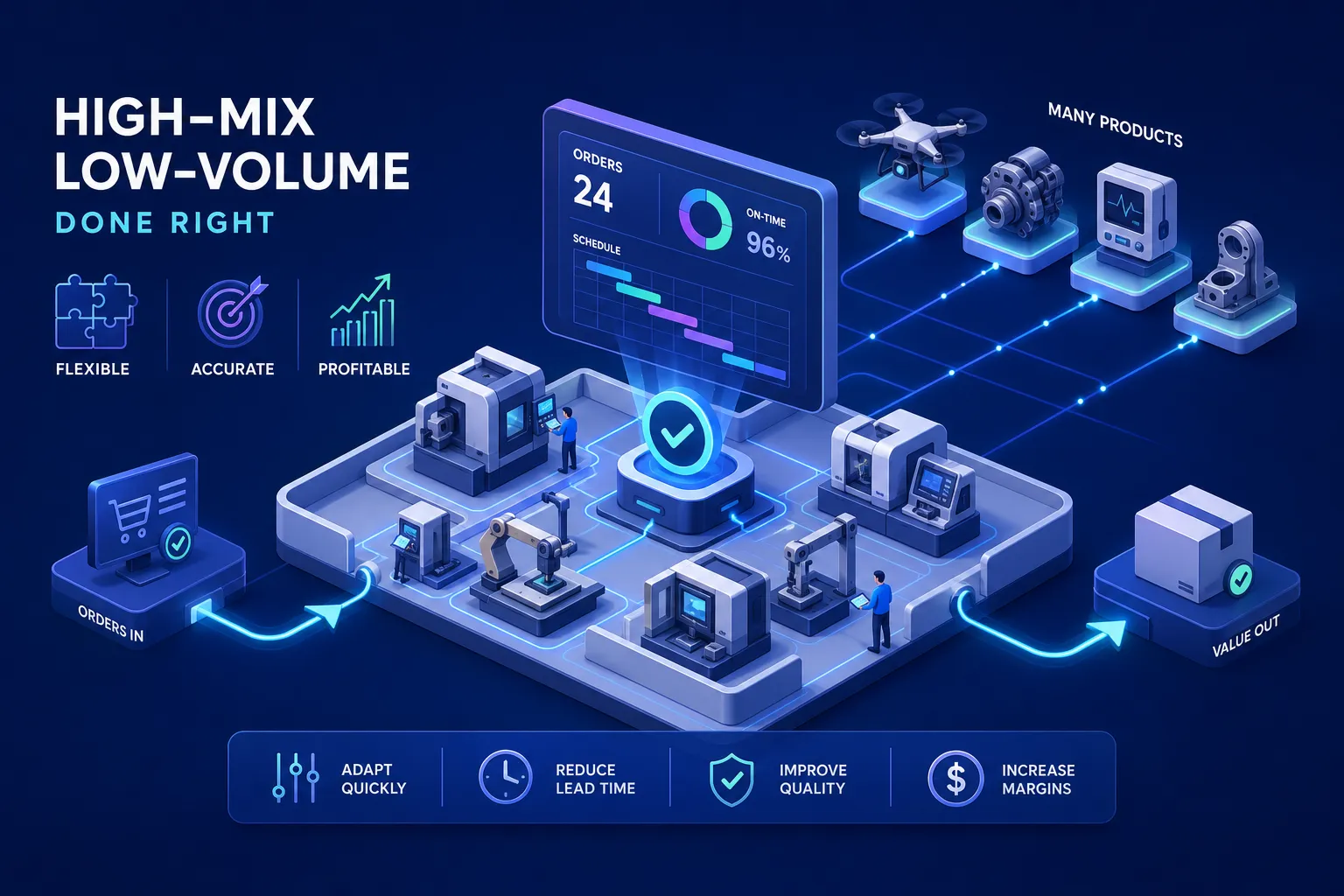
Most production systems are quietly optimized for the wrong environment. The rules that govern high-volume manufacturing (long stable runs, fixed takt times, batch-driven efficiency) fall apart the moment product variety climbs and order quantities shrink. Shops that treat high mix low volume manufacturing as a scaled-down version of mass production pay for that mistake in rework, missed deliveries, and eroded margin. The environment is fundamentally different, and it demands a fundamentally different operating model.
Forward-thinking contract manufacturers are now architecting their entire operations around HMLV realities rather than retrofitting volume-optimized systems. Amtech is one example: purpose-built around flexible production, rapid changeover, and variant-level quality traceability from the ground up. That approach matters because high-variety, low-volume production doesn’t reward incremental adaptation. It rewards intentional design.
This guide walks through what high-mix, low-volume production actually demands: a precise definition, the real failure points, proven lean strategies, the right automation investments, the KPIs that tell the truth, and the partner criteria that separate capable shops from ones that buckle under complexity.
What high-mix low-volume manufacturing actually means
High-mix, low-volume production is defined by wide product variety paired with small batch sizes per order, often down to lot-size-one or batch-size-one runs. This contrasts sharply with high-volume production, where a handful of SKUs run in long, stable cycles with predictable takt times, and with mixed-model production, which still operates at high volume but runs multiple variants on one line. HMLV sits in its own category: high complexity, low repetition, and almost always make-to-order. Demand forecasting becomes nearly irrelevant; responsiveness becomes everything.
You’ll see this type of production described through related terms: job shop manufacturing, discrete manufacturing, flexible manufacturing systems. All share the same core tension. Each order may carry a unique routing, a unique BOM, and a unique setup requirement. The shop floor needs to flex daily, sometimes hourly, without losing quality or throughput.
The customers who need this kind of operation are specific: hardware startups with validated designs but no volume yet, industrial electronics firms serving niche OEM markets, and defense-adjacent manufacturers handling mission-critical assemblies. Common product types include custom PCBAs, wire harnesses, specialized box builds, and low-pressure overmolded assemblies. These customers expect short lead times, precise custom configurations, and quality indistinguishable from mass production, all at quantities that make traditional setup economics genuinely painful.
Where traditional manufacturing assumptions break down
In a high-volume environment, changeovers are scheduled exceptions. In high-variety production, they are the rhythm of the day. Frequent product switches reduce operating rates and require more labor per unit produced. Highly automated environments can make this worse: greater automation often increases retooling complexity, meaning the shop invests in capability that sits idle during product transitions. Shops that ignore setup economics end up with half their available capacity absorbed by non-value-added time.
Quality control presents a different kind of problem. Standard statistical process control requires volume to generate meaningful data. At low quantities, you often can’t run SPC before the batch is complete. Many shops default to 100% inspection as a workaround, which creates queues, delays, and cost overruns that destroy margin. The challenge is building process stability into an environment whose commercial value comes precisely from its variability.
Planning volatility compounds both problems. Customer orders arrive irregularly, BOMs vary across programs, and procurement must span a broad supplier network to source small, specialized quantities. Buying exact quantities is often impossible, so excess materials accumulate. Managers with high-volume backgrounds tend to apply rigid planning logic that stifles problem-solving in variable environments. The result is an operation that can’t respond, can’t quote accurately, and can’t protect delivery performance when complexity increases.
Lean strategies that actually work in high-variety production
Single-Minute Exchange of Die, or SMED, is the highest-ROI lean tool available to any job shop. The methodology separates internal setup activities (machine stopped) from external ones (machine running), reducing changeover time by 40-60% in practice. Shorter changeover directly enables smaller batch sizes, which compresses batch wait time and total lead time. Start here before any other lean initiative; the downstream benefits cascade from changeover reduction.
A shop that cuts setup time by half has effectively unlocked scheduling flexibility it didn’t have before. That’s not a marginal improvement; it’s a structural change to what the operation can profitably accept.
Cellular manufacturing is the second structural move. Grouping machines and operators by product family rather than function cuts movement between operations and increases throughput without new capital investment. In high-variety operations, product-based cells outperform functional layouts because routing variability stays contained within the cell rather than spreading across the floor. The payoff is faster cycle times and fewer handoffs that create delays and quality risks.
Digitizing work instructions is not optional in this environment. When workers rotate across dozens of product types, tribal knowledge fails. Centralized, visual digital SOPs eliminate the errors that come from relying on memory, and they accelerate training when a new variant enters production. Combine digital standard work with finite capacity scheduling, which replaces takt time with an algorithm that plans unique job routings against real machine constraints, and you have the operational backbone that high-mix, low-volume production actually requires. For practical guidance on advanced scheduling approaches, see advanced planning and scheduling resources that focus on job-shop realities.
Automation and technology built for high-variety environments
Collaborative robots and quick-change tooling
Traditional industrial robots were designed for repetitive, high-volume tasks. They require significant programming time and mechanical reconfiguration when the job changes, making them poor investments for HMLV. Collaborative robots perform better in this environment because they can be reprogrammed quickly for loading, inspection, or assembly tasks without major floor reconfiguration or complex safety barriers. ROI timelines for cobots in electronics assembly typically run 6-18 months, with 12 months being the most common outcome, driven by reduced labor costs and faster task switching.
Quick-change fixtures and grippers reduce physical setup from hours to minutes through standardized interfaces, preserving productive machine time and keeping automation running across shifts. Flexible feeding systems with software-driven recipes handle diverse part shapes without retooling, enabling genuine instant product switching.
Vision-guided systems
Vision-guided robots extend flexibility further by adapting to varying part geometries without mechanical redesign. They handle jobs that change weekly or daily without requiring the shop to retool. This makes them well-suited to the kind of low-repetition work that defines high-variety contract manufacturing.
Advanced planning and scheduling software
Traditional MRP systems plan assuming infinite capacity and fixed routings. Both assumptions collapse in high-mix environments. Advanced Planning and Scheduling (APS) platforms and Manufacturing Execution Systems built for job shop environments generate continuously updated production plans based on actual machine availability, current queue depth, and job routing variability. The features that matter most are load-leveling, operation overlap (also called lap phasing), and pull-based work release to prevent bottleneck buildup. Smart scheduling software enables longer unattended production periods, which directly reduces the skilled labor burden that makes HMLV expensive.
KPIs that reveal whether your HMLV operation is healthy
First Pass Yield is the primary quality indicator in high-mix production. Product variety and frequent engineering changes make rework a constant risk. Electronics contract manufacturers running well-optimized HMLV programs typically target FPY above 96%; solid operational performance generally falls in the 91-95% range. A significant portion of FPY loss, sometimes up to 60%, traces back to engineering change communication failures, which makes FPY an early-warning signal for quality drift rather than a lagging measurement.
OEE must be calculated per product variant, not plant-wide. A single slow-moving SKU can mask poor performance elsewhere when OEE is aggregated. In electronics environments with frequent changeovers, realistic OEE benchmarks fall between 45-65%, well below the 75-85% seen in high-volume lines. That gap is structural, driven by changeover frequency and cycle time variability, not operational failure. Tracking at the variant level tells you where improvement efforts will actually pay off.
On-time delivery above 95% and order fulfillment cycle time are the customer-facing metrics that determine whether your operation is commercially sustainable. Capacity utilization in the 80-85% range is the right target; pushing beyond that eliminates the responsiveness buffer customers are paying for. Raw output metrics like units per hour are nearly meaningless when each product type carries a different run time, setup requirement, and quality profile. Supplement operational KPIs with traceable workflows and in-process validation tied to each variant individually.
What to look for in a contract manufacturer built for HMLV
General contract manufacturers optimize for volume. Shops built for high-mix, low-volume production are structured around rapid changeover, variant-level quality traceability, and flexible scheduling systems from day one. The difference shows up in specifics: documented SMED programs, cellular layout by product family, and MES or APS platforms rather than spreadsheet-driven scheduling. Ask directly. Shops that can’t describe their changeover reduction methodology or their variant-level OEE tracking aren’t operating at the level that complex, low-volume programs require.
DFM support depth matters more than most buyers realize. A manufacturing partner who catches design issues before the first production run saves far more than one who surfaces them after the first batch generates rework. Evaluate supply chain resilience as well: approved vendor list depth, alternate sourcing strategies, and component lifecycle planning are all signals of readiness. A shop running thin on AVL depth will struggle the moment a component goes on allocation or hits end-of-life.
Amtech structures its engagement model specifically around where a customer is in their product lifecycle: deep co-development for early-stage programs, production partnership for scaling runs, and the ability to span both without forcing a partner switch. The right manufacturing partner doesn’t just execute the build. It actively participates in DFM, supply chain risk mitigation, and production readiness so the transition from prototype to volume doesn’t crack the program.
Evaluate cultural fit alongside technical capability. A shop that treats your 200-unit order with the same rigor as a 20,000-unit order is the one worth a long-term relationship. In high-variety production, that discipline isn’t a soft characteristic; it’s an operational commitment backed by the systems and processes that make it repeatable. For perspectives on why HMLV approaches are necessary and where the industry is heading, reference pieces like High Mix, Low Volume (HMLV) is the Future of Manufacturing.
The decisions that determine whether HMLV scales profitably
High-mix, low-volume manufacturing rewards operations that are built for it, not adapted to it. The strategic path is clear: address changeover and quality control as root challenges first, apply SMED and cellular lean adaptations before layering in automation, deploy flexible technology that pays back within 12-18 months, and measure FPY and OEE by variant rather than aggregate output. Then select a partner whose infrastructure was designed around high-variety production from the start.
The difference between an HMLV operation that bleeds margin and one that scales profitably usually comes down to one or two foundational decisions made early. Most center on whether the shop’s scheduling logic, quality systems, and changeover discipline were purpose-built for high variety or inherited from a volume-optimized template that never fit. Get those decisions right at the start, and the rest of the system compounds in your favor. If you want practical examples of becoming more agile in HMLV operations, explore resources on becoming agile in HMLV.
If you’re evaluating your current setup against these benchmarks, or selecting a manufacturing partner for a complex, high-mix program, start with the questions this guide surfaces. The answers will tell you quickly whether you’re looking at a shop that holds up when the mix gets complex, or one that quietly struggles and passes the cost to you. That gap shows up fast.
Frequently asked questions
What is high-mix low-volume manufacturing?
HMLV production pairs wide product variety with small batch sizes per order u2014 often down to lot-size-one u2014 and is almost always make-to-order. Each order may carry a unique routing, a unique BOM, and a unique setup requirement, which is what makes it a distinct operating model rather than a scaled-down version of mass production.
Why do high-volume production methods fail in HMLV environments?
High-volume rules assume long stable runs, fixed takt times, and batch-driven efficiency. Those assumptions collapse when variety climbs and quantities shrink u2014 shops that retrofit volume-optimized systems onto HMLV work pay for it in rework, missed deliveries, and eroded margin.
What should I look for in a high-mix low-volume partner?
Look for operations architected around HMLV realities from the ground up: rapid changeover capability, variant-level quality traceability, flexible scheduling, and KPIs built for high-complexity low-repetition work rather than throughput metrics borrowed from mass production.