
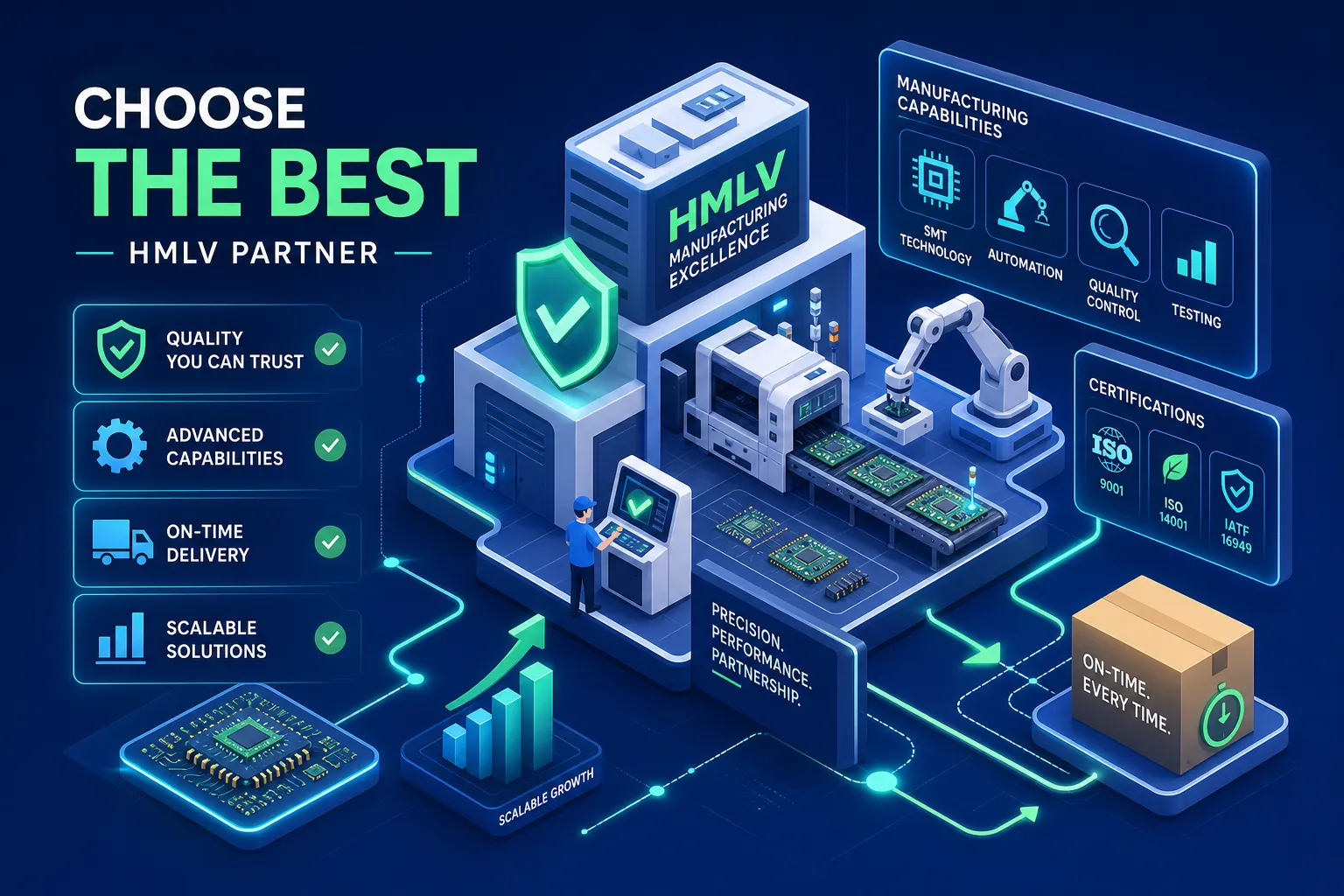
Many high-mix, low-volume electronics programs stall or fail not because the design is flawed, but because the manufacturing partner wasn’t built for this kind of work. High-volume-focused CMs often struggle with the setup and variant complexity of small multi-SKU runs. Setup overhead piles up, communication slows down, and first articles come back late with rework costs you didn’t budget for. Finding the best contract manufacturer for low-volume, high-mix electronics in the USA means understanding exactly why that mismatch happens and how to screen against it before you place a PO.
This guide is for hardware founders, OEM engineers, and product ops leaders who have a real HMLV program and need a reliable U.S. contract manufacturer, not another offshore gamble or a tier-1 EMS player that deprioritizes small accounts. What follows is a working criteria checklist you can use to evaluate any CM before you commit, starting with the economics of HMLV work and ending with the six questions you should ask before you request a single quote.
Amtech is a U.S.-based CM purpose-built for exactly this environment, with proprietary robotics, embedded DFM support, and a scalable engagement model that handles both 25-unit first articles and full production ramps under the same program structure. We’ll reference our own approach throughout, not to sell you on us specifically, but to show you what a purpose-built HMLV partner actually looks like in practice.
Why HMLV programs expose the gaps in a typical CM relationship
The economics of low-volume, multi-SKU production
HMLV work creates a fundamentally different cost structure than high-volume production, and buyers who don’t understand this going in will get sticker shock on their first quote. Non-recurring engineering (NRE) is a batch-level fixed cost that includes stencil fabrication, pick-and-place programming, and first-article inspection. On a 50-unit run, an $800 NRE package adds $16 per board. At 100 units, that same NRE drops to $8 per board. The math is unforgiving at low volumes.
Multi-SKU programs carry an additional burden: the variant tax. Each additional SKU multiplies setup events and inspection complexity, typically adding a 5, 15% cost premium per variant over a single-SKU run at the same volume. A program with eight board variants isn’t just eight times the setup work; it’s eight times the stencils, eight times the programming, and eight times the first-article review. Buyers who understand this going in negotiate clearly. Buyers who don’t understand it get surprised by their second invoice.
Why large EMS providers aren’t the right fit for low-volume, high-mix electronics
Tier-1 EMS players are built around annual program values in the millions. Their workflows, minimum commitments, and account management models are structurally incompatible with an HMLV program that might start at 50 units and scale to 2,000 over two years. The overhead of engaging one of these firms for a low-volume program is real, and so is the risk that your account gets deprioritized when larger customers need floor space.
The right HMLV CM is one whose entire operation is designed around the setup overhead, component reels, and inspection demands that small, diverse runs generate. Mid-tier U.S. specialists that accept low-volume PCB assembly orders and prototype quantities with no annual commitment aren’t a consolation prize; they’re the appropriate match for this kind of work. The largest CM isn’t the best CM for your program. The best contract manufacturer for low-volume, high-mix electronics is the one whose workflow was designed for your program.
Engineering collaboration and DFM depth: the first criterion that separates good from great HMLV contract manufacturers in the USA
What real DFM support looks like at the prototype stage
Genuine design for manufacturability (DFM) support at the HMLV level means catching footprint mismatches before the stencil is cut, flagging single-source components before the BOM is locked, and recommending layout changes that improve yield without requiring a full redesign. It’s an active, iterative exchange between the CM’s engineering team and your design team, not a one-page checklist emailed after the quote is signed. The difference in first-article yield between a CM that enters the program at receipt versus one that enters at the design stage is a consistently observed benefit of early DFM engagement, and one that directly affects your per-unit economics on small runs.
At Amtech, DFM and DFA review is part of the program from the beginning. That means supply chain risk analysis, alternate component identification, and layout feedback happen before the stencil is ever ordered. For an HMLV program where rework on a 50-unit run is a real cost, catching a pad clearance issue in the design phase rather than during first article isn’t a nice-to-have, it’s the difference between a clean launch and costly delays that compound across a short production run.
How to test a CM’s engineering depth before committing
Submit a real BOM, or a simplified version of one, and ask the CM to identify component risks and alternative sources before quoting. A CM with genuine engineering depth will respond with specific lifecycle flags, alternate MPNs, and sourcing notes. A CM that’s primarily a production shop will send back a price without commentary. This single pre-engagement test surfaces more about a CM’s capabilities than any certification list or capability sheet on their website.
Automation capability and quality standards: what they actually mean for your program
Certifications that matter and ones that are just table stakes
ISO 9001 is generally a baseline expectation among reputable U.S. CMs, not a differentiator. Its presence on a capability sheet tells you almost nothing about whether a CM is right for your program. What matters is what’s built on top of it. IPC-A-610 Class 3 is mandatory for mission-critical, defense-adjacent, or medical electronics. AS9100 signals aerospace-grade process discipline. ITAR registration is non-negotiable for controlled technology. ISO 13485 applies to medical device programs.
Frame certifications not as checkboxes but as signals about which customer segments a CM has actually served under audit pressure. A CM with AS9100 and ITAR registration has been through the kind of customer audits that expose process gaps quickly. A CM with ISO 9001 only may have never been seriously stress-tested on traceability or counterfeit part prevention. Ask which certifications are current and which customers audit them against those standards.
How proprietary automation changes yield and lead times on small runs
The automation gap between commodity CMs and advanced U.S. specialists is widest at low volumes. Standard SMT lines programmed manually introduce variability that compounds quickly across a 12-SKU program. Industry experience with advanced automation and in-line inspection integration shows meaningful first-pass yield improvements and setup time reductions compared to fixed, manually-operated lines, improvements that directly protect your per-unit economics on a 25-unit run by reducing rework costs.
Amtech’s investment in proprietary robotics and in-house automation development is specifically aimed at this problem. Flexible robotic systems can be reprogrammed rapidly between variants, which matters enormously when you’re running eight board SKUs in the same week. The result is faster prototype turnarounds, 2, 5 days for rapid proto builds, 1, 2 weeks for standard HMLV complexity, and consistent quality across variant changeovers that a manually-operated line simply can’t match.
Supply chain resilience and component risk management: the criterion that separates proactive from reactive programs
AVL strategy and alternate sourcing for multi-SKU programs
A CM’s approved vendor list (AVL) strategy is a direct indicator of program resilience. An HMLV CM managing 30 SKUs across a customer’s product line needs pre-qualified alternates for every critical component, not just a list of preferred distributors. Because component reels typically run 2,500, 5,000 pieces, production MOQs are often driven by reel economics rather than CM policy. A CM without active alternate sourcing exposes small-run customers to spot-market pricing and shortage delays that a high-volume program can absorb but an HMLV program cannot.
Amtech’s Design for Volatility program is built around exactly this problem. It addresses component risk, tariff-mitigating AVL development, alternate sourcing, and lifecycle planning as a structured part of every program, not as a reactive response when a part goes on allocation. For programs that face Section 301 tariff exposure, the strategy includes pre-qualifying domestic and allied-nation alternates at the BOM level so procurement can pivot quickly without triggering an engineering change cycle.
EOL and obsolescence mitigation for programs that run longer than a product cycle
HMLV programs frequently outlast the component lifecycle they were designed around. Industrial and defense-adjacent programs are especially vulnerable because design freezes are common and component substitutions require engineering review. A CM with genuine BOM analysis capability, specifically one that identifies EOL risks before a critical part reaches end-of-life, protects a program from emergency redesigns that can cost more than the original tooling and delay production by months.
Ask any candidate CM two direct questions: How do you handle EOL notifications? Do you proactively flag lifecycle risk during program reviews, or do you wait for the customer to bring it to you? A CM that waits for you to find the problem isn’t a partner; it’s a vendor. The right HMLV partner runs proactive BOM scrubs using lifecycle monitoring tools and brings EOL flags to your attention before they become crises.
Scalability: finding the best HMLV contract manufacturer in the USA to grow with your program
What a real scalability commitment looks like in practice
A common HMLV failure mode isn’t a quality problem; it’s a growth problem. A startup selects a prototyping shop for speed, reaches 500-unit production, and discovers the CM doesn’t have the capacity or process infrastructure to handle the volume. The result is a painful transfer to a new manufacturing partner, restarting the quality process, rebuilding tooling, and re-qualifying test fixtures from scratch. That handoff penalty is rarely budgeted and can delay a product launch by months, sometimes longer depending on program complexity.
A genuine turnkey electronics contract manufacturing partner maintains capacity headroom and a technology stack that handles both 25-unit first articles and 5,000-unit production ramps under the same program structure. Amtech’s approach is built around this continuity: prototype quantities and production ramps are handled within a single engagement model, with consistent team assignments, a unified quality system, and established supply chain relationships carried through from NPI to full production. That continuity isn’t just operationally convenient; it compounds in value over the lifecycle of the program.
Engagement models that flex with where you are in the product lifecycle
The best HMLV CMs don’t operate in a single mode. Some customers need a full co-development partner from design through production. Others arrive with a locked design and need a reliable production executor. Others are mid-lifecycle and need supply chain intelligence, yield optimization, and tariff mitigation without touching the design. A CM that can operate across these modes without requiring the customer to change partners creates meaningful value across the full product lifecycle.
Ask prospective CMs directly: how does your engagement model change as our volume grows? A CM with a clear, structured answer to that question has thought through the problem. A CM that hesitates or defaults to “we’ll figure it out when we get there” is telling you something important about how your program will be managed when it scales.
Six questions to ask before you request a quote from any HMLV contract manufacturer
Pricing transparency and NRE structure
Three financial questions reveal whether a CM understands HMLV economics or is applying a high-volume pricing template. First: does the quote separate NRE from per-unit production costs? Bundled quotes make it impossible to forecast repeat order costs accurately and are a red flag for buyers who plan to run multiple production cycles. Second: does the unit price hold on repeat orders, or does it reset with each PO? Third: what drives MOQ, CM policy or component reel minimums? The answer to that last question tells you whether the CM understands how low-volume PCB assembly economics actually work.
Confirm how multi-SKU setups are billed, whether per-setup or bundled, before you receive your first invoice. The variant tax is real, and discovering it on invoice three rather than in the initial quote is an avoidable problem. Requiring line-item transparency at the quote stage isn’t being difficult; it’s basic program management.
Responsiveness and program access during production
Three operational questions matter just as much as the financial ones. Who is the named point of contact after the PO is placed? How are first-article results communicated? What’s the escalation path if a component shortage surfaces mid-run? A CM’s answers to these questions in a pre-engagement conversation are more predictive of the working relationship than any published capability sheet.
Slow, generic responses at the quote stage almost always predict slow, generic communication during production. If you send a pre-quote question and receive a templated reply three days later, you’ve already learned something significant about how your escalations will be handled when the floor is busy. Responsiveness is a cultural signal, not a policy one.
Choosing the right partner for low-volume, high-mix electronics manufacturing in the USA
The five criteria that separate a purpose-built HMLV CM from a generic production shop are engineering collaboration, automation capability, supply chain resilience, scalability, and customer responsiveness. The best contract manufacturer for low-volume, high-mix electronics in the USA isn’t the one with the longest capabilities list, it’s the one whose entire operation is designed around the setup overhead and program complexity that small, diverse runs generate.
Use the six questions above before you request a quote from any CM on your shortlist. The answers, and the speed and specificity with which they’re delivered, will tell you more than a facility tour. If a CM can’t answer “who is my named contact after the PO is placed” before you’ve placed a PO, that response pattern tells you a great deal about the relationship you’re about to enter.
Amtech is a U.S.-based electronics CM built around exactly these criteria: DFM support from the design stage, proprietary robotics that sustain yield on small runs, a Design for Volatility program for supply chain resilience, and a single-partner engagement model that scales from prototype and NPI through full production without a handoff penalty. If your program fits this profile, reach out to evaluate whether we’re the right manufacturing partner.