
Many large EMS providers are optimized for one thing: long runs with stable BOMs and minimal line disruption. Bring them a complex, mixed-SKU program with quantities in the dozens or low hundreds, and you become a scheduling problem. The result is inflated setup fees, queued lead times, and a build team that treats your job as a favor rather than a core responsibility.
Finding the best contract manufacturer for low volume high mix electronics means looking past the “yes, we do low volume” sales pitch and into operational infrastructure. The stakes are real. Picking the wrong manufacturing partner for a high-mix, low-volume program doesn’t just hurt your first run cost, it creates compounding problems every time you push an engineering change, hit a component shortage, or need to scale. U.S.-based HMLV specialists have built dedicated frameworks that fold DFM reviews, purpose-built automation, and engineering support into a single intake process. The question is how to measure any candidate against that standard.
This guide covers five capability criteria you must evaluate, the real cost drivers hiding in HMLV quotes, the NPI and DFM services worth requiring from day one, and a scoring model you can use to compare candidates before you send a single RFQ.
Why HMLV Programs Fail at the Wrong Manufacturing Partner
High-mix, low-volume production isn’t a smaller version of high-volume manufacturing. It’s a fundamentally different operational problem. At a volume-focused EMS provider, efficiency comes from long production runs, stable BOMs, and infrequent line changeovers. HMLV flips every one of those assumptions. Frequent variant switches, small lot sizes, and dynamic engineering changes require a line structure built for agility, and most large EMS shops don’t maintain one.
The operational reality is this: changeover times at unoptimized lines run 45 to 60 minutes between product types. HMLV-specialized lines, by contrast, target 10 to 30 minutes using SMED techniques and cross-trained operators, a standard that experienced short-run electronic manufacturing services providers treat as a baseline, not a stretch goal. When a CM runs your 75-unit build between two high-volume jobs, that changeover gap eats into your schedule in ways that never show up in the original quote. Scheduling at generalist providers works against small programs by design; your job gets slotted into gaps, not planned into primary capacity.
Buyers often hear “yes, we do low volume” from providers that technically assemble any quantity but amortize their inefficiency into setup fees, minimum order penalties, or extended lead times. To tell the difference between genuine HMLV capability and reluctant accommodation, ask two specific questions: what percentage of their current active jobs are under 300 units, and what is their standard changeover time between product types. Those two data points will tell you more than a factory tour.
How to Pick the Best Contract Manufacturer for Low Volume High Mix Electronics: Five Core Criteria
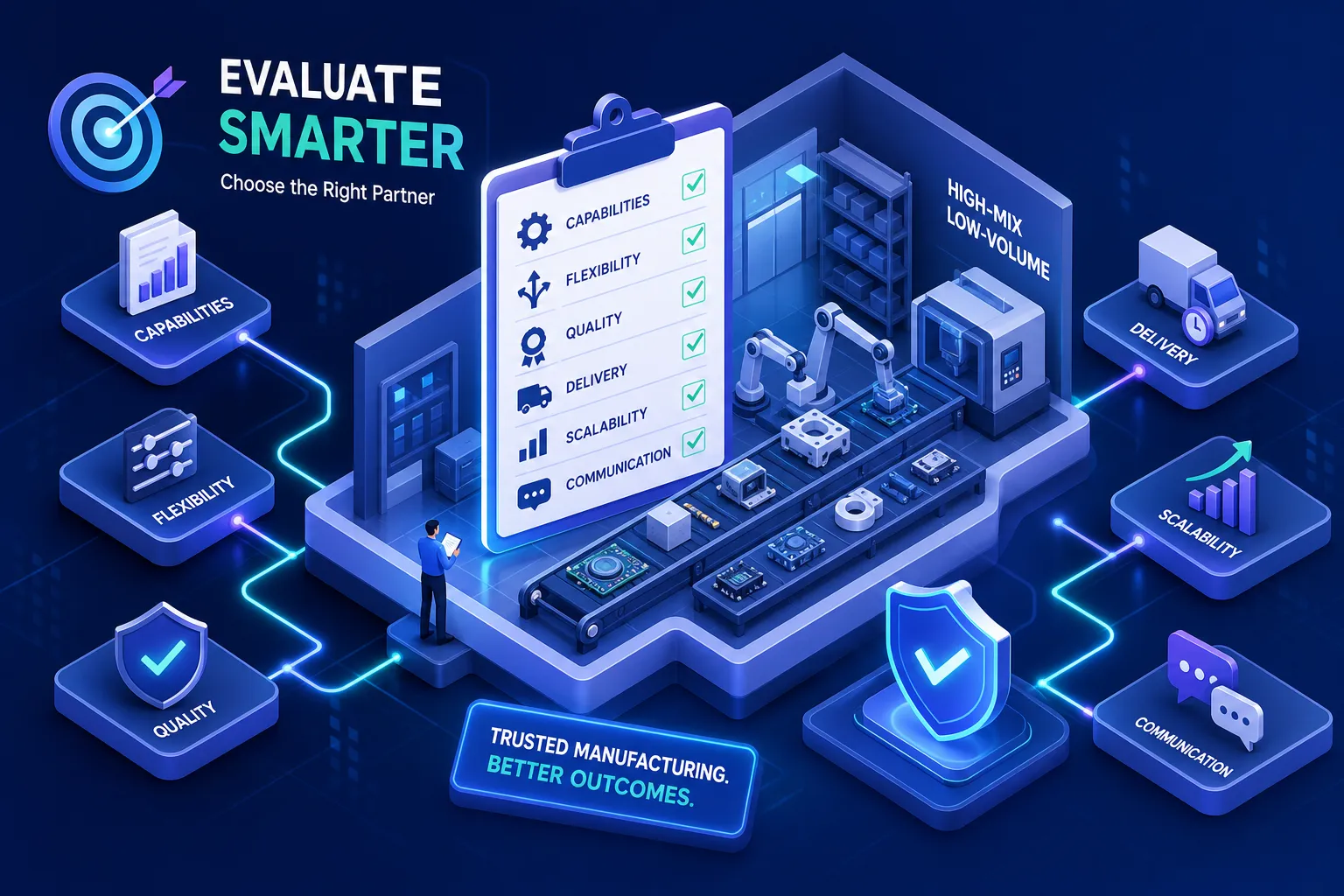
Before you shortlist any small-batch electronics manufacturer, evaluate five dimensions. They’re the structural differences that separate an HMLV-ready partner from a generalist shop that will squeeze your program in when convenient. For an expanded discussion of buyer-side considerations see the Electronics Contract Manufacturing Buyer’s Guide.
Engineering depth matters first. A qualified partner doesn’t just receive Gerbers and build boards. They engage at the design stage, flag manufacturability issues before tooling, and support engineering changes without restarting the production cycle. Look specifically for in-house DFM analysis, electrical design review capability, test fixture development, and early supplier involvement in component selection. If engineering support is billed as an add-on or requires a separate engagement, that’s a signal it isn’t embedded in the process.
Equipment flexibility is the second dimension. Jet-printing SMT platforms that eliminate stencil swaps, multi-format inspection systems, and dedicated HMLV lines signal genuine investment in short-run capability. Ask directly whether their equipment can handle your component complexity, including BGAs, 01005 components, and package-on-package configurations if relevant to your design. A boutique EMS operation with purpose-built HMLV tooling is likely to outperform a large shop running your boards on shared high-volume equipment, particularly on low-volume PCB assembly where setup efficiency determines margin. Providers that specialize in high-mix, low-volume production often publish specific line-change and tooling strategies you can compare during evaluations.
Supply chain resilience is the third dimension, and it’s where many short-run electronic manufacturing services providers quietly fall short. An HMLV CM that can’t manage end-of-life components or qualify alternate sources will bottleneck your program at the worst possible moment. Providers with a formal approved vendor list strategy and real-time EOL monitoring operate in a different category than those relying on a standard purchasing team that reacts to shortages after a PO lands. The fourth and fifth dimensions, NPI process maturity and scalability provisions, are covered in the sections below.
How Setup Fees, Sourcing, and Testing Shape Your Per-Unit Cost
HMLV pricing looks different from high-volume quotes, and buyers who don’t understand the structure end up comparing quotes that aren’t comparable. The core issue is that non-recurring engineering charges (NRE) function as batch-level fixed costs. On a 50-unit run, a total NRE package of $800 covering stencil setup, pick-and-place programming, first-article inspection, and DFM review adds $16 per board before a single component is placed. At 100 units, that same $800 drops to $8 per board. The math is simple, but many buyers miss how much NRE dominates short-run cost. For a practical cost breakdown and examples, see this PCB assembly cost guide.
Typical NRE components at a U.S. HMLV contract manufacturer break down roughly as follows: laser-cut SMT stencils run $300 to $500, pick-and-place programming adds $50 to $200, first-article inspection runs $100 to $300, and custom test fixtures, when required, can push total NRE past $2,000. The right model is transparent separation: NRE as a distinct line item, not amortized into unit price. That structure lets you accurately forecast repeat order costs without reverse-engineering a bundled quote.
The variant tax is the hidden cost most buyers underestimate. Each additional product variant in an HMLV program multiplies setup events, component line counts, and inspection complexity. In practice, mixed-variant programs routinely carry a 5 to 15 percent cost premium over single-SKU runs at the same volume, a reality any experienced prototype and short-run EMS provider will confirm. Before you finalize your RFQ, ask every prospective CM how they price repeat orders on the same product and whether NRE recurs on repeat builds. CMs that reset setup fees on every order are treating your program as a high-margin exception, not a core business relationship.
NPI and DFM Services That Protect Long-Term Programs
A genuine NPI process at a capable HMLV manufacturer goes well beyond first-article inspection. The real test is whether the build documentation produced during NPI is mature enough to support a re-order six months later without re-engaging engineering. That means BOM analysis with RoHS and lifecycle flags at intake, 48-hour firm fixed-price quoting, configuration change management with ECO support, and functional test coverage from the very first build. If any of those elements are missing, you’ll pay for them later in engineering time and schedule slippage.
DFM reviews conducted before production, not after a failed first run, are where a good NPI contract manufacturer earns its value. A properly scoped DFM review catches component placement issues, pad geometry mismatches, and testability gaps while they’re still free to fix. Once a board is tooled and a stencil is cut, those same issues cost money, time, and often a second prototype run. Require a formal DFM review as a documented step in any candidate’s NPI process. If they can’t describe what that review produces and who signs off on it, move on.
HMLV programs are especially vulnerable to component EOL events because they often run for years at low velocity with no buffer stock strategy. A capable CM monitors part lifecycle in real time and proactively recommends alternates before an EOL event freezes a build. Ask specifically: do you flag EOL components at NPI intake, and do you maintain a qualified alternate sourcing AVL for critical parts? Providers who do this work during design review rather than after a purchase order lands are the ones who will keep your program moving. For practical sourcing and NPI guidance for HMLV programs, see Altium’s resource on high-mix, low-volume electronics manufacturing sourcing.
Scoring the Best Contract Manufacturer for Low Volume High Mix Electronics
Once you’ve gathered information from multiple candidates, you need a repeatable way to compare them. A 0 to 3 scoring model across five dimensions works well: HMLV-specific experience, engineering support depth, equipment and changeover capability, supply chain resilience, and scalability provisions. Score each dimension, total the scores, and rank candidates before you invest time in site visits or detailed negotiations.
Knowing what a “3” looks like in each dimension gives you the reference point. A 3 on supply chain resilience means the CM maintains an active AVL, real-time EOL monitoring, and a formal alternate-sourcing process. A 3 on engineering support means in-house DFM analysis, electrical design review, and test fixture development are standard intake steps, not billable add-ons. A 3 on changeover capability means documented changeover times under 30 minutes with cross-trained operators and SMED implementation.
Include these questions in every RFQ for an HMLV program:
- What percentage of your current active jobs are under 300 units?
- What is your standard changeover time between product types?
- Do you charge NRE on repeat orders of the same product?
- Is DFM review a documented step in your standard intake process?
- How do you monitor component EOL, and do you maintain an alternate-sourcing AVL?
- Can you provide references for programs that transitioned from low-volume NPI into sustained production without changing manufacturing partners?
That last question is the most revealing. A best-in-class contract manufacturer for low volume high mix electronics that can name customers it has grown with over multiple years is demonstrating something no capability checklist can capture: it’s a real partner, not a transactional vendor. To structure vendor comparisons and ensure you cover commercial and operational hygiene, you may find a vendor selection checklist useful: How to Select a Contract Manufacturer: a 9-Point Checklist.
Contract Terms and Red Flags Before You Commit
Before you sign anything, nail down tooling ownership. Who owns the fixtures, stencils, and test equipment built for your program? If the CM owns them, what happens when you exit the relationship? These aren’t adversarial questions; they’re standard commercial hygiene. Specify tooling ownership in the agreement before production begins, and define storage terms and ownership conditions for any period when your program goes on hold.
Pricing transparency on repeat orders is non-negotiable. Require unit pricing that separates NRE from production cost clearly, and confirm whether pricing holds on repeat orders at the same volume or resets each time. CMs that can’t commit to consistent repeat-order pricing are signaling that HMLV work is a high-margin exception for them, not a core service line. That misalignment will show up in how your program is prioritized every time you place an order.
Three red flags warrant immediate scrutiny. CMs that require volume commitments before providing competitive pricing have a cost structure built around high-volume runs, not HMLV flexibility. Providers that lack dedicated HMLV capacity and route your job through shared high-volume lines will deliver the scheduling problems described earlier, reliably. Walk away from any shop that cannot produce a single long-term HMLV customer reference with a verifiable contact. Each signal points to an operational structure that wasn’t built for how your program actually works.
Choose a Partner Whose Operations Match Your Program’s Reality
Choosing the best contract manufacturer for low volume high mix electronics isn’t about finding the cheapest quote on a first run. It’s about finding a partner whose operations, engineering support, and supply chain infrastructure are built around how HMLV programs actually work, dedicated line capacity, transparent NRE pricing, real DFM support, and proactive lifecycle management from day one.
Use the five-dimension scoring model, ask the RFQ questions in this guide, and pressure-test how each candidate handles DFM, EOL monitoring, and repeat-order pricing before you sign anything. The investment in a thorough evaluation pays back on every build cycle, every engineering change, and every time a component goes end-of-life on a program you can’t afford to pause.
HMLV programs demand long-term partnership, not transactional manufacturing. Amtech is built around exactly that model, U.S.-based HMLV production, in-house DFM support, purpose-built automation, and a supply chain process designed for programs that run at low velocity for years. If you’re ready to put this framework to work, submit an RFQ or request a DFM review. Learn more about Choosing a U.S. High-Mix, Low-Volume Electronics Partner. The right conversation starts before the first build, not after the first problem.