
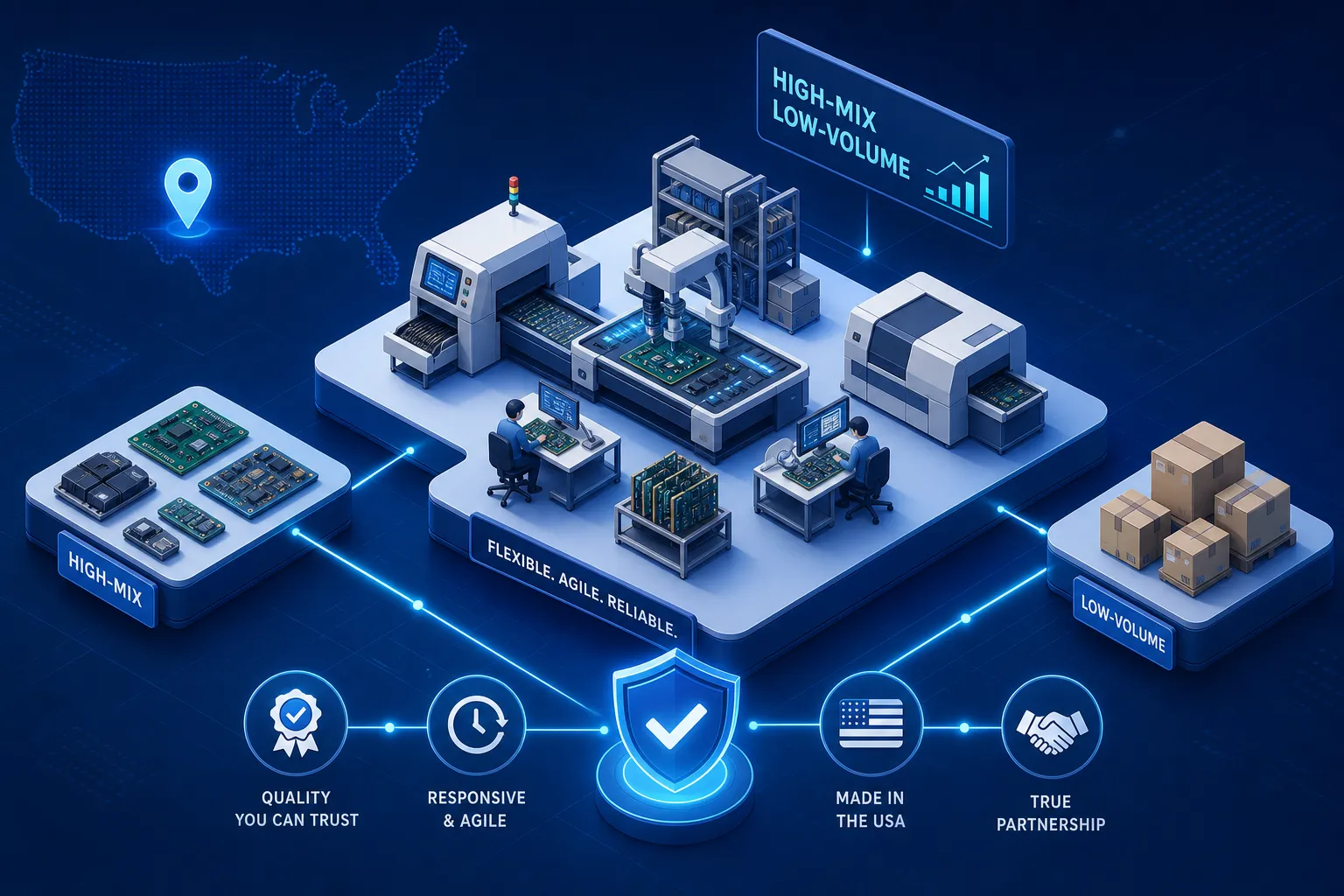
Your design is done. The BOM is locked. The prototype validated. Now you need to build, and that’s where the search gets hard. Finding a reliable high-mix, low-volume electronics manufacturing USA partner is more difficult than it looks, because many traditional contract manufacturers have historically optimized for high-volume throughput: large runs, stable BOMs, repeatable configurations. Bring them a program with five product variants, batch sizes under 200 units, and a need for fast turns between jobs, and you’ll feel the friction immediately. Pricing spikes. Lead times stretch. Engineering engagement is often deprioritized at smaller, fragmented runs unless the CM has dedicated HMLV processes in place.
Short-run, high-variety electronics production is a distinct discipline. It demands a partner who has built their infrastructure around it, not one who tolerates it between large-volume programs. This guide gives you a clear framework: what capabilities to require, what questions belong in your RFQ, and how to build a shortlist of domestic EMS partners who can actually execute. Amtech is one example of a U.S. contract manufacturer purpose-built for this kind of work, not retrofitted for it after years of optimizing for volume.
What Makes High-Mix, Low-Volume Electronics Manufacturing Fundamentally Different
Standard contract manufacturing is optimized for throughput. The economics work when you’re running the same board configuration thousands of times with minimal changeover. High-mix, low-volume (HMLV) production inverts that model entirely. Frequent product changes, diverse component sets, and small batch sizes aren’t edge cases you accommodate; they’re the operating rhythm every single week.
The dominant operational burden in a high-mix environment isn’t production rate, it’s changeover frequency. Every time a new variant enters the line, the floor reconfigures: programs load, feeders swap, solder paste stencils change, inspection parameters update. Partners who apply SMED-style changeover discipline, separating internal machine-stop tasks from external prep work that runs concurrently, achieve 40 to 60 percent reductions in setup time. That compression directly shortens your lead time and reduces per-batch overhead. For a practical primer on SMED principles and how they reduce changeover time, review this resource on SMED to reduce changeover and boost efficiency.
Flexibility in this model is a structural capability, not a marketing position. It lives in reconfigurable production cells, vision-guided cobots, and software that adapts quickly across product configurations. When you’re evaluating any prospective partner, ask directly: what is your average setup time per new variant, and how do you reduce it? A vague answer tells you the capability isn’t real. If you want to hear how manufacturers translate those practices into organizational agility, the discussion in Becoming Agile in HMLV: The Actions of High Mix, Low-Volume Manufacturing is a useful practical perspective.
Engineering Support from NPI Through Production Ramp
An assembler executes your files. A capable manufacturing partner engages with your design before a single board is built. That distinction is where the gap between a commodity EMS shop and a qualified co-development partner becomes visible, and where programs either launch cleanly or spend months debugging avoidable yield problems.
Design for manufacturability review should be a baseline expectation, not an upsell. A serious HMLV partner reviews your board layout, component placement, soldering constraints, and BOM health before production begins. DFM and DFA reviews catch issues that don’t appear in simulation: fine-pitch components placed too close for reflow clearance, test point access blocked by mechanical features, BOM entries with no second-source equivalent. In new product introduction programs where small-batch PCB assembly surfaces design issues quickly, getting this right upfront compresses time-to-market significantly.
Some partners go further than file review. They flag component obsolescence risk during BOM analysis, advise on sourcing strategy for long-lead items, and participate in design decisions that affect production cost and yield. At Amtech, this co-development model is built into how the team engages from first contact, so the manufacturing engineering team functions as an extension of your program, not a downstream constraint. For companies building complex or mission-critical electronics, that kind of upstream partnership can materially reduce time-to-market and program risk compared to working with a shop that only engages after design handoff. For broader sourcing strategies and examples of HMLV-focused supplier selection, see this guide to high-mix, low-volume electronics manufacturing sourcing.
Supply Chain Strategy and Component Risk Management
The most underestimated variable in any short-run production program isn’t the assembly line; it’s the components. A single capacitor with a 16-week lead time can stall a build that would otherwise ship in days. Evaluating a partner’s supply chain posture is as important as evaluating their equipment list.
Partners who don’t review BOM lead times proactively, flag long-lead items early, or maintain strategic buffer stock on critical components leave customers exposed to delays that have nothing to do with production capacity. Proactive material management looks like this: early lead time analysis on every BOM, buffer stock strategies for components with constrained availability, and clear communication protocols when supply situations shift mid-program. That’s a baseline standard worth expecting from any serious low MOQ electronics manufacturing partner, not a premium service. For tactics specifically aimed at reducing lead times in high-mix, low-volume manufacturing, the referenced strategies are practical and proven.
Obsolescence management is where strong partners separate from the rest. Best practice includes continuous monitoring of Product Change Notifications and Product Discontinuance Notices, maintaining preferred parts lists with multi-source availability, qualifying alternate vendors before they’re needed, and planning last-time buys for at-risk components. A capable partner integrates these reviews into every BOM analysis, not as a separate engagement, but as standard program hygiene. In the current tariff environment, approved vendor list development that accounts for component origin and alternate sourcing routes is a tangible differentiator that protects your program across its full lifecycle. For practical insights on managing electronic component obsolescence, that resource is a helpful reference.
How HMLV Pricing and Lead Times Actually Work
Short-run electronics production costs more per unit than high-volume work. That’s not a flaw in the model; it’s a structural reality of absent economies of scale and frequent changeovers. Understanding the cost mechanics helps you budget accurately, compare quotes fairly, and avoid mid-program surprises.
The high-mix, low-volume cost structure breaks down across several categories, each of which scales differently from high-volume programs:
- Per-board labor and overhead run highest at low volumes, where setup costs spread across fewer units.
- Setup and changeover fees apply per production run, covering stencil changes, machine reprogramming, and recalibration. Based on 2026 EMS cost data, these typically range from $180 to $650 per batch depending on board complexity and component mix.
- NRE charges cover design validation and test protocol development on a project basis.
- Test fixture costs vary by product complexity and typically add $200 to $2,000-plus as a one-time investment.
- Tooling investment in HMLV is generally lower than in high-volume programs.
Changeover frequency is the dominant ongoing cost lever. Partners who reduce it through automation and lean discipline pass measurable savings to you over the program’s life.
Prototype turnaround in the U.S. reaches 5 to 10 business days for standard-complexity boards when material is ready. Small-batch production typically completes within weeks. The ceiling on turnaround time, in most cases, is component availability rather than production capacity. A domestic HMLV partner can move fast, but only when the BOM is properly managed. Lead time commitments that don’t include visibility into component availability aren’t credible. Hold your prospective partners to that standard.
The RFQ Checklist for Vetting U.S. High-Mix, Low-Volume Electronics Manufacturing Partners
An RFQ for a high-mix, short-run engagement is not a commodity assembly quote. The questions need to surface capability depth, supply chain maturity, quality rigor, and scalability, not just price per board. Use the following categories to structure your vetting process. For a step-by-step approach to Vetting a Contract Electronics Manufacturer Before You Sign, include these RFQ elements early in your vendor selection.
Capability and Certifications
- Which assembly technologies run fully in-house: SMT, through-hole, box build, functional test, wire harnessing?
- What certifications are current and verifiable: ISO 9001:2015, IPC-A-610 (with Certified IPC Specialists on staff), ITAR registration, AS9100 for defense-adjacent work, ISO 13485 for medical?
- Can they provide case studies or references from programs with similar batch profiles and complexity in your industry vertical?
- What is their average setup time per new variant, and how is it tracked and reduced over time?
Quality, Traceability, and Test Protocol
- What inspection equipment is in use: AOI, SPI, X-ray, ICT, functional test fixtures?
- How is traceability managed across serial numbers and lot codes? Can they demonstrate serialized build records on request?
- What are their first-pass yield and on-time delivery actuals? Industry benchmarks for well-optimized HMLV programs typically target first-pass yield above 96% and on-time delivery above 95%, request historical data, not targets.
- What are their non-conformance handling procedures, and what are your audit rights?
- For high-reliability applications: are test fixture development and calibration schedules documented and maintained?
Supply Chain and Obsolescence Management
- How do they perform lead time analysis on a new BOM, and at what point in the engagement does that happen?
- Do they maintain buffer stock for components with known supply constraints?
- How do they monitor PCNs, PDNs, and EOL notices? Is this reactive or systematic?
- Can they demonstrate an AVL development process that includes alternate sourcing and tariff-aware qualification?
Scalability and Engagement Model
Ask whether the partner can handle both prototype quantities and production volume ramps within the same program, without requiring you to transfer to a different shop. Confirm their minimum order quantity flexibility and their capacity headroom for growth. The right HMLV partner functions as a co-development resource during NPI. As volumes increase, they transition into production mode, within the same relationship, with no requalification overhead required.
Building Your Shortlist and Making the Final Call
The right domestic high-mix, low-volume electronics manufacturing USA partner checks four non-negotiable boxes: they’re built for flexibility at the infrastructure level, they bring genuine engineering depth to the engagement, they manage supply chain risk before it becomes your problem, and they can scale with your program without requiring you to start over with a new shop. Domestic production adds a fifth structural advantage: shorter lead times, greater supply chain visibility, and meaningful insulation from offshore tariff exposure. For additional sourcing perspectives specific to HMLV programs, this HMLV sourcing resource is a helpful supplement when comparing options.
Amtech is a U.S. contract manufacturer purpose-built for exactly this kind of work. From DFM review and first article inspection through small-batch PCB assembly and volume ramp, the team engages as a manufacturing partner, not an order taker. The combination of custom automation, proprietary robotics, and supply chain intelligence means programs move faster and carry less risk than they would at a shop that retrofitted HMLV capability onto a high-volume floor. Learn more about Amtech’s approach to High-Mix Low-Volume Manufacturing: Getting It Right.
Use the checklist from this guide to compare three to five domestic EMS candidates on consistent criteria. Prioritize partners who answer capability questions with data: actual yield metrics, documented changeover times, verifiable certifications, and real references from programs like yours. That discipline in the vetting process is what separates programs that ship on time from ones that stall, and it starts before you send a single file.