
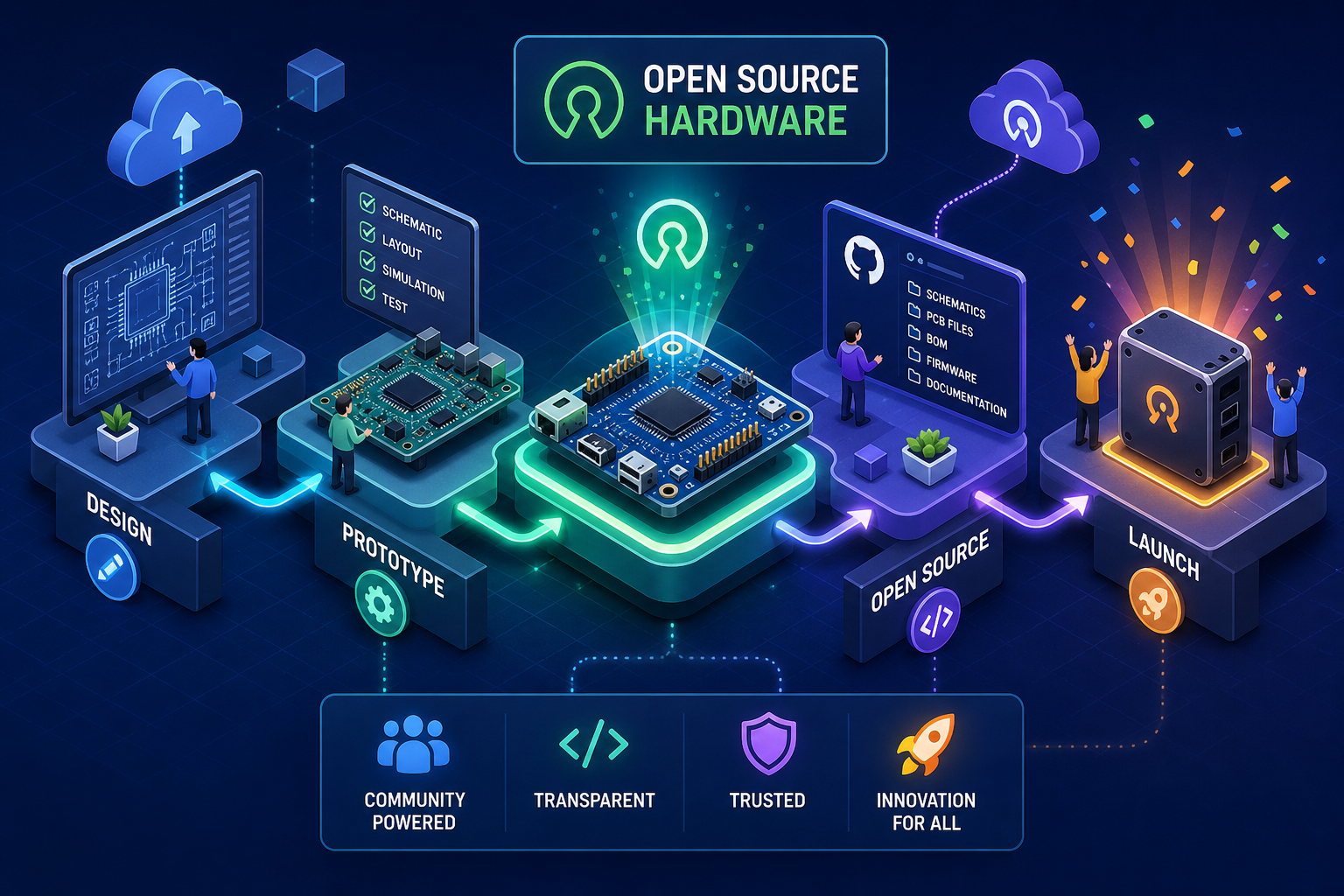
Open source hardware has changed what’s possible for small teams building real electronics products. A hardware engineer can now pull a community-proven schematic off GitHub, iterate on the design in days, and ship something to a fab shop in a fraction of the time it would have taken a decade ago. The infrastructure is there: repositories, licenses, certification frameworks, and a global community that stress-tests designs in public.
But there’s a gap most articles skip over. The distance between a published design file and a reliable, manufacturable product is significant, and it catches teams off guard. This guide covers both sides of that gap. You’ll learn what open source hardware actually is, how licensing works, where to find quality open PCB designs and open-source electronics projects, what OSHWA certification means, and what it takes to move an open design into contract manufacturing. Early-stage hardware teams consistently discover that the production side of open source hardware is more complex than expected, and choosing the right manufacturing partner before the first build changes everything that follows.
What sets open source hardware apart from proprietary design
The design package that defines “open”
Open source hardware means the full documentation required to reproduce a physical design is publicly available. That includes schematics, PCB layout files, bill of materials, CAD files, and assembly notes. This is not just making a product available to buy. The “source” here is the complete design documentation for the physical object, not a compiled output or a product spec sheet.
When a project meets this definition, anyone can study the design, build it independently, modify it, and distribute their version. The openness lives in the design package, and the quality of that package determines how useful the project is to the people who depend on it. For the formal criteria, see the OSHWA open source hardware definition, which lays out the community-backed expectations for what “open” means in a hardware context.
How it compares to proprietary hardware and open-source software
Proprietary hardware gives you the finished product but keeps the design locked. You can buy it, use it, and replace it when it fails. You cannot inspect the architecture, modify it, or manufacture your own version. Open-source software shares code that can be copied and redistributed at near-zero cost. Open source hardware shares design intent, but reproduction always requires real materials, fab shops, component sourcing, and assembly work. That distinction is fundamental.
Arduino is the clearest reference point. The schematics are public. Anyone can fabricate a compatible board. That openness built an ecosystem of thousands of compatible products, sparked countless commercial ventures, and accelerated hardware education worldwide. The design being open didn’t prevent commercial success, it enabled it, because the community did the hard work of validating the architecture in public.
How to choose the right license for your OSH project
CERN OHL, TAPR, and Solderpad: the hardware-native options
Hardware-specific licenses exist because software licenses don’t map cleanly onto physical designs. The three options most teams evaluate are CERN OHL, TAPR OHL, and Solderpad. CERN OHL comes in three variants: Strongly Reciprocal (S), which requires all downstream designs to remain open under the same license; Permissive (P), which allows incorporation into proprietary products with attribution; and Weakly Reciprocal (W), which sits between the two.
TAPR OHL operates with strong share-alike requirements, similar to GPL. Solderpad is permissive and comparable to Apache, allowing broad reuse without requiring derivatives to stay open. The choice comes down to one question: do you want to protect openness downstream, or maximize adoption? CERN OHL-S is the right choice if keeping the design open matters more than broad commercial uptake. CERN OHL-P or Solderpad are better fits if you want other companies to build on the design freely, including in proprietary products.
A practical multi-license strategy for hardware projects
Most well-structured open source hardware projects use a layered approach. A hardware-specific license covers the design files. GPL or MIT covers firmware. CC BY or CC BY-SA covers documentation and assembly notes. This split is practical because each layer has different reuse requirements and different communities consuming it.
One important note for teams considering commercialization or OSHWA certification: CC BY-NC is not considered open-source compliant. The noncommercial restriction disqualifies a project from meeting the open source hardware definition, which matters if you’re planning to certify or build a business around the design. Use CC BY or CC BY-SA for documentation instead.
Where the best open source hardware designs live
Key repositories and how to search them effectively
OHWR (Open Hardware Repository) is the right starting point for engineering-grade designs, particularly scientific instruments, FPGA-based boards, and reproducible lab hardware. The documentation quality tends to be high because the projects originate from research institutions with rigorous standards. GitHub is where the volume lives: searching the open-hardware and pcb topics surfaces a large number of open-source electronics projects across categories, from microcontroller breakouts to motor controllers to sensor nodes.
Curated lists accelerate discovery. The awesome-open-hardware repository on GitHub aggregates high-quality open PCB designs and projects by category and is often actively maintained. For purchasable boards with published design files, SparkFun, Adafruit, and Seeed Studio are reliable vendor sources. Evaluate any design you find by checking four things: documentation completeness, license clarity, last commit activity, and whether a BOM with real part numbers is included. A well-documented design with an active community will save weeks of reverse engineering.
OSHWA certification: what it is and what it signals
OSHWA certification is a free, per-project self-certification administered by the Open Source Hardware Association. It verifies that a specific version of a design meets the open source hardware definition. The requirements are straightforward: an open hardware license that allows others to make, modify, and distribute the design; an OSI-approved license for any necessary firmware; and public documentation sufficient for someone else to reproduce and understand the hardware. Certification is version-specific and typically renewed annually, per OSHWA’s published certification guidelines.
For a product team evaluating a community design, OSHWA certification is a credibility signal. It doesn’t provide legally enforced IP protection, but it confirms that the licensing and documentation meet a recognized standard, one backed by a public certification database. For your own project, certification builds trust with contributors, buyers, and manufacturing partners. It signals that the project is maintained with enough discipline to meet a clear compliance bar. For implementation details and required documentation, consult the OSHWA certification requirements.
Moving an open source hardware design into contract manufacturing
DFM review and BOM cleanup: the work most teams skip
When a design moves from a community repository to production, it almost always carries issues that engineers outside the project never flagged. DFM review catches the ones that affect yield and cost: pad geometries that won’t survive reflow reliably, copper-to-edge clearances that create fabrication problems, via-in-pad configurations that wick solder away from joints, and trace widths that pass electrical rules but exceed process tolerances. These are standard first-pass failures for designs that were built to work in a lab, not optimized for volume assembly. Most PCB fabricators publish DFM guidelines that enumerate exactly these categories, and checking against them before submission is the minimum bar for production readiness. Teams that want a structured approach to moving from community design to production often find a focused Start-of-Production Analysis can expose the most time-consuming problems early.
BOM cleanup is equally critical and often underestimated. Community BOMs frequently include obsolete parts, single-source components with no alternates, and inconsistent manufacturer part numbers. A production-ready BOM includes approved vendor list entries with qualified alternates, lifecycle status for each component, lead-time data, and sourcing alternatives for any part with supply risk. The standard is simple: if a line item can’t be ordered unambiguously, it’s not production-ready yet. Addressing this before the first quote saves weeks of back-and-forth with the contract manufacturer.
Sourcing strategy when the design was built for the community
Open source hardware designs are often built around whatever components were available to the original designer. Moving to production means auditing every part for current availability, lifecycle status, and tariff exposure. The right framework is to tier components by risk: commodity passives are low risk and easy to dual-source; single-source ICs and specialty sensors need qualified alternates before the first build starts; community-mandated “signature” parts (a specific MCU or sensor the project is built around) should remain the primary specification, with documented alternates that preserve footprint and firmware compatibility.
A contract manufacturer with real supply chain intelligence will flag end-of-life components and suggest drop-in alternatives before they become a production problem. That capability is worth specifically asking about during CM selection. A reactive sourcing conversation after the first build is far more expensive than a proactive one before it.
Choosing a contract manufacturing partner for open hardware projects
What an OSH-ready CM partner actually looks like
Not every contract manufacturer is set up to handle open source hardware projects. Early-stage designs typically arrive with incomplete assembly documentation, unvalidated BOMs, and no test strategy. A capable CM runs DFM reviews before quoting, helps structure the approved vendor list, and advises on test fixture design before the first board is built. If a prospective partner only wants a frozen, high-volume design, they’re not the right fit for a project that still needs production-hardening.
The questions that reveal the most are the ones about design-stage collaboration:
- Have you worked with designs that originated from a community repository?
- What does your DFM review process look like before the first prototype build?
- How do you handle engineering change orders as the design evolves from open version to production version?
- Can you support a ramp from tens to thousands of units without requiring a partner change?
The answers tell you whether the CM is a production-only vendor or a genuine manufacturing partner, one that will flag problems early rather than quote against an incomplete package and let the issues surface during assembly.
Bridging the design-to-production gap
Contract manufacturers who work closely with early-stage hardware teams understand that open source hardware projects arrive with a unique starting condition. The design files are public, the community has stress-tested the architecture, and the core schematic is often solid. What’s missing is the production layer: DFM-clean layout files, a sourced and validated BOM, a functional test strategy, and a supply chain built for resilience rather than convenience. Amtech specializes in exactly this work, DFM/DFA reviews, AVL development, and high-mix, low-volume production, so teams can start where the design is and build the production infrastructure around it rather than forcing a restart.
There’s a commercial and legal dimension worth addressing directly. If a design is licensed under CERN OHL-S and you manufacture it for sale, you must publish the modified design files, a hard requirement of the license, and one your CM needs to understand before production begins. Your business model also needs to account for it. Open hardware companies have validated several paths: selling assembled products while keeping designs open tends to work well alongside kit and parts sales, while service and support revenue layers on top of both. Open-core and service revenue models are proven. What doesn’t work is assuming the copyleft obligations will go away if you don’t mention them.
From published file to production unit
Open source hardware has matured into a legitimate path for building commercial electronics products. Repositories like OHWR and GitHub’s topic collections are well-organized and searchable. OSHWA certification provides a recognized signal of openness backed by a public database. The licensing frameworks are solid. None of that replaces the work of getting a design into production, but it means you’re not starting from nothing.
The teams that move fastest treat manufacturing readiness as part of the design process, not a phase that begins after the schematic is published. That means choosing the right license before the first commit, building a BOM that survives a sourcing review, and partnering with a contract manufacturer who understands where open designs come from and what they need to become reliable, repeatable products. For practical lessons from teams that made the journey from prototype to market, the From Prototype to Product podcast is a useful companion.
If you’re moving an open source hardware project toward production, the decisions you make in the first few weeks with a CM partner will shape every unit you build after that. Choose one that can work with what you have and build the production infrastructure around it.