
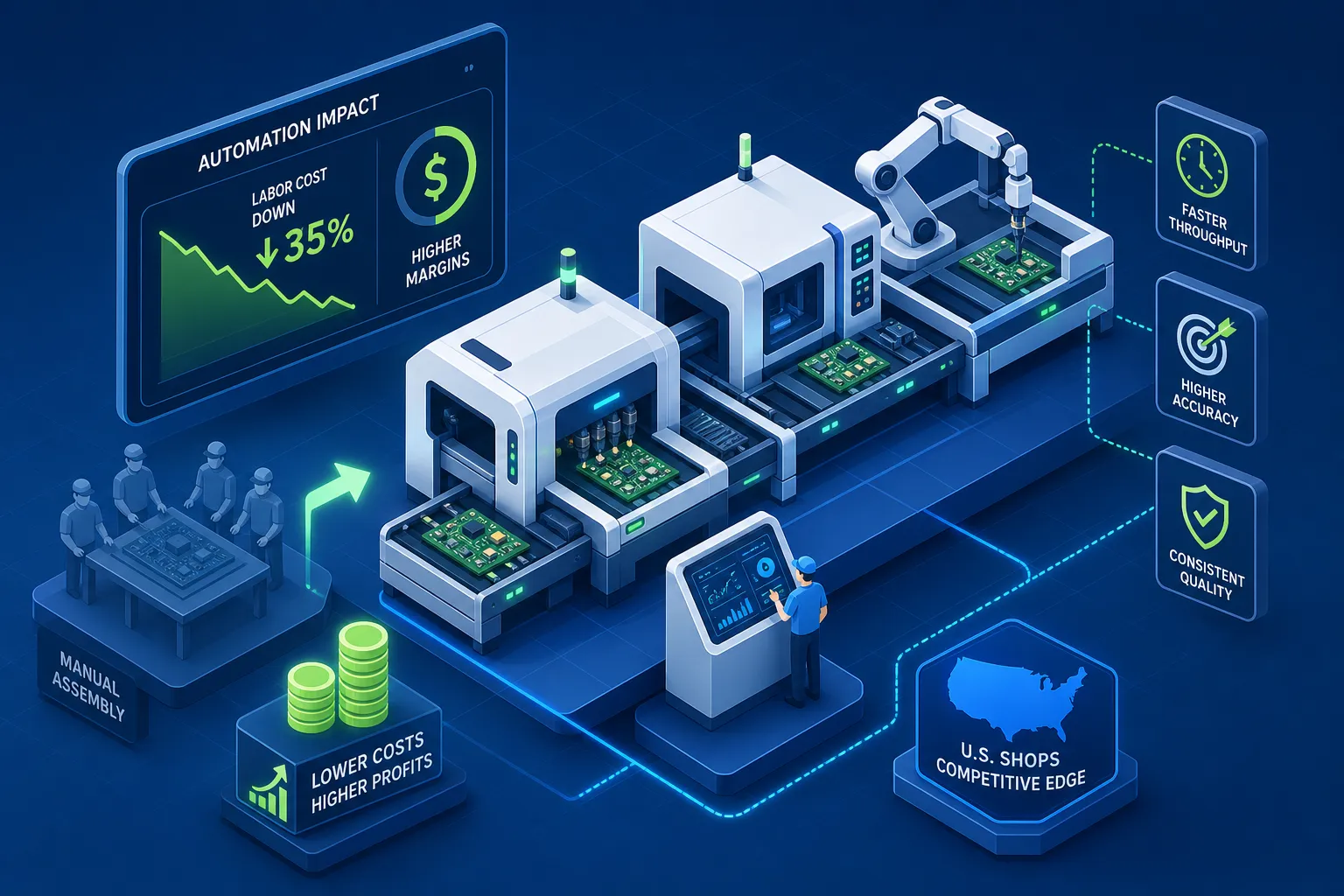
PCB assembly automation reducing labor costs in the U.S. is reshaping the economics of domestic production. U.S. labor rates in PCB assembly have historically been significantly higher than many offshore alternatives, a gap that, for decades, served as the primary argument for moving production to Asia. But the arithmetic is shifting in 2026, and it’s shifting fast. Rising offshore logistics costs, Section 301 tariffs, and a new generation of accessible automation equipment are changing the cost structure for domestic contract manufacturers. Companies like Amtech are demonstrating that a U.S.-based PCB shop with the right automation stack can deliver globally competitive pricing without offshoring the risk along with the cost. This article breaks down which automation technologies deliver the largest labor cost reductions, what they cost to implement, and at what production volumes the investment starts paying for itself.
Why the Offshore Labor Cost Gap Is Finally Shrinking for U.S. PCB Shops
For years, the decision to offshore PCB assembly came down to a single number: direct labor rate. Manually intensive processes, component placement, soldering, inspection, and board handling, could be executed overseas at a fraction of domestic costs, making the math hard to argue with for high-volume production. That calculation felt unassailable because it focused on the most visible cost in the production process.
What’s changed is how OEMs and contract manufacturers are defining “cost.” When you factor in tariff exposure under Section 301, extended ocean freight lead times, and the rework and quality-escape costs that accompany offshore production, the total landed cost picture looks very different from the factory labor rate alone. The offshore cost advantage narrows every time a shipment is delayed, a tariff schedule is updated, or a component shortage traces back to a single overseas supplier.
Modern PCB assembly automation directly attacks the labor-intensive steps that made offshore production attractive in the first place. When soldering, placement, and inspection are mechanized, the labor rate differential loses most of its power. A domestic line with a well-configured automation stack competes on unit economics, not just on proximity and lead time.
PCB Assembly Automation Reducing Labor Costs in the U.S.: Which Technologies Move the Needle
Not all automation investments deliver equal returns, and the highest-ROI upgrades are not always the most obvious ones. The sequence in which you implement them determines how quickly labor reduction in PCB manufacturing translates into a measurable cost advantage.
Soldering Automation: The Single Highest-Impact Upgrade
Selective soldering and automated reflow systems consistently deliver the largest percentage reduction in labor cost of any single automation step. Replacing manual soldering with automated systems typically cuts soldering-related labor hours by 50 to 70 percent, and total soldering cost per board by 40 to 65 percent. This is the upgrade that removes the most skilled-operator time from a production line in one step, which is why it should be the first priority for any shop still running manual soldering at volume.
The economics are particularly strong when selective soldering targets through-hole components on boards that otherwise run through an SMT line. In those configurations, a well-specified selective soldering system can reduce conversion cost per PCB assembly by 51 to 78 percent compared to manual through-hole soldering, with payback periods in the 12 to 18 month range achievable at moderate production volumes.
Pick-and-Place and SMT Line Automation
Automated component placement eliminates repetitive manual insertion and reduces direct SMT labor by approximately 40 percent at the line level. The throughput gains compound the savings significantly. Where a manual operator might place a few hundred components per hour, even an entry-level automated pick-and-place machine handles thousands of placements per hour. That gap between human throughput and machine throughput is where the labor cost reduction actually lives.
AOI, Inline Testing, and Depaneling: Indirect but Compounding Savings
Automated optical inspection (AOI) and inline test systems reduce labor indirectly by cutting inspection cycle time, eliminating rework hours, and catching defects before they become field failures. AOI combined with solder paste inspection can reduce rework labor by up to 40 percent, a meaningful cost reduction even though it doesn’t directly replace a placement operator. Automated depaneling removes additional operator handling time from post-assembly processing, cutting the manual touchpoints that add cost without adding value.
What This Equipment Actually Costs at Each Production Tier
The capital cost of PCB assembly automation spans a wide range, and matching the equipment tier to your production volume is the difference between a sound investment and an expensive mistake.
Entry-Level Systems: The Low-Barrier Starting Point
Entry-level pick-and-place machines run roughly $5,000 to $30,000 and deliver throughput in the 3,000 to 10,000 components-per-hour range. For low-volume or high-mix shops, these machines offer a cost-accessible entry into SMT automation that can eliminate multiple manual placement operators from the line. The tradeoff is flexibility: entry-level machines often require more changeover time between jobs, which can reduce effective utilization by 20 to 30 percent on high-mix programs and extend payback timelines accordingly.
Mid-Range Systems: The Production Sweet Spot for Most U.S. Contract Manufacturers
Mid-range equipment typically runs $30,000 to $150,000 and delivers 15,000 to 45,000 placements per hour. At this tier, the throughput and capability improvements are substantial enough to justify the investment for shops running steady production volumes. The ROI period shortens considerably compared to entry-level units, and the machines handle a wider component variety with less manual intervention between setups.
High-End Production Lines and Total Automation Investment
High-end inline systems start around $150,000 to $250,000 and can exceed $500,000 for fully configured lines, with throughput surpassing 50,000 to 100,000-plus components per hour. When you add AOI, selective soldering, automated depaneling, and inline test equipment to a full SMT line, total automation investment can range from $300,000 to well over $1 million depending on configuration. At that level of capital, the volume requirements to justify the spend are substantial, but the per-unit economics at scale are where domestic production becomes genuinely cost-competitive with offshore alternatives.
Volume Thresholds and EMS Automation ROI Timelines You Can Plan Around
Automation investment decisions require concrete volume and payback assumptions. The following ranges reflect real deployment data rather than theoretical projections.
When SMT Automation Starts Making Economic Sense
SMT automation becomes cost-effective at around 1,000 boards per month at the minimum practical threshold, with significantly stronger economics at 5,000 boards per month and above. At those volumes, a well-specified automation investment can pay for itself within 12 months. Fully automated lines running 20,000-plus units per month can drive payback even faster, particularly in high-labor-cost regions where the operator savings per unit are largest.
Through-Hole Automation Needs a Different Calculus
Through-hole assembly keeps more manual labor in the process by nature, which means the volume required to amortize automation equipment is substantially higher, often in the tens of thousands of boards per month. For most U.S. shops, the highest-ROI move is converting through-hole components to SMT equivalents where the design allows. Reducing manual labor through design changes rather than capital investment is faster, cheaper, and more durable as a cost strategy.
Realistic Payback Ranges by Technology Type
Across PCB assembly automation deployments, payback periods typically run 12 to 30 months for full-line investments. Targeted upgrades like robotic soldering systems can deliver payback in 6 to 12 months when they eliminate high-cost skilled manual labor positions. The wide range reflects the impact of production volume, labor rates, and utilization. A machine running two shifts at consistent volume pays back far faster than the same machine running intermittently on unpredictable job flow.
How DFM and Component Choices Multiply Every Automation Dollar
Automation investments deliver their best returns when the board design is built to support them. The design decisions made during DFM review can either strengthen or erode every dollar of capital equipment investment.
Standard Packages and Multi-Sourced Parts Reduce Assembly Labor Before the Line Runs
The board design itself determines how much automation can do. Standard component packages in reel quantities are straightforward to automate; specialty parts, fine-pitch packages, and non-standard packaging force manual handling steps that no automation investment can fully eliminate. Choosing multi-sourced, automation-friendly components during DFM review directly reduces labor hours per board before a single machine is purchased, labor cost reduction built into the design itself.
First-Pass Yield as the Hidden Labor Cost Driver
Every defect that escapes the line creates rework labor, and rework is expensive. DFM problems like tight clearances, inadequate test access, and inefficient layouts inflate rework rates and raise the true labor cost per good board. Improving first-pass yield through DFM review is effectively free labor reduction in PCB manufacturing. When fewer boards need rework after the main assembly pass, the labor cost is spread across more good boards, and the economics of the entire line improve without any additional capital investment.
How DFA-Driven Panelization and Placement Density Improve Throughput Efficiency
Thoughtful panelization and component placement density reduce changeover time, minimize board handling, and allow automated equipment to run at higher utilization. When a board is designed so that automated equipment can process it efficiently without frequent operator intervention, the same capital investment produces more output per shift. That higher utilization is where the compounding effect of good DFA practice shows up in unit economics.
Amtech’s Automation Approach: A Working Model for Domestic PCB Competitiveness
The gap between a theory of automation-driven competitiveness and an actual production operation that delivers it is significant. Understanding what it looks like in practice helps when evaluating whether a domestic CM partner can actually close the cost gap.
Proprietary Robotics R&D as a Competitive Differentiator
Amtech reports having invested in proprietary robotics development, custom automation tooling, and AI-enabled inspection systems, building capabilities designed to go beyond what off-the-shelf equipment alone can deliver. That internal R&D effort is specifically aimed at reducing manual labor content across the production process and bringing per-unit costs in line with offshore alternatives, without the supply chain exposure that comes with overseas production. When a contract manufacturer develops its own automation rather than only buying it, the cost structure can improve over time rather than staying fixed at the equipment’s original capability.
What This Means for Companies Evaluating a Domestic CM Partner
Amtech’s approach combines DFM support at the design stage, tariff-mitigating sourcing strategy through its Design for Volatility program, and a continuously developing automation stack. That combination positions customers for a partnership that can, depending on volume and product mix, approach offshore pricing while keeping production in the U.S., and one built to stay competitive as labor rates and tariff structures continue to shift. The question to ask any CM you’re evaluating isn’t just what equipment they have today; it’s what their automation investment roadmap looks like for the next two to three years.
Building the Business Case for Automation-First Domestic Manufacturing
PCB assembly automation reducing labor costs in the U.S. is not a future possibility, it’s happening now at well-run domestic contract manufacturers with the right technology stack and the engineering discipline to deploy it correctly. The technologies exist, the cost thresholds are clearly defined, and the EMS automation ROI timelines are concrete enough to build a business case around.
The key is sequencing the investment correctly. Start with the highest-labor-reduction steps: soldering automation and pick-and-place. Pair those with DFM improvements that maximize automation compatibility and first-pass yield. Then add AOI, inline test, and depaneling automation to compound the gains and reduce the indirect labor costs that inflate total cost per good board. Work with a CM partner whose automation capabilities are actively evolving, not one that bought a line five years ago and considers the investment complete.
Amtech is a reference point for what this looks like in practice: a U.S. operation that has built proprietary robotics and AI-enabled inspection into its production process with the goal of delivering pricing that competes globally. If you’re building the business case for domestic PCB assembly, or evaluating whether your current manufacturing partner has the automation depth to stay competitive, contact Amtech to explore what an automation-first domestic partnership could mean for your program.