
Meta Description: Learn how to scale from prototype to production without changing manufacturing partners. Get the playbook on DFM, pilot runs, validation gates, and contract structure. Read the guide.
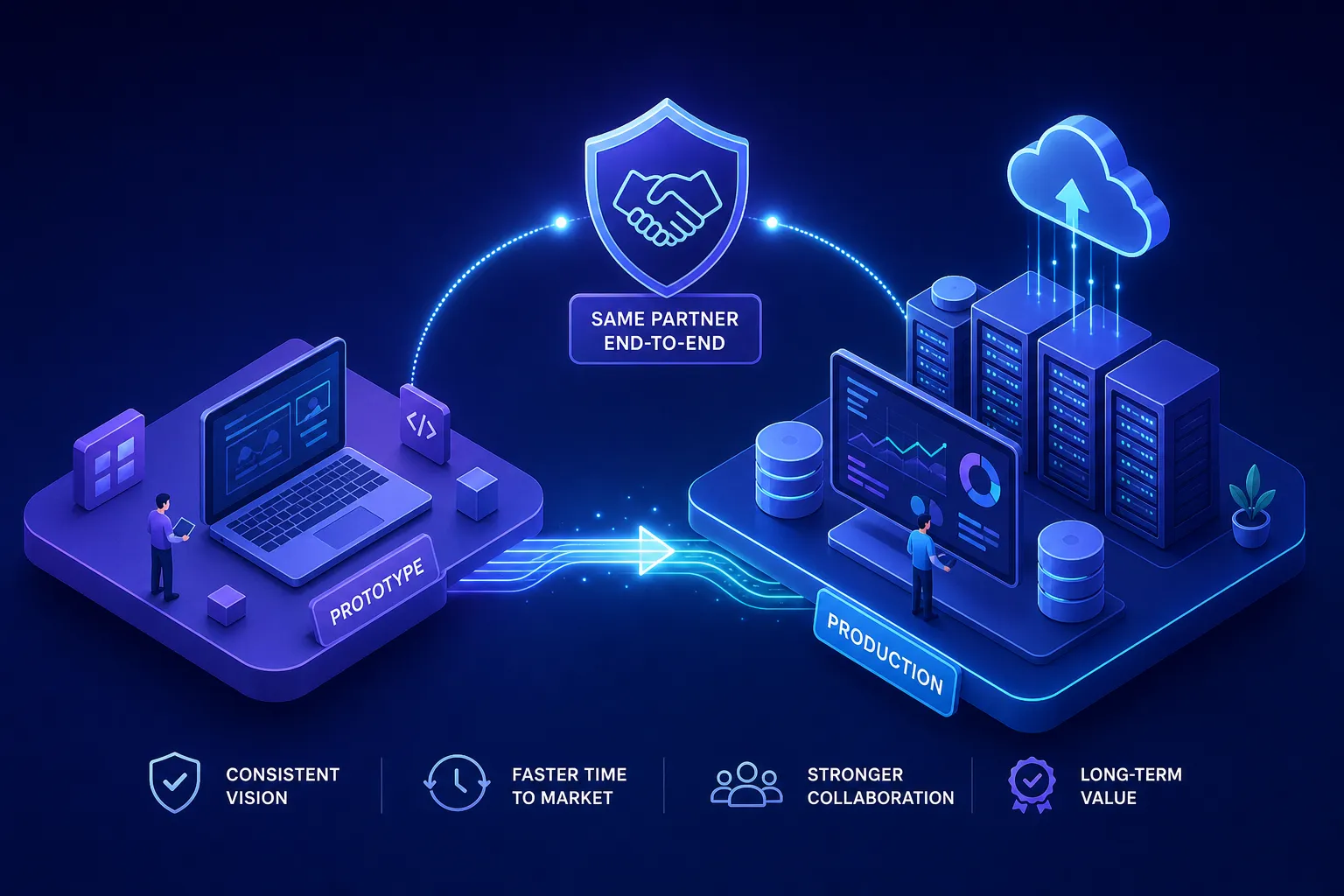
Many production ramps don’t fail because the design was wrong. They fail because the manufacturer who built the prototype was never set up to handle the volume. Knowing how to scale from prototype to production without changing manufacturing partners starts with vetting capacity, locking in DFM, and setting clear validation gates before a single production board gets built. The cost of switching partners mid-lifecycle is concrete: requalification routinely adds weeks to your schedule, institutional knowledge resets to zero, tooling gets rebuilt from scratch, and pricing negotiations restart without any leverage. In post-mortems across hardware programs, teams consistently report underestimating this cost until they’re living it.
Staying with one partner from prototype through volume production is not just convenient. It’s a strategic decision that directly affects your unit economics, schedule, and quality baseline. This article breaks down what it actually takes to execute that transition cleanly, what to vet before the first board gets built, how to structure validation gates, and how to use contracts and tooling ownership to protect your position as you scale.
Amtech is built around exactly this lifecycle, with defined engagement roles that move from early design support through full production without requiring you to re-onboard or re-explain your product to someone new. That continuity is a structural advantage, and it’s worth understanding how to build it intentionally.
Why Switching Manufacturing Partners Mid-Scale Costs More Than You Expect
Every production relationship builds context that can’t be fully documented. This includes workarounds for specific component behaviors, yield patterns that only surface after 500 units, supplier relationships built around your exact BOM, and process adjustments made quietly to keep your defect rate down. When you switch partners, that knowledge resets. Your new manufacturer starts with a clean file and zero production history on your product.
The requalification process that follows is concrete and time-consuming. A new manufacturer needs a fresh DFM review, new tooling qualifications, new process development runs, a new First Article Inspection, and new pricing negotiations. Many engineering teams estimate this at two to three weeks. The actual timeline varies significantly by product complexity, simpler assemblies may resolve in a few weeks, while complex multi-layer boards with BGAs or tight mechanical tolerances can stretch the process considerably longer. That gap lands directly on your launch schedule.
The schedule risk compounds against itself. Lost transition time stacks against customer commitments, inventory orders already placed, and marketing timelines already communicated. A switch that felt like a contained decision becomes a cascade. The companies that ramp cleanly are the ones that never created the gap in the first place.
What to Vet in Your Manufacturing Partner Before the First Prototype Ships
The time to evaluate your manufacturer’s production readiness is before any boards get built, not after you’ve approved tooling. Start with capacity utilization. Suppliers operating at 60 to 80 percent utilization have room to absorb your volume growth. As utilization approaches 85 percent and above, you’re competing for floor time the moment your order size increases. Request historical production logs from the last 90 days alongside the current utilization rate, not just a verbal estimate.
Equipment claims deserve scrutiny. A factory’s design capacity and its effective capacity are different numbers. Ask to see the equipment list alongside maintenance records. A line that looks capable on paper may be running below its rated throughput due to aging equipment, unplanned downtime, or single-shift constraints. The gap between claimed and actual capacity is exactly where volume commitments get broken. First Pass Yield above 95 percent is the floor for any acceptable production partner; world-class operations run at 98 percent or better.
Four scenario questions reveal long-term partnership readiness better than any audit checklist. Ask how they handle a sudden 3x volume increase, how they manage EOL component substitutions mid-production, what their process looks like when an urgent order conflicts with existing commitments, and how they’ve handled a failed First Article Inspection in the past. Vague answers are disqualifying. At Amtech, the Tech Facilitator engagement role is specifically structured to work through these questions before a single board gets assembled, setting up the production relationship on a foundation of verified capacity rather than assumed availability.
DFM Fixes That Must Happen Before Volume Tooling Gets Cut
Prototypes are optimized for speed, not yield. The gap between a prototype that works and a design that produces consistently at volume is where most cost overruns originate. The most common issues fall into four categories:
- Unnecessarily tight tolerances on non-functional features
- Inconsistent component orientations on PCBs that slow pick-and-place programming and inspection
- Parts originally designed for 3D printing that don’t translate to injection molding
- Fastener variety that multiplies sourcing complexity across your BOM
At the board level, DFM for electronics requires specific attention to courtyard clearances for machine nozzles, component orientation standardization, replacement of NRND (not recommended for new designs) parts before production locks, and silkscreen placement that supports assembly clarity at speed. These fixes are low-cost when caught before volume tooling begins. After tooling is cut, each one becomes a costly rework event, and in some cases requires a mold revision or board spin that adds weeks and budget you didn’t plan for.
A formal DFM review is not a checklist pass-through. It’s a structured session where your engineering team and your manufacturer’s process engineers walk the design against real production constraints together. The deliverable is a categorized issue log with priority ratings, resolution owners, and a clear distinction between must-fix items and optimization opportunities. No volume tooling should be released until every critical flag on that log is closed.
How to Scale From Prototype to Production Without Changing Manufacturing Partners: Pilot Runs and Validation Gates
For PCB and PCBA production, pilot runs typically range from 10 to 50 units for standard assemblies, scaling toward 50 to 200 units for more complex programs depending on the first production order commitment and AQL plan requirements. The pilot has to be large enough to reveal repeatability issues and satisfy the sampling plan. Fewer than 10 units doesn’t generate enough variance to calculate reliable SMT yield rates. For boards containing BGAs or fine-pitch QFNs, 50 units is the specific minimum needed to verify stencil aperture accuracy. Running too few units produces data that can’t support a defensible Go/No-Go call.
Two core validation gates run in sequence before volume tooling gets released, with a third applied in regulated or high-reliability programs. First Article Inspection confirms that tooling and process produce parts within dimensional tolerance on the initial run. PPAP, required in automotive and standard in high-reliability electronics, delivers the formal production release package including process flow, control plans, and measurement system analysis. Statistical process capability analysis using a minimum of 30 independent samples validates not just that good units are being produced, but that they’re being produced consistently. Cp/Cpk data tells you whether your process is centered and capable, not just lucky.
The Go/No-Go criteria before releasing volume tooling must be explicit. A clear Go requires FPY above the established threshold, all FAI dimensions within spec, no open critical DFM flags, and a documented yield reconciliation. Any yield miss greater than 10 percent triggers a second pilot iteration, not a release to volume. Skipping this gate is the single most common cause of expensive production defects appearing after full-scale launch, where the cost to fix them is an order of magnitude higher than catching them during the pilot.
Tooling Ownership and Contract Structure That Protects Your Margins at Scale
Tooling ownership language is where production partnerships get held hostage. Your contract must state explicitly that title vests in the buyer upon full payment, that all tooling is labeled and physically segregated, and that you have the unqualified right to collect it along with all associated design files upon termination. Without these clauses, your ability to move production, even as negotiating leverage, disappears. The manufacturer holds the keys to your production, and they know it.
Require the manufacturer to hold tooling as a bailee, not an owner. The contract should specify permanent physical marking identifying you as the owner, a complete serialized inventory of all tooling, and your right to enter their facility to remove equipment at no cost. Set a fixed deadline for return of tooling and data files upon request, and define damages for failure to comply, including lost revenue and retooling delays. Consult legal counsel to ensure these terms are enforceable under the applicable jurisdiction; when written correctly, they reflect standard practice in mature supply chain agreements.
On pricing, negotiate step-down unit costs tied to volume thresholds with clawback provisions that require the supplier to return overpaid amounts if annual commitments fall short. Index-based pricing for raw materials should include documented caps and floors to prevent pass-through abuse. Establish quarterly business reviews with a defined KPI scorecard before volume ramps begin, so the governance cadence is routine rather than reactive when order sizes grow and pricing pressure increases.
Phase Milestones to Plan From Prototype Through Full Production
A clean production ramp runs across four phases with defined exit criteria at each. In the prototype and DFM phase, the design is finalized against real process constraints and all critical DFM flags are resolved before tooling decisions are made. The pilot production phase covers the appropriate unit count for your assembly type, with full FAI and process capability validation producing a documented Go/No-Go decision before volume tooling is released. The low-volume ramp phase focuses on iterative yield improvement, tooling confirmation, and BOM lock with no open sourcing risks. Full-volume production engages the governance cadence, steps down pricing tiers, and maintains reserved capacity through the contract terms negotiated earlier.
Each phase has a specific exit criterion before the next begins. Skipping exit criteria to compress schedule is how defects escape into full production and how cost overruns become structural rather than recoverable. The discipline of holding each gate is what separates a clean ramp from a reactive scramble.
Amtech operates across three defined engagement roles that map directly to this lifecycle. The Tech Facilitator role covers early design and DFM support. The ODM-style collaboration role handles co-development and production readiness. The Production Partner role executes full-volume manufacturing. A single-partner model eliminates re-onboarding cost because engineering context, supply chain relationships, and quality baselines carry forward from first prototype through sustained production. That continuity is not incidental, it’s the operational infrastructure that makes a single-partner lifecycle work in practice, not just in theory.
The Transition Is the Risk, Not the Volume
Scaling production is manageable when the foundation is right. The risk lives in the transition points: switching partners, skipping validation gates, releasing tooling before DFM is complete, or entering a long-term production relationship without the contract terms to keep both sides accountable. Every hand-off introduces requalification time, lost context, and renegotiated economics. The companies that ramp cleanly choose their production partner with production in mind from the start.
The steps are discrete and executable: vet scalability before the first prototype ships, fix DFM before volume tooling is cut, validate with FAI and process capability data, structure tooling ownership and tiered pricing into the contract, and map the ramp to defined phase gates with real exit criteria. None of these steps are complex in isolation. The challenge is executing all of them consistently across a compressed timeline with a partner who’s aligned on the outcome.
Use the criteria in this article to evaluate your current manufacturing partner’s readiness for scale. If there are gaps, address them before volume commitments are made. If you’re selecting a partner for a new program and want to understand how scaling from prototype to production without changing manufacturing partners works in practice, reach out to the Amtech team to talk through your product’s specific ramp requirements.