
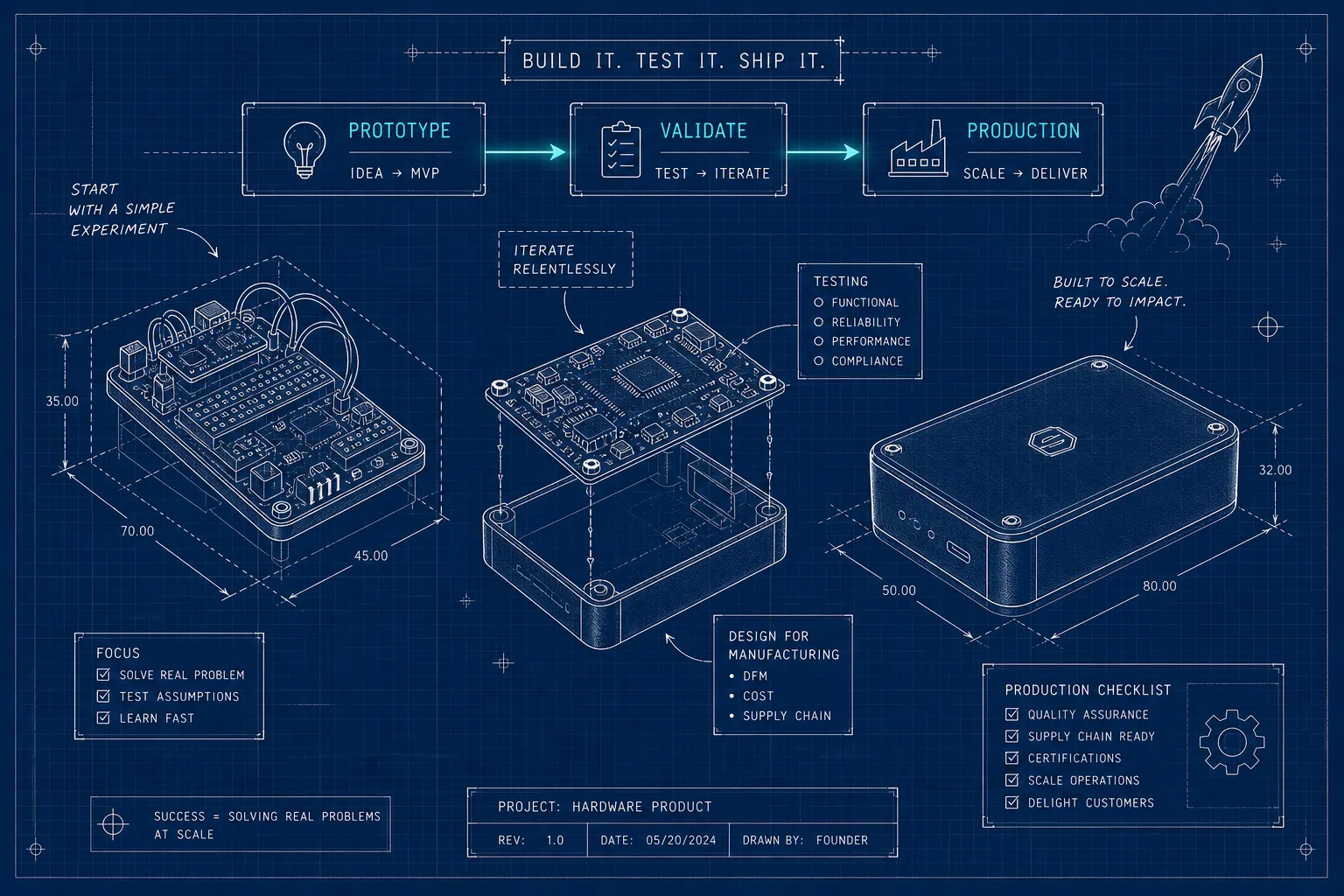
Going from prototype to production is one of the most punishing transitions in hardware development, and one of the most misunderstood. A prototype that works on the bench and a product that ships at scale are two completely different things. Most hardware founders discover this the hard way: six months building a clean, functional prototype, followed by nine months firefighting yield issues, scrambling for allocated components, and re-qualifying vendors who can’t hold the tolerances the design assumed. The gap between “it works” and “it ships” is the single most expensive mistake in hardware development, and it’s almost entirely avoidable.
The teams that close that gap efficiently don’t do it by working harder during the crisis. They do it by treating the prototype-to-production transition as a disciplined sequence with known milestones, predictable failure points, and the right manufacturing partner across every stage. At Amtech, we’ve supported that journey from early DFM review through full production ramp long enough to know exactly where programs break down and what it takes to keep them moving.
This is a five-stage playbook covering the critical path between a validated prototype and a repeatable production run. Each stage has specific deliverables, decision gates, and common failure modes you need to understand before you hit them.
Why Your Prototype Isn’t Production-Ready Yet
A functional prototype is a proof of concept built for one unit under ideal conditions. Production demands something fundamentally different: repeatability across hundreds or thousands of units, assembled by operators who didn’t design the product, using components sourced from distributors with MOQs, lead times, and lifecycle constraints. The tolerances that your engineer held with a steady hand and a rework station do not transfer to a pick-and-place machine running at speed.
The gap shows up in four specific areas that any honest prototype-to-production checklist must address:
- Component tolerance variation. In production, tolerances vary more than in hand-assembled prototypes. Designs that don’t account for that variation produce inconsistent results at volume.
- BOM fragility. Prototype BOMs are often built with samples, one-off distributor finds, or reference design parts that sit on long-lead allocation or are nearing end-of-life.
- Assembly complexity. What felt manageable for a single unit becomes a cycle-time and labor-cost problem at scale.
- Missing test infrastructure. A prototype gets verified by the engineer who built it. A production unit needs a fixture, firmware test modes, and a pass/fail protocol that any operator can run in under two minutes.
Productionization, converting a custom, hand-assembled design into something that is manufacturable, testable, and scalable, is what the industry calls productization. It’s not a single review. It’s a disciplined sequence of design decisions, supply chain validations, and process confirmations that the rest of this playbook will walk you through. For an external overview of the common pitfalls in scaling from a proof-of-concept to volume manufacturing, see prototype to mass production.
Prototype to Production: The DFM Review
A real DFM review for PCB assembly covers component spacing, courtyard clearances, pad-to-pad distances, solder mask expansion, fiducial placement, via-in-pad handling, and BOM standardization. For enclosures and mechanical parts, it covers wall thickness uniformity, draft angles, rib geometry, and gate placement. These aren’t aesthetic preferences. They are the specific parameters that determine whether your product assembles reliably on a production line or generates rework at every stage. If your product uses molded plastics, follow best practices for design for manufacturability in plastic injection molding to avoid common tooling and molding failures.
Design freeze is the formal gate that starts the production transition. After freeze, every change carries a real cost: re-qualification, updated documentation, and supply chain disruption. What needs to be locked before freeze includes the final BOM, PCB Gerbers, mechanical CAD models, and assembly tolerances. Teams that skip or delay design freeze enter the manufacturing ramp with an unstable design, which compounds every downstream problem, changes mid-ramp ripple through test fixtures, work instructions, and supplier commitments simultaneously.
The cost of skipping DFM is measurable. Catching a design issue before tooling typically saves 10 to 100 times the cost of catching it after first article inspection. DFA (design for assembly) is the companion check that reduces assembly time per unit. Fewer steps and fewer opportunities for error per board directly reduces labor cost per unit at volume. Neither review is an audit, both are design conversations that belong before freeze, not after. For projects that include injection-molded enclosures, understanding the injection molding cost and tooling implications during DFM can prevent expensive late-stage changes.
Locking Your Supply Chain Before You Lock Your Design
BOM validation means cross-referencing every component against real distributor stock levels, current lead times, and lifecycle status. The most common failure mode is a prototype BOM built with samples or distributor spot buys that includes components nearing end-of-life or approaching end-of-supply with no announced replacement. A single EOL component can force a board respin that resets your design freeze, your tooling timeline, and your certification testing. BOM lock and supply chain validation must happen in parallel with DFM, not sequentially after it.
An approved vendor list (AVL) is the structural protection against that risk. For every critical component in your design, you need at least one qualified alternate source. In 2026, with continued tariff exposure on components sourced from specific regions under Section 301, alternate sourcing is also a cost strategy, not just a risk strategy. A tariff-mitigating AVL that identifies domestic or allied-country alternatives for high-exposure line items can meaningfully reduce your production cost structure before you commit to volume.
A strong contract manufacturing partner brings this infrastructure to the table. Building an AVL, tracking lifecycle status, and maintaining alternate source relationships is a full-time capability, not a project. If your CM can’t actively contribute to supply chain resilience, they’re treating your program as a transaction rather than a partnership. Learn more about Building a Strong Manufacturing Relationship, Amtech and how a collaborative CM can protect your program timeline.
Test Strategy: Build the Infrastructure Before You Build the Line
EVT, DVT, and PVT: Sequential Gates
EVT, DVT, and PVT are sequential gates, not interchangeable phases. Engineering Validation Testing (EVT) confirms that the core electronics function correctly under expected operating conditions, using approximately 20 to 50 prototype units over four to five weeks. Design Validation Testing (DVT) evaluates the complete product, including enclosure, materials, and environmental performance, typically using 50 to 200 units over eight weeks. Production Validation Testing (PVT) confirms that the manufacturing line is ready, using 5 to 10 percent of the first production run to validate assembly stability, test fixture performance, and yield before volume ramps. For a concise explanation of EVT, DVT, and PVT testing, consult third-party resources that outline expected sample sizes and timelines.
Compliance Testing Timeline
DVT is when compliance testing begins: FCC for any RF-enabled device, UL for safety certification, and CPSIA for children’s products. Third-party certification lab schedules are not instant, FCC, UL, and CE testing all require planning, pre-submission documentation, and meaningful lead time. A failed test at DVT can add weeks or months to your timeline. The compliance plan belongs in the DFM review phase so that test requirements inform the design, rather than forcing redesigns after tooling is already cut.
Functional Test Fixtures
Functional test coverage in production requires hardware test fixtures and firmware test modes built specifically for manufacturing. ICT fixtures, functional test rigs, and in-circuit programming setups all require engineering time to develop. Teams that wait until PVT to start fixture development consistently delay their production start date. That pattern repeats across programs regardless of team experience. Fixture development belongs on the project plan at the same time as EVT, so it’s ready before PVT begins.
Prototype to Production: Running a Pilot Build
A pilot build’s purpose is often misunderstood. It does not validate the product design, EVT and DVT handled that. The pilot run, typically 100 to 300 units, validates the production process: assembly line setup, operator execution, test fixture performance, and QC checkpoint effectiveness. The deliverables are yield data, assembly cycle time per unit, defect distribution by stage, and confirmation that operators can build the product consistently without engineering support on the floor. For guidance on how to ensure a successful pilot run, consult practical checklists and lessons from electromechanical program pilots.
Reading pilot yield data correctly matters as much as collecting it. A healthy benchmark for PCB assembly is above 95 percent first-pass yield before rework. Headline yield alone, however, can hide a serious problem. Defect clustering at a specific assembly step, even at a low overall defect rate, becomes a major bottleneck when volume increases by 10 times. One soldering step that generates 60 percent of your defects will not solve itself at scale. Define your go/no-go criteria before you review the data, not after. Criteria set after seeing the numbers are shaped by the numbers, which defeats the purpose of the gate.
Document everything the pilot surfaces. Work instructions that remove operator guesswork, visual aids at each station, torque specs on mechanical fasteners, and sub-assembly verification steps before enclosure close are all artifacts of a well-run pilot. These documents are what make the next 10,000 units look like the first 200.
Choosing a Manufacturing Partner Who Covers the Whole Journey
The evaluation criteria that matter for prototype-to-production programs are specific. Does the CM offer DFM review as part of the engagement, or only after you hand over Gerbers and a purchase order? Do they have active supply chain infrastructure for BOM validation, lifecycle tracking, and alternate sourcing? Can they run small pilot builds in the 100 to 500 unit range and scale into full production without a separate qualification process? These questions separate program partners from transaction partners.
Switching manufacturing partners mid-scale is one of the most expensive mistakes a hardware team can make. Re-qualification, re-documentation, new test fixture builds, supply chain re-validation, and the loss of institutional knowledge built through prototyping are all real costs. For a moderately complex electronics product, switching CMs between EVT and production ramp adds three to six months and tens of thousands of dollars in transition costs, none of which appear in the new CM’s quoted unit price.
Amtech is built specifically to eliminate that risk. As a U.S.-based contract manufacturer supporting customers from prototype review through full production ramp within a single partnership, Amtech keeps programs moving without the re-qualification tax. The 3R Promise, Reliable, Robust, Responsive, is the operational commitment behind that continuity. When the same team that reviewed your Gerbers for DFM issues is also running your PVT build and your production line, the institutional knowledge that protects your yield stays in the program instead of walking out the door. If you’d like to learn more about our approach to end-to-end program support, visit Product Development, Amtech.
The Teams That Launch on Time Treat This as a Discipline
The five-stage roadmap from validated prototype to repeatable production covers DFM review, design freeze, supply chain validation, EVT through PVT testing, and a properly scoped pilot build. Each stage has specific deliverables and known failure points. None of them are optional checkboxes. The teams that launch on schedule and on cost are not the ones with the best prototype, they’re the ones who treated every stage as a non-negotiable gate rather than a suggestion.
The prototype-to-production journey also gets faster and cheaper each time you run it with the right infrastructure in place. Supplier relationships carry forward. Test fixtures can be adapted. Process knowledge compounds. That’s the compounding return on partnering with a CM invested in the outcome of your program, not just the output of your next purchase order. For ongoing insights and case studies from our team, check the Blog, Amtech.
If your team is approaching design freeze or evaluating manufacturing partners for a new program, contact Amtech to start with a DFM review. We’ll give you a clear picture of where your design stands before you commit to tooling.
Mass Production Checklist: Go/No-Go Gates by Stage
Use this checklist to confirm readiness before advancing through each stage of your prototype-to-production journey.
- Design Freeze Gate: Final BOM locked and validated against distributor stock; PCB Gerbers released; mechanical CAD models approved; assembly tolerances documented; DFM and DFA reviews completed.
- EVT Gate: Core electronics function confirmed across 20, 50 units; critical failure modes identified and logged; test fixture development started.
- DVT Gate: Full product validated including enclosure and environmental performance; compliance testing (FCC, UL, CE as applicable) submitted or completed; no open design changes.
- Pilot Build Gate: First-pass yield above 95% with no clustered defects at a single assembly step; cycle time per unit measured and within target; work instructions and visual aids finalized; go/no-go criteria met as defined before data review.
- Production Ramp Gate: AVL confirmed with qualified alternates for all critical components; test fixtures validated and documented; QC checkpoints staffed and trained; PVT yield data approved by engineering.