
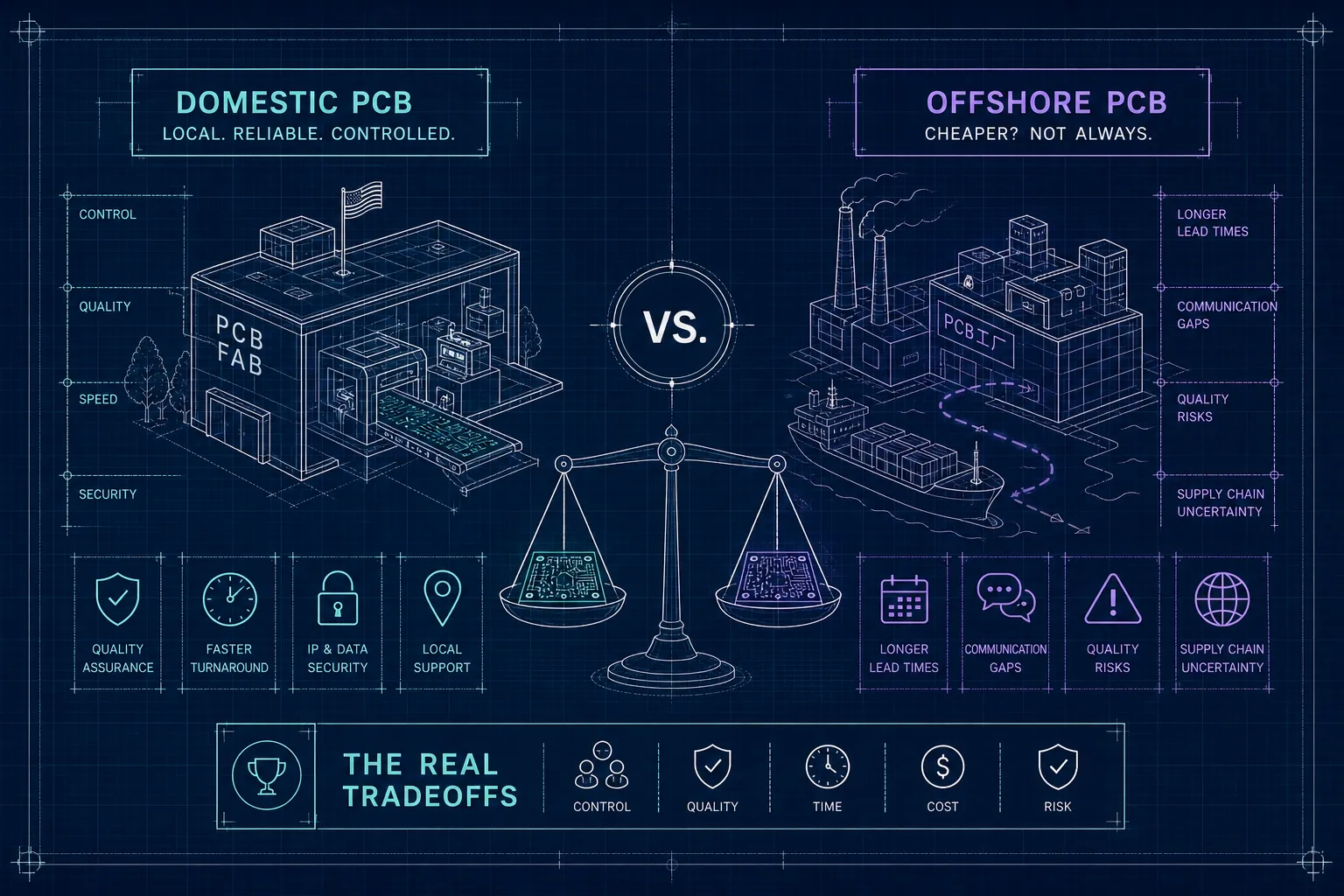
Every procurement lead has seen it: the offshore PCB quote comes in at a fraction of what domestic production costs, and the decision feels obvious. But that first quote rarely captures what the board actually costs by the time it clears customs, survives a tariff calculation, and finally lands at your facility in 2026. Domestic PCB production has been quietly closing the gap for years, and a new round of tariff adjustments has accelerated that shift in ways most sourcing teams haven’t fully priced in yet.
U.S. contract manufacturers have invested heavily in automation and supply chain intelligence to address the price gap that kept domestic production out of consideration for so long. The result is a market where the offshore-vs.-domestic decision is genuinely competitive again, and the right answer depends on which of five dimensions matters most to your program: cost, lead time, quality, IP protection, and tariff exposure.
This article delivers a direct, side-by-side comparison of both paths across all five dimensions, along with the specs you need to gather and a shortlist framework to make the call with confidence. The most important takeaway: for many commercial and high-reliability programs in 2026, the offshore cost advantage is smaller than your last quote suggested, and the total program risk is considerably higher.
Why the offshore cost advantage is smaller than it looks in 2026
The “offshore is cheaper” assumption is built on base price comparisons. When you replace base price with total landed cost, the math changes significantly. As of publication in June 2026, multilayer PCBs imported from China (6+ layers, flex, or metal core) carry a combined tariff of 35%: 25% under Section 301 plus a flat 10% additional tariff under the Trade Act of 1974. Two-layer and four-layer rigid boards benefit from a Section 301 exclusion and face only the flat 10%, but that exclusion is set to expire in November 2026 unless extended. Tariff schedules are subject to change; verify current rates with your customs broker before finalizing sourcing decisions.
Put that against a concrete example. A 6-layer board quoted at $50 offshore lands closer to $67.50 after tariffs alone, before freight. Add escalating logistics costs and standard transit time from China (7 to 10 days via DHL Express for commercial shipments), and the total landed cost can reach 40% or more above the base quote when broker fees, inventory carrying costs, and rework risk are included. For American-made PCBs, copper derivative tariffs are eliminated entirely, which further reduces the material cost differential on domestic programs.
Freight, delays, and the transshipment risk most buyers underestimate
Logistics instability has compounded the tariff math. Transshipment hubs through Vietnam and Mexico have faced growing disruption as trade routes shift in response to tariff pressure. Reduced Chinese import volumes into the U.S. have created measurable supply gaps, with lead time consequences that don’t appear anywhere in the vendor’s quoted turnaround. For commercial and industrial orders, the total landed cost of offshore boards now sits much closer to domestic rates than most procurement teams realize. The offshore advantage still exists, but it’s narrower than the base price comparison suggests, and it carries far more schedule risk.
Where domestic PCB production pulls ahead regardless of cost
Cost is only one dimension of the decision. For teams working on defense-adjacent electronics, medical devices, or high-reliability industrial systems, three other factors often outweigh price entirely: lead time, IP protection, and quality auditability.
Lead times that change how fast you can iterate
Domestic quick-turn fabrication runs 24 to 72 hours for prototypes at verified U.S. facilities. The offshore equivalent, even from manufacturers who quote 24-hour fabrication, adds 7 to 10 business days of international shipping on top of that build time. For a product team running DFM iterations or responding to an engineering change order during a production ramp, that difference is the gap between hitting a launch window and missing it. Responsiveness on ECOs is a structural advantage rooted in proximity and shorter transit times, one that domestic manufacturers hold independent of tariff cycles, not just during periods of trade disruption. For standard production orders of 100 to 500 units, domestic programs typically deliver 5 to 10 days faster than offshore equivalents when total lead time is measured from order to receipt.
IP protection and quality verification you can actually enforce
Sending detailed Gerber files, BOMs, and test specifications offshore means transferring your most sensitive design data to facilities operating under a different legal framework. Documented risks include unauthorized reverse engineering, supplier-led cloning where the manufacturer modifies and resells the product, and situations where subcontractors refuse to return source files. Foreign NDAs are frequently unenforceable under Chinese law, and cases like the 2013 Sinovel-AMSC incident confirm that high-value IP is a real target, not a theoretical concern. See examples of documented IP theft in global supply chains for context: examples of China IP theft.
Domestic manufacturers operate under U.S. contract law with enforceable NDAs, audit rights, and the ability to verify certifications in person. IPC Class 2 and Class 3 compliance, ITAR registration, ISO 9001:2015, and AS9100D certifications are verifiable through domestic oversight. You can walk the floor, inspect the process, and hold the manufacturer accountable in a U.S. court. That level of enforceability and in-person auditability is generally not available with overseas partners, where legal recourse is limited and on-site audits are logistically difficult to conduct and verify.
Manufacturing capabilities to verify before committing to domestic PCB production
Don’t assume a domestic vendor can handle your board without verifying their capability spec first. The leading U.S. fabs support layer counts from standard multilayer up to 42 to 70+ layers at the top tier, with minimum trace and space as low as 2 mil at high-capability shops and minimum hole sizes down to 0.004 to 0.005 inches via laser drilling for micro-vias. Board thickness ranges from 0.008 inches for ultra-thin flex applications to 0.500 inches and above for heavy builds.
Surface finish options at domestic fabs include ENIG, immersion silver, selective gold, and epoxy plugging for high-reliability applications. HDI designs with blind and buried vias, controlled impedance for RF and high-speed circuits, and heavy copper up to 6 to 8 ounces are all supported at leading U.S. facilities. These are the items to verify explicitly before submitting a quote request, because not every domestic fab handles all of them. A PCB supplier comparison across these spec dimensions, not just price, is the most reliable way to separate capable vendors from commodity shops.
Turnkey assembly, component sourcing, and what “no MOQ” actually means
Leading domestic vendors offer turnkey PCBA with component sourcing from authorized distributors. Many operate with zero MOQ for new designs and 1-piece capability for quick-turn prototypes. Assembly labor cost in the U.S. runs approximately $50 per board compared to under $3 per board offshore, but that comparison ignores the coordination overhead that inflates offshore program costs: managing multiple handoffs, dealing with time zone delays on engineering questions, and absorbing the cost of rework from quality issues that weren’t caught during distant production. Turnkey domestic programs consolidate that overhead. Tooling costs are typically a one-time solder paste stencil at approximately $300, reused for repeat builds. MOQs for repeat orders are quoted at the time of build, typically 3 to 5 units minimum with no surprise fees.
Quick-turn and low-volume: what U.S. vendors can realistically deliver
For prototype and low-volume programs, several verified domestic options exist. Sierra Circuits (ProtoExpress) offers 24-hour, 48-hour, and 72-hour domestic fabrication with instant quoting through their Turnkey Pro system. FastTurn PCBs delivers 24 to 48-hour turns for 2 to 4 layer boards and same- or next-day assembly with in-stock parts. Rush fees across domestic vendors typically run 20 to 50% above standard pricing depending on layer count and complexity, so build that into your prototype budget planning upfront.
On pricing, small boards under 20 by 20 millimeters in 3-unit batches can run $1 to $2 per board domestically. Larger boards scale significantly from there. The major pricing breakpoints that make domestic PCB production markedly more competitive occur at 100, 1,000, and 5,000 units. At production scale, the combination of automation-driven cost reduction and eliminated tariff exposure closes the remaining gap with offshore pricing for most commercial applications.
How to shortlist the right domestic PCB partner for your program
A vendor can’t return an accurate quote without complete information. Before you reach out, have the following ready:
- Gerber files and drill files
- Layer count and board dimensions
- Material specification (FR4, Rogers, metal core, or flex)
- Surface finish requirement
- IPC class target
- Minimum trace and space, and minimum hole size
- Controlled impedance requirements
- Finished copper weight
- Annual volume forecast
Providing a complete BOM upfront enables component sourcing to be quoted simultaneously, cutting the back-and-forth that inflates your timeline before a single board gets built.
Questions that separate capable vendors from commodity shops
Ask every vendor you’re evaluating the same five questions and compare how they answer. Do you fabricate in-house or broker the work out? What does your DFM review process look like before fab begins? Can you support both prototype and production volume under one agreement, without handing the program off? What is your traceability and serialization process? How do you handle component EOL or shortage events mid-program? A capable domestic manufacturer answers all five with specifics. Generic answers to any of these questions are a signal worth taking seriously before you commit a program to that vendor.
How Amtech approaches domestic PCB production differently
Amtech has invested in robotics and AI-assisted inspection tools to reduce manual labor across its production process. SMT automation at this level supports high-speed component placement with real-time optical inspection that catches quality issues during production rather than at end-of-line. That kind of process investment is how domestic assembly costs can compete with offshore rates at production volume, not through wage arbitrage, but through efficiency that offsets the labor cost differential.
Amtech’s approach to supply chain resilience includes AVL development structured to reduce tariff swings, alternate sourcing strategies, and lifecycle planning designed to protect programs from component shocks and tariff swings. This isn’t advisory services layered on top of manufacturing. It’s built into how every program is managed from day one.
The end-to-end model covers DFM and DFA review, quick-turn prototyping, low-volume PCBA, wire harnessing, box build, functional test, and volume production scaling, all within a single partnership. Many domestic fabs hand off at the fab stage and leave the customer to coordinate assembly, sourcing, and test separately. Amtech holds the program through its full lifecycle. For procurement leaders currently managing multiple vendors across a product lifecycle, that consolidation reduces handoff risk and the schedule compression that comes with fragmented supply chains.
Making the call: domestic vs. offshore in 2026
Domestic PCB production has closed the gap more than most procurement teams have priced into their current strategy. For multilayer and high-reliability boards, current tariff structures can bring offshore landed costs within a narrow margin of domestic rates before freight, schedule risk, and IP exposure are factored in, and that margin shrinks further once total program costs are calculated. The strongest domestic vendors aren’t competing on price alone. They’re competing on total program value: speed, quality, auditability, and supply chain resilience built into the process rather than bolted on after problems emerge.
Before your next sourcing decision defaults to offshore, gather your board specs and request a real landed-cost comparison that includes tariffs, freight, rework risk, and schedule exposure. The cost gap you assumed may be considerably smaller than your last quote suggested. Amtech’s 3R Promise, Reliable, Robust, and Responsive, reflects more than 20 years of engineering depth applied to exactly this kind of decision. If you’re ready to evaluate a domestic production partner with verified capabilities, request a DFM review or landed-cost estimate and get a number you can actually build a sourcing strategy around.