
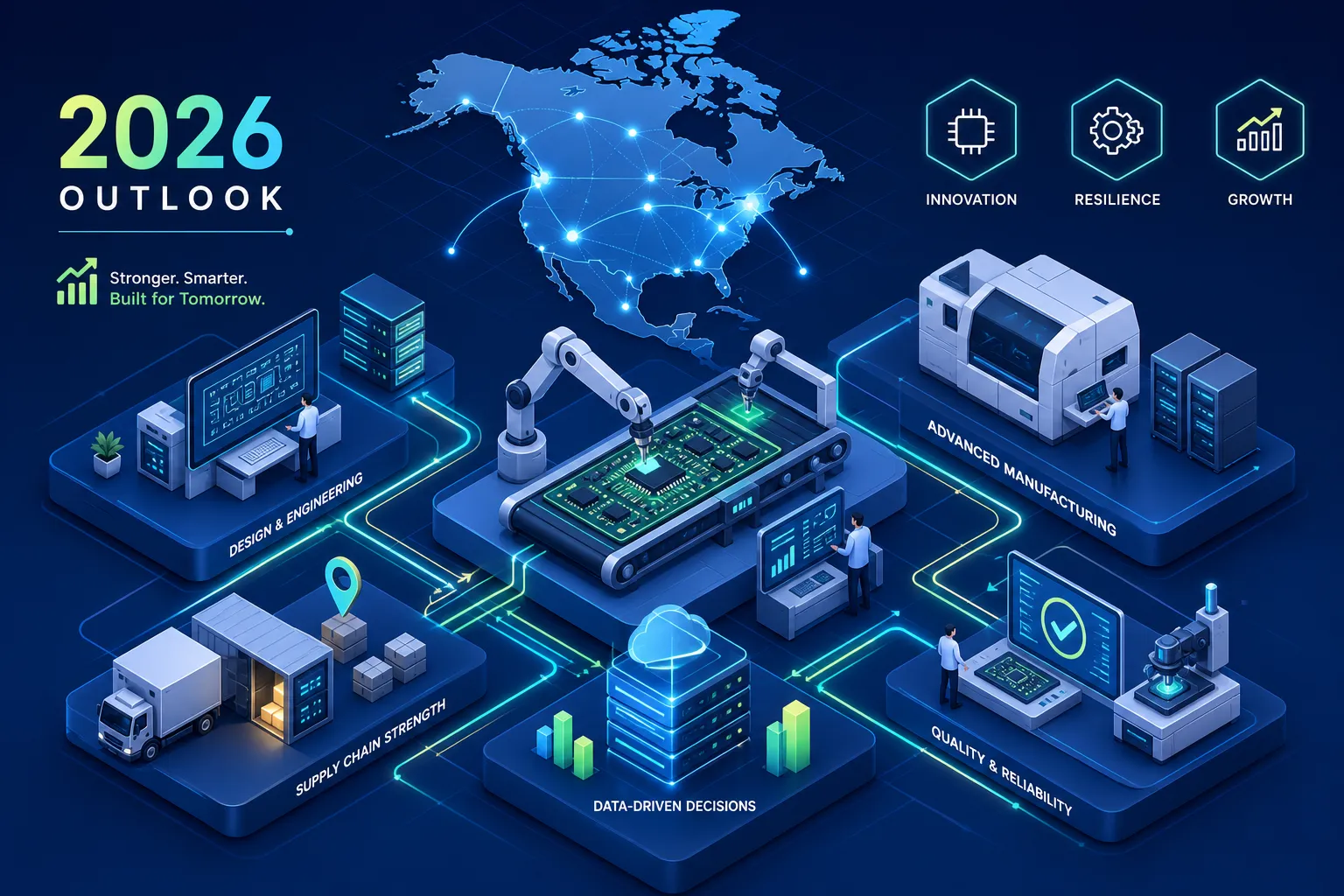
The assumption that offshore is always the cost-efficient default has quietly collapsed. As the North America electronics manufacturing services market reaches an estimated $175.55 billion in 2026, the region is no longer playing catch-up with Asia. It’s pulling ahead in the categories that matter most: supply chain security, total landed cost, and production agility.
The question OEM executives and supply chain leaders are wrestling with has shifted. It’s no longer “can we afford to manufacture domestically?” It’s “can we still afford not to?” Tariff-driven cost realignment, USMCA-protected nearshore supply chains, and a wave of automation investment have fundamentally changed the economics of domestic and near-domestic production.
This article gives you a clear-eyed snapshot of the 2026 North America electronics manufacturing landscape, the real total landed cost picture, and a practical framework for evaluating domestic manufacturing partners. Companies like Amtech are already operating in this new model, combining proprietary automation with supply chain intelligence to deliver unit costs that compete with any geography.
North America Electronics Manufacturing Market: Bigger and Faster-Growing Than Most Forecasts Suggest
The market numbers behind the momentum
The North America electronics manufacturing services market is estimated at $175.55 billion in 2026, with the U.S. alone accounting for roughly $135.87 billion of that figure. That scale matters because it signals something deeper than revenue: supplier depth, workforce development, and infrastructure investment that simply wasn’t present a decade ago. The global EMS market is growing at a 7.1% CAGR through 2034, and North America is the fastest-growing region within it, with regional estimates ranging from 6.1% to 6.7% depending on the forecast window.
This is not a temporary reshoring blip driven by political headlines. The investment thesis for domestic and near-domestic electronics production is structural, and the market numbers reflect it. The U.S. share of global semiconductor manufacturing capacity is projected to reach 14% by 2032, up from 8% before the CHIPS Act, backed by over $630 billion in announced private sector investments across 140 projects in 28 states.
What’s pulling manufacturers back to this region
The demand drivers vary by buyer type. Defense and aerospace procurement mandates require domestic sourcing and ITAR compliance, directing spending to U.S. contract manufacturers regardless of unit price. Medical device OEMs are tightening supply chain security requirements after years of single-source exposure. Together, these compliance-driven buyers represent a substantial and durable share of domestic volume.
On the market-driven side, semiconductor fab expansion in Arizona, Texas, and New York is creating adjacent demand for PCB assembly and box build services among top electronics manufacturers in North America. IoT product companies with Asia-heavy supplier networks are actively de-risking by splitting volume between offshore and domestic partners. Each of these drivers represents a real customer type with a real procurement mandate, not an abstract reshoring trend.
Tariffs, USMCA, and the Policy Tailwinds Reshaping Sourcing Geography
How the 2025, 26 tariff wave shifted the landed cost equation
The direct financial impact of current U.S. tariffs on Chinese electronics imports is measurable: China is now approximately 21% more expensive in total landed cost terms for goods sold into the U.S. market. Without those tariffs, China retains a modest 4% landed cost advantage. That swing alone is enough to restructure a supplier map. The tariff stack on Chinese imports runs from 17.5% to 35% depending on product classification, while Mexico-origin goods that qualify under USMCA enter at 0%. Canada’s steel and aluminum exports face doubled tariffs of 50%, which flows directly into costs for enclosures, heat sinks, and structural electronics components.
A proposed 25% tariff on imported semiconductors adds further pressure at the component level. Company filings from major chipmakers have already disclosed impacts running into the billions, and for OEMs with Asia-dependent BOMs, the math has changed materially. It hasn’t changed back.
USMCA exemptions and the $250 billion investment signal
On March 6, 2026, goods covered by USMCA were exempted from the new tariffs on Mexico-origin goods, restoring the viability of nearshore supply chains for compliant manufacturers. That exemption was a structural reprieve for the nearshoring calculus, not a minor procedural update. To qualify, products must meet Tariff Shift or Regional Value Content thresholds, meaning real manufacturing transformation in North America rather than final assembly labeling. In January 2026, the U.S. and Taiwan reached a bilateral agreement where Taiwanese chipmakers pledged $250 billion in U.S. manufacturing investment in exchange for preferential tariff treatment. These policy signals represent durable structural changes. Supply chain planners who treat them as such are already repositioning their sourcing strategies accordingly. For a broader view of the tectonic shift in global manufacturing trends that supports these moves, see analysis on the global shift in manufacturing.
The Real Total Landed Cost Story: What the Unit Price Comparison Misses
Breaking down what “offshore is cheaper” actually costs
An offshore quote captures unit price. It doesn’t capture the five cost components that actually determine whether offshore is cheaper. Ocean freight adds 30 to 45 days of transit versus 3 to 5 days by truck from Mexico. Depending on lead-time variability and demand volatility, that transit window can require several additional weeks of buffer stock, and inventory carrying costs scale accordingly. Tariff exposure adds 17.5% to 35% at the border for Chinese-origin goods. Quality rework and scrap rates increase with distance because communication gaps in distributed programs are harder to resolve. And when something goes wrong, expedite premiums on air freight or emergency domestic production can erase months of unit-price savings in a single purchase order. For more detail on how to model the full landed cost equation for electronics, review this practical breakdown of landed cost in electronics.
For a 300,000-unit program, cost analysis across comparable programs shows Mexico at roughly $0.687 per part in total landed cost versus China at approximately $0.745, a difference that compounds to about $17,400 annually at that volume. China only recaptures the cost advantage at volumes above 5 million units per year, where base piece-price scale begins to outweigh the tariff and freight burden.
Where the math genuinely favors North American production
The domestic and near-domestic advantage is most pronounced under specific program conditions: products with frequent design changes that require rapid engineering feedback cycles, assemblies with strict traceability requirements where FDA or ITAR compliance drives the sourcing decision, programs with high rework risk due to design complexity or low yields, and situations where speed-to-market is a revenue-generating asset. The 3-week domestic lead time versus a 12-week offshore benchmark is a concrete illustration of where proximity translates directly into revenue protection. A product that ships 9 weeks earlier doesn’t just save logistics cost, it captures earlier market share and reduces the financial exposure of a delayed launch.
Automation Is Closing the Labor Cost Gap, Faster Than Most Buyers Realize
What robotics and AI are doing to North American production economics
The traditional objection to domestic manufacturing has always been labor cost. That objection has weakened significantly. Advanced SMT automation, robotic soldering, AI-enabled optical inspection, and automated test fixtures have structurally reduced the labor content per assembly across modern North American facilities. In high-mix, low-volume production environments, automation also delivers consistency that manual labor in low-cost regions cannot replicate. 3D AOI systems now replace manual visual checks, inspecting at speeds and detection rates that far exceed what human inspection can sustain across a full production shift. AI-driven defect classification reduces false failure rates and, based on vendor-reported outcomes, improves yield without adding head count. Robotic conformal coating applies material with precision that eliminates the variability inherent in manual spray processes.
These are systematic improvements, not marginal ones. They reduce the labor content that made offshore production appear cheaper in the first place. When you account for the automation advantage alongside tariff realignment and logistics cost, the domestic cost structure looks very different than it did five years ago.
What to look for in a manufacturer’s automation maturity
Not all North American EMS providers have invested equally in automation. The distinction that matters is whether a manufacturer builds proprietary automation or simply purchases off-the-shelf equipment and installs it. Proprietary robotics and custom AI systems developed around specific production challenges can deliver cost reduction and quality gains that generic equipment may not achieve in the same context, particularly in high-mix programs where standard automation lacks the flexibility to handle frequent changeovers. Amtech operates in this category, integrating custom AI and proprietary robotics into a production environment designed to remain cost-competitive even on complex, high-mix assemblies. The right question to ask any prospective partner isn’t “do you have automation?” It’s “does your automation apply across high-mix programs, or only when you’re running high volume?”
Which Products and Sectors Are Actually Suited for North American Production
High-reliability, defense, and regulated electronics
Certain product categories don’t require a landed cost argument to justify domestic production; they require it operationally. Defense-adjacent programs with ITAR and security requirements have no viable offshore alternative. FDA-regulated medical devices need traceability documentation and quality management systems that are far easier to audit domestically. Industrial safety electronics and automotive assemblies require rigorous QMS compliance and responsive engineering support when field issues emerge. One practical constraint worth planning around: only approximately 145 U.S. PCB fabricators remain, holding roughly 4% of the global market. Programs with complex HDI or uHDI requirements need to qualify domestic fabrication capacity early in the design cycle, not during production ramp.
IoT, industrial, and connected device assemblies
Beyond strictly regulated categories, a broader set of electronics programs benefits from domestic production for operational reasons. IoT hardware companies with high-mix, variable-volume production needs require a partner who can flex across prototype runs and production ramp without forcing a partner change. Industrial automation OEMs running frequent design iteration cycles need DFM collaboration at close range, not across 12 time zones. Connected device companies with Asia-heavy supply exposure are actively splitting volume to reduce single-region risk. For these programs, shorter lead times, accessible engineering support, and built-in supply chain resilience make North American production the lower-risk choice, even when the unit price comparison is close.
How to Evaluate a North American Contract Manufacturer: The Criteria That Actually Matter
Beyond the capabilities list: what to probe in your evaluation
Most contract manufacturers can produce a credible capabilities sheet. The differentiation lives underneath it. When evaluating a domestic EMS partner, the questions that reveal genuine operational quality are specific. Does the manufacturer offer DFM and DFA review before quoting, or do they simply quote what you give them? Do they maintain an alternate-approved vendor list (AVL) that protects your program against component shortages and tariff exposure? Do they have in-house functional test design capability, or do they rely on customer-supplied test fixtures? Can they provide yield optimization data from programs comparable in complexity to yours? These criteria separate manufacturers who execute production from partners who actively reduce program risk.
- DFM/DFA review integrated into the quoting process
- Alternate-approved vendor list with active lifecycle and tariff monitoring
- In-house functional test design capability
- Yield optimization documentation from comparable programs
- Scalable engagement model from prototype through high-volume production
Supply chain intelligence and design depth as the real differentiators
The highest-value capability a North American contract manufacturer can offer isn’t faster lead times or lower overhead rates. It’s active participation in design risk reduction, tariff mitigation strategy, and onshoring transitions. Amtech’s Design for Volatility program is a concrete example of what this looks like in practice: proactive AVL development to mitigate tariff exposure, component lifecycle planning to avoid EOL disruptions, and engineering co-development that bridges design intent and production reality. A partner who engages at this level reduces program risk in ways that no unit price negotiation can replicate. When you’re evaluating contract manufacturers, the question isn’t just “can they build my product?” It’s “will they help protect my program over its entire lifecycle?”
The Domestic Manufacturing Advantage Is Real, and It’s Growing
North America electronics manufacturing in 2026 is no longer a compromise between cost and control. For the right product and the right partner, it is the strategically superior choice. The signals are consistent: a $175.55 billion market growing faster than any other region globally, tariff-driven landed cost shifts that have erased Asia’s apparent price advantage across the 100,000-to-2-million-unit volume range where most mid-market programs compete, and automation investments that have permanently changed the domestic cost structure.
The analysis that leads to the right sourcing decision starts with total landed cost and production risk, not the unit price on a quote sheet. Factor in tariff exposure, transit time, inventory carrying cost, rework risk, and the value of engineering proximity. When you run that calculation honestly, North America’s position in the comparison changes significantly.
Amtech is built for exactly this transition: an end-to-end electronics contract manufacturer with proprietary automation, supply chain intelligence, and engineering co-development capabilities that allow customers to start at any phase of their product lifecycle and scale without switching partners. If you’re evaluating your manufacturing geography or looking for a domestic partner who brings more than a production floor to the relationship, the conversation starts with Amtech’s 3R Promise, Reliable, Robust, and Responsive.