
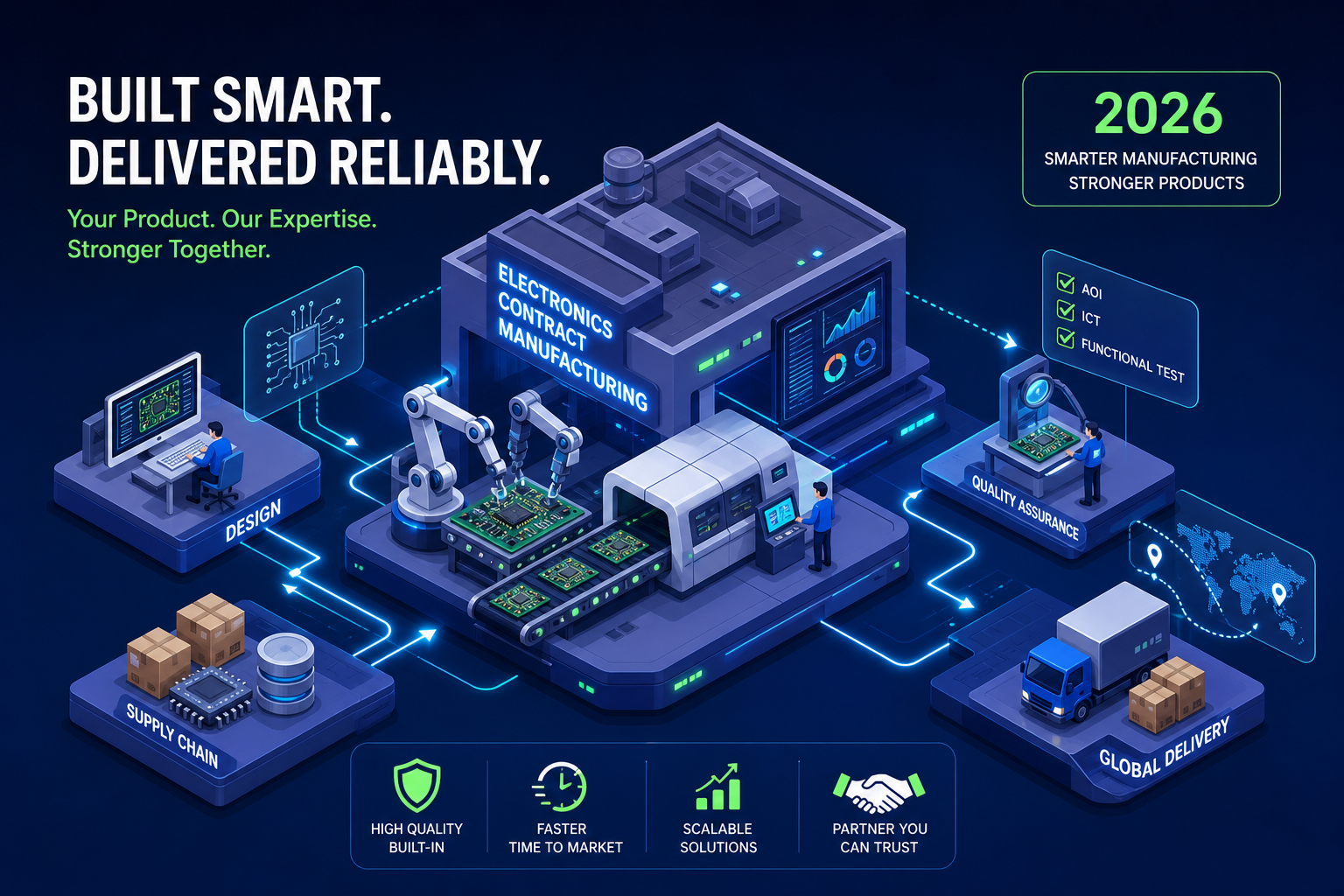
Electronics contract manufacturing decisions in 2026 look nothing like the procurement exercises buyers ran even five years ago. You used to compare quotes, check lead times, and pick whoever could build your boards without burning your margin. That calculus has changed completely. Today the decision involves tariff exposure, reshoring strategy, automation maturity, and supply chain resilience, and the wrong partner costs you far more than a bad price per unit.
The companies navigating this well aren’t just vetting factories. They’re selecting strategic manufacturing partners. Domestic electronics contract manufacturing (ECM) providers are now actively participating in product development and proactively managing component risk, a fundamentally different relationship than a traditional contract manufacturer offers.
This guide gives you a repeatable framework for evaluating any electronics contract manufacturer across seven criteria: scope and capability fit, certification depth, quality metrics, automation maturity, supply chain resilience, NPI process, and pilot structure. Use it before your next RFQ, during a supplier audit, or when your current partner is no longer keeping pace with your product’s complexity.
How the 2026 landscape is reshaping electronics contract manufacturing
The reshoring wave is real, and tariffs are accelerating it
Section 301 tariffs on China-origin electronics inputs remain active in 2026, with many categories still carrying 25% duties. Supply chain disruptions from 2020 through 2024 exposed how fragile single-source, offshore-dependent programs really are. Industry tracking by the Reshoring Initiative indicates that cumulative reshoring and foreign direct investment announcements in U.S. manufacturing have surpassed 2 million jobs since 2010. Survey data from manufacturing industry groups suggests a significant and growing share of OEMs have already reshored some production or are actively doing so.
For electronics buyers, the practical consequences show up in procurement: unpredictable import duties, extended overseas lead times, and limited ability to get fast engineering responses when a design issue surfaces mid-production. These aren’t abstract risks. They’re schedule killers and margin destroyers.
Why “cost” is no longer a reason to stay offshore
The assumption that domestic manufacturing costs more is losing its grip. Automation investment, AI-driven yield optimization, and proximity benefits, shorter lead times, faster engineering response, no duty overhead, are closing the gap. When you factor in tariff exposure, logistics costs, and the risk premium from policy volatility, a U.S.-based electronics contract manufacturer with strong automation is often the more cost-competitive option for high-mix, time-sensitive, or IP-sensitive programs. That’s the context you need before you start comparing quotes.
The capability checklist your ECM partner must pass
Full-service vs. specialty: why scope matters more than price
A specialty contract electronics manufacturer (CEM) might win on prototype price. But if your product requires wire harness integration, low-pressure overmolding, box build, and functional test under one roof, you’ll eventually need to hand off work to additional partners. Those handoffs create coordination overhead, quality risk, and schedule fragility. For companies building hardware that scales, full-service capability isn’t a nice-to-have; it’s a risk management decision.
Full-service EMS providers handle PCB assembly (PCBA), box build, wire harness, functional test, kitting, and NPI within a single process framework. That continuity matters when you’re ramping from 50 units to 5,000 and can’t afford to switch partners mid-growth.
The non-negotiables: DFM, NPI support, and box-build capability
Before shortlisting any EMS partner, confirm these capabilities directly: SMT and through-hole assembly, DFM and DFA review, wire harness integration, low-pressure overmolding, functional test development, and box build. Ask specifically whether DFM reviews happen before the pilot build or only after the first failed run. Engineering involvement at the design-for-manufacturability (DFM) stage directly reduces yield problems, rework costs, and engineering change order churn downstream.
Good questions to ask during scoping calls: “Who leads your DFM review, and what’s the typical finding closure rate before pilot?” and “Can you show me an example of a DFM report you issued on a recent program?” Vague answers here are a reliable indicator of what your NPI experience will look like.
Certifications and quality benchmarks that actually matter
Which certifications to require and why
ISO 9001 is the baseline for any serious EMS partner. For medical-adjacent programs, require ISO 13485. For aerospace-adjacent builds, AS9100 is non-negotiable. IPC-A-610 governs assembly quality standards and tells you whether the partner operates with formal inspection checkpoints and documented work instructions. When you request certifications, ask for the actual scope documents, not just a logo on a website. Scope statements reveal exactly what processes and product types are covered under the certificate.
The quality metrics worth requesting before you sign
Certifications prove a quality system exists. Metrics prove it’s working. Before committing to any ECM partner, request hard data: first-pass yield (FPY) by product type, defect rate in defects per million opportunities (DPMO), on-time delivery percentage, rework rate, and corrective action (CAPA) closure time. Based on industry benchmarks for high-reliability electronics manufacturing, world-class PCBA programs in 2026 should target 99.5% to 99.7% FPY and fewer than 30 DPMO. A partner who can’t produce trend charts for these metrics likely lacks a mature quality system, regardless of what their certificate says.
High-reliability box build targets run slightly lower: 98.5% to 99.5% FPY, with best-in-class at 99.0% and above. If a partner can’t tell you where they stand against these benchmarks, that’s a disqualifying gap.
What automation and AI integration reveal about your ECM partner
How AI-enabled inspection and proprietary robotics are changing yield
The most capable domestic electronics contract manufacturers in 2026 have moved well beyond traditional rule-based AOI. Machine learning-driven inspection systems train on defect datasets to distinguish true solder failures from process variation, cutting false positives and improving escape detection. Closed-loop feedback connects 3D solder paste inspection data back to upstream process parameters in real time. The practical result: fewer escapes, tighter process control, and lower dependence on manual inspection labor for repetitive defect detection.
At Amtech, proprietary robotics and AI-enabled production are infrastructure investments that directly affect yield stability and cost competitiveness at volume. A partner investing seriously in automation builds long-term cost advantages that a labor-dependent shop simply can’t replicate as your program scales.
Questions to ask about automation maturity before committing
Ask what percentage of inspection is automated versus manual, whether the EMS provider has developed any proprietary tooling or software, and how automation investments have affected first-pass yield over the past two years. Ask specifically whether their AOI systems use rule-based or ML-based detection and whether they operate a closed-loop feedback system between inspection and upstream assembly. A partner who can answer these questions with specific data is a partner who actually understands their own process.
Supply chain resilience: the silent disqualifier most buyers miss
How to evaluate AVL depth and alternate sourcing strategy
Your EMS partner’s Approved Vendor List (AVL) is a supply chain asset, not just a procurement document. A strong AVL classifies components by country of origin, tariff exposure, lifecycle status, and alternate source availability. Ask how many qualified alternates exist per critical component family, how the partner handles end-of-life events, and whether they maintain strategic inventory buffers for long-lead items.
The concept of Design for Volatility takes this further: proactively building tariff-mitigating AVLs and lifecycle planning into the NPI process from day one. At Amtech, this approach is a core part of how programs are structured. A partner who only reacts to component crises after they happen is a liability at volume.
The right questions about tariff exposure and sourcing geography
Ask your prospective ECM partner whether they audit component sourcing geography across their supply base and how often. Ask whether they maintain sub-tier visibility into where critical inputs originate.
The difference between reactive tariff mitigation, finding alternatives after a duty hits, and proactive AVL strategy, qualifying domestic and non-China alternates before exposure materializes, can represent several points of margin on a production program. To understand the magnitude, consider the direct impact of a 25% Section 301 duty on components sourced from China versus a pre-qualified domestic or third-country alternate: the cost delta on a complex electronics BOM can be substantial before freight and inventory carrying costs are added. A best-practice AVL in 2026 diversifies sourcing, makes tariff exposure visible, and enables fast, compliant switching when policy changes.
NPI, pilot builds, and the test that reveals if your ECM can scale
What a strong NPI process looks like in practice
A mature NPI process runs as a cross-functional program, not an extended prototype build. It includes DFM review, BOM and AVL validation, first article inspection, pilot build with documented yield data, test fixture development, and production release criteria with specific exit gates. The KPIs that predict a smooth production ramp are FPY at pilot, ECO count pre-production release, and DFM issue closure rate before the build begins. An EMS provider who treats NPI as “building a few prototypes until it looks right” leaves buyers exposed to yield surprises and cost overruns at volume, neither of which shows up until it’s expensive to fix.
How to structure the pilot so it validates scalability, not just buildability
Run the pilot under production conditions, not prototype conditions. Use standard operators, standard work instructions, and production-rate pacing. Use the pilot to verify test coverage, process validation, and yield stability before committing to volume. Ask for documented FPY results from the pilot, a summary of any process adjustments made, and confirmation that test fixture coverage meets your reliability targets.
An ECM partner worth keeping long-term will welcome this level of scrutiny. They’ll use the pilot data to sharpen their own process and give you confidence in the ramp. If a partner pushes back on pilot rigor, treat it as a red flag, the appropriate response is to ask for their documented pilot protocol and the specific yield metrics they use as a go/no-go gate. Reluctance to share that detail usually signals the process discipline isn’t there.
Electronics contract manufacturing in 2026: applying the framework
The seven criteria covered here form a repeatable shortlisting filter: scope and capability fit, certification depth backed by real metrics, automation and AI maturity, supply chain resilience with a proactive AVL strategy, NPI process rigor, pilot structure designed for scalability, and quality benchmarks you can actually track over time. Use them in sequence. Eliminate partners who fail on scope before you spend time on certifications. Eliminate partners who can’t produce quality metrics before you tour their facility.
The 2026 ECM market rewards buyers who treat this as a strategic partnership decision. Commodity EMS providers can build boards. What your program needs is a partner who actively participates in design readiness, supply chain risk, and production ramp strategy from the first conversation.
Amtech delivers end-to-end electronics contract manufacturing services, from PCBA and wire harness to box build and functional test, backed by proprietary automation, AI-enabled inspection, and a Design for Volatility approach to component sourcing. If you have a product ready for DFM review or a program you’re considering reshoring, engage our team directly. Start with an RFQ or a DFM review and see exactly how this framework applies to your specific build.
Frequently asked questions
What should I evaluate in an electronics contract manufacturer in 2026?
Seven criteria: scope and capability fit, certification depth, quality metrics, automation maturity, supply chain resilience, NPI process, and pilot structure. Price per unit still matters, but tariff exposure, reshoring strategy, and component risk management now carry equal weight in the total cost picture.
How have tariffs changed contract manufacturer selection?
Section 301 tariffs on China-origin electronics inputs remain active in 2026, with many categories still carrying 25% duties. Unpredictable import costs and extended overseas lead times have made domestic ECM partners a strategic hedge, accelerating a reshoring wave that industry tracking puts at over 2 million announced U.S. manufacturing jobs since 2010.
What separates a strategic manufacturing partner from a traditional CM?
A traditional contract manufacturer builds to print and quotes what you send. A strategic partner actively participates in product development, flags DFM issues early, and proactively manages component risk before it hits your schedule u2014 a fundamentally different relationship with different economics over the life of a program.