
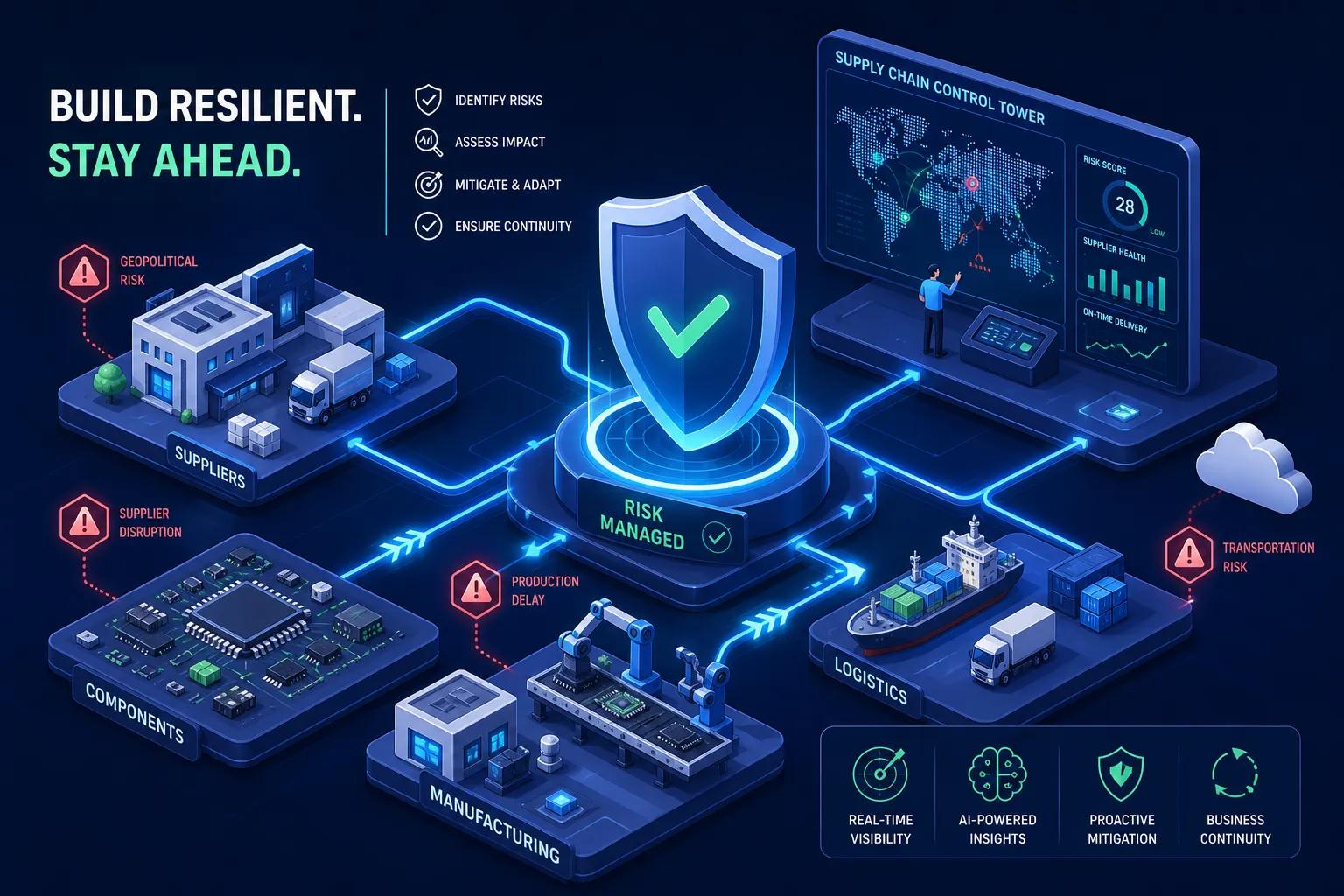
Electronics supply chain risk management strategies for 2026 require treating concurrent structural disruptions as design-time problems, not procurement reactions. Export controls on advanced semiconductors, an acute DRAM shortage with projected 50% price spikes by mid-year, and rolling tariff escalations are not unfolding in sequence. They are operating simultaneously, hitting the same BOM, the same suppliers, and the same production schedules at once. This is not a harder version of 2020. It is a structurally different problem.
Most procurement and operations teams are still running reactive sourcing models built for disruptions that were temporary, isolated, and recoverable with a spot buy. That model doesn’t hold when the disruptions are concurrent and structural. A handful of contract manufacturers, Amtech among them, have already built proactive supply chain risk management directly into their production model, which means the choice of manufacturing partner is itself a risk-mitigation decision, not just a cost negotiation.
This playbook outlines electronics supply chain risk management strategies 2026 teams should adopt: how to identify the highest-impact risks, where to focus mitigation effort for the strongest return, which visibility tools solve which problems, and how to execute a 90-day resilience plan with measurable deliverables.
What’s actually threatening electronics supply chains in 2026
Four risk categories carry the highest operational impact right now. The first is geopolitical fragmentation and export controls: U.S.-China restrictions on EUV lithography tools, selective licensing of AI chips, and the December 2024 Chinese export ban on gallium, germanium, and antimony. The practical translation is not a news headline; it’s a sourcing block. Parts or materials you could buy last quarter may require licensing, sourcing substitution, or outright redesign today.
The second category is memory and semiconductor constraints. S&P Global has flagged an acute DRAM shortage with price spike projections reaching 50% by mid-2026. This is not broad market scarcity; it’s targeted, hitting specific memory grades and AI-adjacent components hardest. For electronics manufacturers, that means production stoppages on specific product lines, not a general slowdown.
The third category is component end-of-life obsolescence, which forces redesigns and last-time-buy decisions under time pressure. The fourth is demand volatility driven by compressed product cycles, which breaks forecast assumptions and leaves procurement teams holding the wrong inventory at the wrong time.
Traditional reactive sourcing models treat each disruption as temporary. In 2026, these four categories are concurrent and structural. Risk management has to move upstream: into design, AVL development, and manufacturing partner selection. Procurement firefighting alone won’t close the gap.
Mapping your tariff exposure before it maps you
Semiconductors classified under HTS headings 8541 and 8542 moved from 25% to 50% Section 301 tariff on January 1, 2025. McKinsey research on advanced-industries manufacturers puts 10, 20% of COGS at risk from current trade policy, with 5, 15% of that addressable through a restructured sourcing network. Those numbers only become actionable when the analysis happens at the BOM level, not the supplier level. You need HS code classification, country-of-origin verification, and Section 301 status, which governs additional duties on Chinese-origin goods, for each critical line item, not an aggregate vendor assessment.
Once you have that map, the most practical mitigation tool is a tariff-mitigating Approved Vendor List. The concept is straightforward: qualify domestic or allied-nation alternates before a tariff event forces a panic switch. Cross-reference your current AVL against country-of-origin data, identify single-region concentrations, and pre-qualify alternates with engineering sign-off before you need them. This is a design-time and procurement-time activity, not an operational reaction. It is also distinct from dual sourcing, the focus is on building geographic flexibility into the supply base, not just adding a second vendor in the same region.
Geopolitical sourcing dependencies: where concentration risk hides
Most procurement teams map Tier 1 suppliers with reasonable diligence. Most stop there. The actual failure point across many 2024, 2026 disruption events has been at Tier 2 and Tier 3: a single substrate supplier in Japan, a single packaging house in Taiwan, a single test site concentrated in one country. When that node fails, the Tier 1 supplier fails too, regardless of how well-diversified the Tier 1 base looks on paper.
Extending supplier mapping to critical sub-tiers is not optional at this point. Start with your top 20% of spend and highest-criticality components. Map each to its manufacturing site, packaging and test location, and primary sub-tier inputs. Platforms like Z2Data and Resilinc are built specifically for this kind of multi-tier mapping on electronics programs.
Nearshoring and reshoring are worth addressing here because they are often framed as a political preference when they are actually a risk-adjusted sourcing decision. McKinsey’s 2023 fulfillment redesign case study on multi-continent sourcing reported 30% fewer stockouts and 20% lower emergency logistics costs. Shorter lead times, better demand signal transmission, and reduced customs exposure are measurable outcomes. Regionalization works best when product value density and logistics sensitivity justify the shift. It is not a universal answer, but it is consistently underused by OEMs that have not yet run the math on their specific product lines.
Electronics supply chain risk management strategies: mitigation with the strongest ROI
Dual sourcing has the strongest risk-adjusted ROI of any single mitigation lever, with evidence that network rewiring can reduce systemic supply chain risk by 16, 50%. The starting model is “supplier + 1”: for each high-criticality, single-source component, qualify a second approved source before you need it.
Dual sourcing: execution checklist
Prioritize by criticality, single-source flag, and lead time. That intersection, high criticality, single source, long lead time, is where a disruption becomes a line-down event. For each flagged component, confirm engineering equivalency, run qualification testing in parallel with production, and document approval before the primary source experiences stress. Don’t wait for the crisis to start the paperwork.
Inventory buffering: when to use it
Strategic inventory buffering complements dual sourcing; it does not replace it. Safety stock is most defensible for long-lead, single-source, or EOL-risk components with a defined restocking cadence. The ROI on buffering weakens over a multi-year horizon because of carrying cost and obsolescence risk. Its value is speed: it absorbs the first impact of a disruption while alternate sourcing qualifications complete.
Flexible product design, engineering for component substitution, is the most underused mitigation in most hardware programs. When engineering and procurement collaborate early enough to build form-fit-function equivalents into the design, a part shortage becomes a sourcing decision rather than a redesign project. Most companies don’t reach that point until they’re already in crisis. EOL lifecycle planning follows the same logic: track last-time-buy windows against active BOM status, qualify alternates before the end-of-life date, and build contractual allocation priority into distributor relationships before availability tightens.
Supply chain visibility tools worth using in 2026
Transportation visibility tools, project44, FourKites, Shippeo, solve in-transit shipment monitoring and predictive ETA. They answer one question: where is my shipment and when will it arrive? Supplier risk intelligence platforms, Resilinc, Z2Data, solve upstream counterparty monitoring: factory disruptions, geopolitical events, financial distress at supplier sites, and multi-tier exposure mapped against your specific BOM.
For electronics manufacturers tracking component-level disruption, the supplier risk intelligence layer is what most teams are missing. Z2Data is built explicitly for electronics BOM and component risk mapping and covers over one billion components and one million suppliers. Resilinc adds continuous global event monitoring mapped to your specific supplier network. These are not substitutes for transportation visibility; they solve a different problem upstream.
Cyber supply-chain security: the risk hiding in your supplier network
One dimension that sits outside most AVL reviews is cyber supply-chain risk. Firmware compromise at a contract manufacturer, a ransomware event at a sub-tier packaging house, or inadequate IT security practices at a key component supplier can disrupt production just as effectively as a physical shortage. When evaluating supplier risk intelligence platforms, confirm that cyber incident monitoring is part of the event feed, not just factory closures and geopolitical alerts. For high-assurance programs, add supplier IT security posture to AVL qualification criteria alongside quality certifications and financial stability. This is increasingly a requirement in defense and medical electronics and is becoming standard practice in commercial programs as well.
Three features are worth paying for in any platform you evaluate: real-time event alerting mapped to your actual BOM and supplier network (not generic news feeds), multi-tier supplier mapping beyond Tier 1, and planning-integrated visibility that connects disruption alerts to inventory and production decisions. For companies already running SAP, Oracle, or Kinaxis, the planning-suite path keeps disruption alerts inside the ecosystem where they can drive actual replanning, rather than sitting in a separate dashboard that nobody checks before the line stops.
90-day electronics supply chain risk management strategies (action plan)
The first four weeks are the risk audit. The deliverables are specific: a BOM-level tariff exposure analysis with HS code and country-of-origin flags, a single-source component list with lead-time data, sub-tier supplier mapping for the top 20% of spend, and an EOL status check against active BOM lines. This audit does not require new software. It requires structured cross-functional time between engineering, procurement, and operations, and a willingness to surface the concentrations most teams already suspect but haven’t documented.
Weeks five through twelve are sequenced action. Stand up dual-source qualifications for the highest-risk components first, using the criticality-by-lead-time-by-single-source-flag ranking from the audit. Initiate strategic inventory positions on long-lead and EOL-risk items. Begin AVL restructuring for tariff-exposed lines, prioritizing domestic and allied-nation qualifications. Track progress weekly against a short scorecard: open dual-source qualifications, inventory coverage on flagged components, AVL restructuring status, and tariff exposure reduction.
Design For Volatility, Amtech runs this framework as part of its standard production model, not as a consulting add-on. Tariff-mitigating AVL development, alternate sourcing qualification, component lifecycle planning, and proactive BOM risk reviews are built into the customer engagement from day one. The choice of manufacturing partner is a supply chain risk decision. Working with a contract manufacturer that monitors these risks continuously means resilience is embedded in production, not assembled after a disruption forces the issue.
Resilience is an operating discipline, not a project
The companies that will navigate 2026 supply chain conditions most effectively are not the ones with the best crisis response. They’re the ones that have moved risk management upstream, into design, into AVL development, into manufacturing partner selection, and into a continuous monitoring cadence that catches exposure before it becomes a line-down event.
The framework is clear: map your tariff, EOL, and geographic concentration exposure at the BOM level; apply mitigation in priority order starting with dual sourcing and AVL restructuring; instrument with the right visibility tools for both transportation and supplier risk intelligence; and execute in a structured 90-day cycle with measurable deliverables and weekly reviews.
Amtech’s engineering depth, alternate sourcing infrastructure, and Design For Volatility, Amtech program mean you get a partner that’s already tracking your component risk profile before you have to ask. Read Electronics Sourcing Risk: A Playbook for Procurement Teams, Amtech and Supply chain resilience strategies for electronics OEMs, Amtech for more on program-level risk management.
Contact the Amtech team to run a BOM-level risk assessment against your current program and build a production-ready resilience plan.