
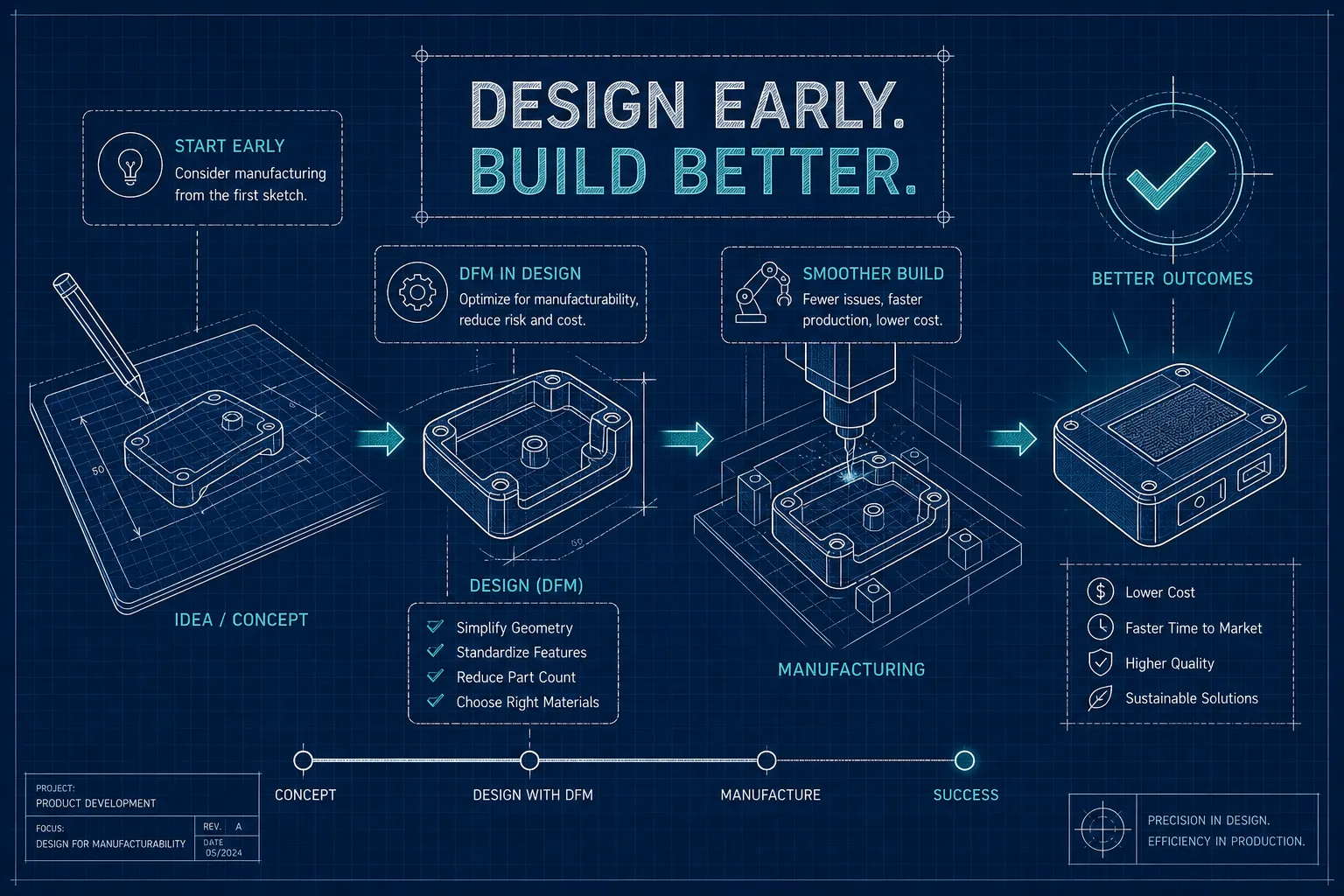
You know the feeling. The CAD looked immaculate, the BOM cleared procurement, and the prototype even powered on. Then the first SMT run hit a wall: bridges on the QFN, warped panels, a hand-solder loop to fix a connector that never should have been hand-soldered. That gap between elegant design and repeatable production is where schedules and margins go to lose altitude, often because design for manufacturability wasn’t considered early enough.
Design for manufacturability is the discipline that closes the gap. It aligns geometry, tolerances, materials, and component choices with the real capabilities of fabrication, assembly, and test. At Amtech, we integrate DFM and DFA collaboration from day one, not as a late gate. In this article, we define what DFM means in electronics, when timing matters most, what it costs to ignore, and the practical rules that keep a line running clean.
What design for manufacturability actually means in electronics
The gap between a clean schematic and a buildable board
DFM is not code for dumbing down a design. It is the practice of shaping decisions to what your processes can execute repeatedly and economically. A board that simulates correctly and looks tidy in your EDA tool can still suffer low yield if pad spacing is below real solder mask capability, if annular rings are marginal, or if component courtyards overlap so rework is impossible.
Manufacturability analysis brings production physics into design conversations. It translates “works on my bench” into “works at scale” by checking trace and space against fab limits, balancing copper to control warp, validating land patterns against the actual package, and confirming that test points, fiducials, and orientation marks exist. The win is simple: fewer surprises on the first article, faster ramp, and lower total cost.
DFM vs. DFA: related but not the same
Design for Manufacturing focuses on how parts are made. In electronics, that means PCB fabrication rules, drill and plating limits, resin choices, tolerance capability, and process windows for soldering. Design for Assembly focuses on how parts come together: part count, placement access, joint types, fasteners, handling, and AOI coverage.
You evaluate them together because they are coupled. A footprint that fabricates easily but is hard to place and reflow is still a yield problem. A molded boss that forms cleanly but requires a contortionist to install a standoff in a box build is an assembly problem that lands on your cost of goods. Think of DFMA as a single review with two lenses: make and assemble.
Where design for manufacturability decisions carry the most weight in your product lifecycle
The design phase: highest leverage, lowest fix cost
The rule of ten holds in electronics. Catch a manufacturability issue in design and it costs one unit to fix; catch it in pilot and it is roughly ten; find it after release and you are eating a hundred. That multiplier is not superstition; it reflects tooling already cut, vendors already engaged, fixtures already built, and regulatory paperwork already filed.
Walk the lifecycle quickly. In concept and schematic, you can still change packages, materials, and stackups with minimal disruption. In detailed design, you can tune spacing, pad geometry, and test access. In prototype, the cost of changes rises because fixtures and documentation chase the design. By pre-production and volume, changes ripple across supply commitments, factory work instructions, and qualification testing. Moving design for manufacturability earlier typically reduces later schedule risk and rework.
Prototyping is not a DFM safety net
Prototypes often hide the very problems that will stop a line. Hand assembly can nurse a marginal footprint through reflow. Substituted passives can mask placement issues. Relaxed stencil and mask specs can keep paste from bridging, until you tighten to production rules and the defect rate spikes.
When that same design meets pick-and-place feeders, reflow profiles, and AOI requirements, weak DFM choices show up as scrap and rework. Run a DFM/DFA review before you build the first prototype. Validate footprints against IPC and the component datasheet, confirm solder mask web widths, place fiducials, add test access, and check copper balance. Prototype to learn function; use design for manufacturability to protect production.
What skipping a DFM review actually costs
Rework rates, yield loss, and missed launch windows
Published DFMA case studies report double-digit improvements in cost, assembly labor, and cycle time when structured reviews are applied (see Boothroyd Dewhurst DFMA case studies and real-life DFM case studies). Representative results include total cost reductions of about 20 to 50 percent, with individual projects hitting around 40 percent lower assembly labor and up to 60 percent shorter cycle time after redesign (Boothroyd Dewhurst, DFMA case histories). A CNC bracket simplified from complex multi-setup milling to a 2.5D form cut cost by roughly 57 percent and cut lead time from three weeks to five days (manufacturer case example).
Sheet metal delivers similar results. One welded assembly consolidated into a single bent part eliminated welding entirely and dropped cost by about 68 percent (DFMA sheet metal example). In electronics, a board redesigned to follow IPC land patterns improved first-pass yield from roughly one in four to nearly nine in ten (IPC-aligned footprint redesign case). None of these wins required heroics. They came from fixing manufacturability before tooling and process were locked.
Where the losses actually come from
Losses are traceable to specific rules that were ignored. Solder bridges at reflow originate in pad geometry, stencil aperture ratios, or inadequate solder mask webs. Component clearance violations cause placement errors and AOI blind spots that lengthen cycle time and hide defects. Unbalanced copper distribution warps panels, which breaks registration and spikes scrap.
Late engineering change orders multiply the pain. Move a connector after fixtures are built and you buy a new fixture, new programming, and new training time. Swap a package after AVL approval and you reset sourcing, re-verify the stencil, and rerun process development. Skipping DFM is not a single miss. It is a cascade of compounding cost.
10 design for manufacturability guidelines that reduce cost, rework, and production delays
PCB design for manufacturability rules that prevent the most common yield problems
Start with the handful of checks that drive first-pass yield. Land patterns must match the package and IPC guidance, not a library you inherited. Trace width and clearance need to meet your fabricator’s capability and current carrying needs, not the EDA defaults. Drill rules matter: via aspect ratio, finished hole size, and annular ring must be manufacturable and reliable.
Solderability is where most SMT failures originate. Published industry sources (e.g., IPC-7525 and SMTA/industry defect analyses) often attribute the majority of SMT assembly defects to solder paste printing, frequently cited in the 60, 90 percent range, so stencil aperture design, pad geometry, and solder mask expansion are first-order. Add thermal relief for pads tied to large copper to avoid cold joints. Place global and local fiducials, keep silkscreen off pads, and reserve test points so you can diagnose quickly instead of guessing at escapes. For a concise, practical checklist aimed at PCB designers, see the ten essential DFM rules for PCB design.
Process-specific rules for molding, sheet metal, and machining
For injection-molded housings (injection molding DFM), use uniform wall thickness to control sink and warp, add draft to every vertical face so parts eject cleanly, and size ribs at about 50 to 60 percent of the wall to add stiffness without printing through. Place gates, parting lines, and ejectors where they will not ruin cosmetics or critical tolerances. Pick resin early, since viscosity and shrink drive both fill and tolerance reality.
For sheet metal, design with constant gauge, use bend radii your brake can form consistently, and add bend reliefs so edges do not tear. Keep holes and cutouts away from bend lines to avoid distortion, and select standard gauges and hardware to avoid special tooling.
For machined parts, avoid deep narrow pockets and knife edges, add generous internal radii because cutters are round, and minimize setup count because every flip adds time and error stack. These are manufacturability optimization moves that speed cycle time without compromising function.
The tolerance and standardization rules most designs get wrong
Tight tolerances are a tax you pay on every part, every shift. Apply them only where function demands it and specify the widest acceptable tolerance everywhere else. Pair that with standardization. Use standard drill and thread sizes, common fasteners, standard PCB via sizes, and preferred component footprints to compress cost and lead time instantly.
Finally, prioritize fixes by ROI, not by the loudest complaint. Rank issues by severity to production, frequency of occurrence, and ease of change. The fastest wins often come from relaxing noncritical tolerances, consolidating parts, or correcting a few high-risk footprints. Spend engineering time where it cuts the most rework per dollar and per week of schedule.
Design for manufacturability checklist
- Validate land patterns to IPC and the datasheet. Do not trust legacy libraries for new packages.
- Set trace/space to your fabricator’s rules. Avoid designing to the absolute minimum unless function requires it.
- Respect via drill, aspect ratio, and annular ring limits. Reliability starts with a drill that can be plated well.
- Control paste and mask. Use proper aperture ratios and ensure solder mask webs prevent bridging on fine pitch.
- Add thermal relief on pads tied to pours. Improve wetting and reduce cold joints at reflow.
- Design for assembly visibility. Place fiducials, mark polarity, and keep silkscreen off pads to support AOI and placement.
- Keep wall thickness uniform in molded parts and add draft. Use ribs at 50, 60 percent of the wall to add stiffness without sink.
- Use bend reliefs and hole-to-bend spacing in sheet metal. Choose standard gauges and hardware to cut cost.
- Machine with tool reality. Add internal radii, avoid deep narrow pockets, and minimize setup count.
- Right-size tolerances and standardize parts. Reserve tight specs for critical fits and prefer standard sizes everywhere else.
How Amtech closes the gap between engineering intent and production reality
DFM collaboration built into the engagement, not bolted on
At Amtech, we aim to integrate DFM and DFA into early engagements. Our product development support includes manufacturability analysis, DFA simplification, BOM risk and cost review, and production-readiness planning before a production purchase order is issued. That means your schematic and enclosure layout are cross-checked against SMT constraints, test access, and real supply options while changes are still low cost.
For startups and OEMs building in North America, this co-development model typically reduces prototype loops and streamlines required signoffs by addressing issues earlier. We also address obsolescence (EOL), tariff exposure, and alternate sourcing alongside geometry and process choices, so the design is not only buildable but more resilient.
What a DFM review looks like at the production stage
Our pre-production review is a working session, not a document dump. We align the PCB stackup to impedance targets, confirm copper balance and panelization, and verify placement for pick-and-place, reflow, and AOI access. We validate footprints, polarity, fiducials, and test points, then tie the BOM to supply reality with alternates identified and documented.
We plan fixtures and functional test early so coverage is built into the design, not bolted on later. Findings are prioritized by production risk and ROI, with specific edits, examples, and acceptance criteria. You leave the review with prioritized, actionable changes and clear next steps to improve first-pass yield. During pilot and volume builds, standard AOI, functional test, and traceability practices help maintain process discipline. For perspective on how quality-driven design can change outcomes, see The Deming Difference: How Quality Design Can Revolutionize Electronics Manufacturing, Amtech.
Conclusion
Design for manufacturability is a front-loaded investment that pays back across production. The earlier you apply it, the cheaper the changes and the cleaner the launch. The rule of ten favors early action, and the case studies make the point.
Use the ten rules here as a quick checklist, then zoom into the process-specific guidance for PCB, molding, sheet metal, and machining. If you want a partner that treats design for manufacturability as core practice, Why Design for Manufacturability (DFM) Can Save You Millions, Amtech is a good place to start; bring your design to Amtech before the schematic is locked, we will review footprints, stackups, and test access while changes are still inexpensive. For another Amtech perspective on the same topic, see Why Design for Manufacturability (DFM) Can Save You Millions, Amtech.
Design for manufacturability FAQ
When should you run a DFM review?
Run design for manufacturability reviews before the first prototype (at schematic/library freeze), again after initial bring-up, and once more before pilot. Early passes catch footprint, spacing, and test-access issues when changes are cheapest.
How does design for manufacturability reduce launch risk?
It prevents predictable yield killers (paste print, pad geometry, AOI coverage, copper balance) from surfacing late, which reduces rework, shortens debug, and stabilizes first-pass yield.
What’s the difference between DFM and DFA?
DFM focuses on how parts are made (fabrication limits, materials, tolerances); DFA focuses on how they’re assembled (part count, access, tooling, inspection). Reviewing both together (DFMA) avoids trade-offs that move defects from one stage to another. For an overview of DFMA principles, see Design for Manufacturing.