
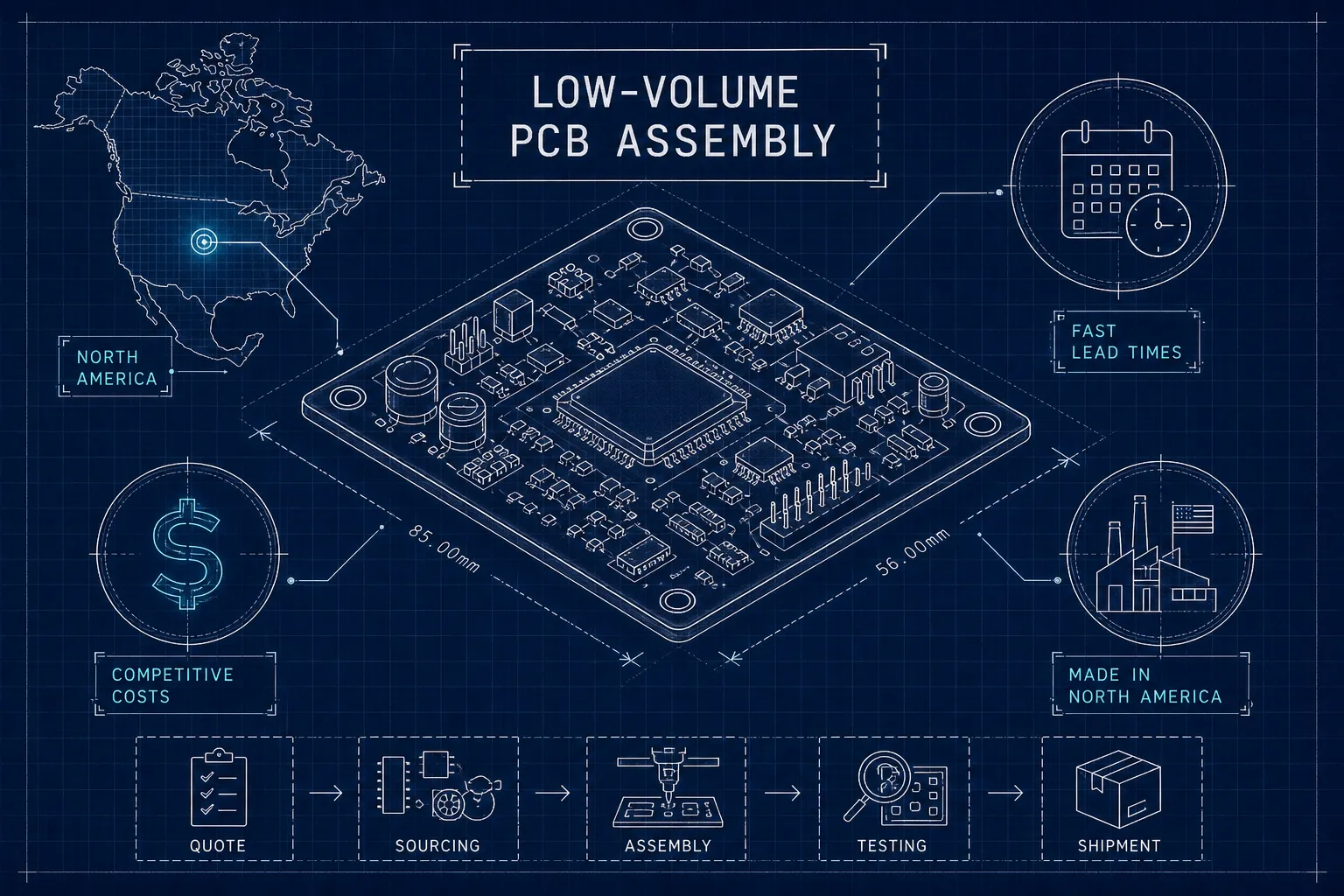
Getting honest, specific information about low volume PCB assembly services in North America is harder than it should be. Many sources emphasize offshore pricing that ignores tariffs and shipping risk, or they stay vague enough to be useless for actual budgeting. If you’re comparing low volume PCB assembly services in North America for a prototype build or short-run production program and you need real numbers, this guide has them.
What follows covers what small-batch PCB assembly in North America actually looks like in 2026: realistic MOQs, honest cost ranges by region and complexity, lead time breakdowns by sourcing model, and a clear framework for evaluating domestic partners. Providers like Amtech have built their low-volume PCBA services specifically around this gap, with integrated DFM support, supply chain management, and a direct path to scaled production without changing partners mid-program.
What “low-volume” actually means for North American assemblers
Most providers don’t share the same definition of low-volume, and that ambiguity creates real friction when you’re trying to budget or plan a build. For electronics assembly in North America, low-volume generally means production runs between 1 and 500 units. Within that range, most assemblers treat 1 to 10 units as prototype or first-article builds, and 11 to 500 units as small-batch or short-run production. The terminology matters because pricing structures, lead times, and setup fees differ significantly between these tiers.
U.S.-based assemblers often accept as few as 1 to 5 boards for prototype builds, though production-quality runs typically start at 5 to 25 units. Canadian assemblers align closely with U.S. thresholds. Mexican facilities often serve as nearshore options for slightly higher volumes, where 100 to 1,000 units is a more natural fit and labor cost savings become more meaningful. Below 100 units, setup fee structures across all three countries are often similar enough that regional pricing differences become secondary to design complexity and sourcing model.
There is also a cost-spike threshold that every small-run buyer hits: when your order size drops below the point where fixed setup fees get diluted, per-unit costs climb fast. NRE (non-recurring engineering) charges of $600 to $1,750 at standard U.S. contract manufacturers get spread across fewer boards, which is why a 5-unit run can cost dramatically more per board than a 50-unit run on an identical assembly. Understanding this dynamic before you budget is the difference between a realistic plan and a project that blows its cost target before the first board ships.
Low Volume PCB Assembly Services in North America: What to Expect to Pay in 2026
Pricing for low-volume PCBA in North America varies based on complexity, layer count, sourcing model, and provider overhead. For prototype builds of 1 to 10 units in the U.S., per-unit costs typically land between $50 and $250 per board for assembly labor alone, before component and PCB fabrication costs. At 10 to 100 units, that range drops to $15 to $80 per board. Canada runs 5 to 10 percent above U.S. rates on average, while Mexico can come in 10 to 20 percent below for small batches. Full turnkey pricing, where the assembler sources components and bare boards, will add to these figures based on your BOM (bill of materials).
Board complexity reshapes your budget significantly. A 2-layer SMT board at prototype quantity might cost $20 to $80 in assembly labor. A 4-layer mixed-technology design at the same quantity jumps to $80 to $150. An 8-layer or BGA-heavy design can exceed $150 per unit even at low volumes. Complexity doesn’t just affect assembly time; it drives longer setup, specialized equipment requirements, and higher first-article inspection overhead that pushes NRE fees toward the upper end of the range.
Most quotes you receive are for assembly labor only. Gerber files and a clean BOM get you a number, but the total program cost also includes PCB fabrication, component procurement with applicable markups, test fixture development, and any DFM review fees. Comparing quotes without accounting for these line items leads to budget surprises mid-project. A quote that looks 20 percent lower than a competitor’s may simply be excluding line items the other provider included. Ask every assembler to define exactly what their quote covers before you use it for budgeting.
Realistic lead times for prototype and short-run builds
Lead times in North American low-volume PCB assembly are directly tied to your sourcing model, design complexity, and how ready your files and parts are before the job starts. For consigned jobs, where you supply the components, assembly-only lead times run 1 to 5 working days in the U.S. for straightforward designs. Turnkey jobs, where the manufacturer sources everything, take 3 to 7 working days when parts are in stock. For simple 2-layer boards with available components, some U.S. shops can deliver in 24 to 72 hours. When BOM sourcing involves harder-to-find components, plan for 10 to 25 working days on a complete turnkey build.
Layer count has a direct impact on your schedule. A 2-layer consigned board can come off the line in 24 to 48 hours. A 6-layer to 8-layer consigned build takes 48 to 72 hours minimum. At 10-plus layers or with complex mixed technologies combining SMT and through-hole, plan for 5 to 7 working days even on a fast-track job. These timelines assume your Gerber files, BOM, and pick-and-place data are complete and correct before the job starts, which brings us to the most common cause of schedule slippage.
File readiness is one of the biggest sources of delay regardless of sourcing model. Incomplete BOM data, missing reference designators, or Gerber files that don’t match the physical parts add days before assembly even begins. DFM issues caught mid-job cause additional rework cycles. Providers that run a DFM review before accepting a job surface these problems early and keep your schedule intact. That review isn’t overhead; it’s schedule insurance on a program where every day of delay has a real cost.
Choosing Low Volume PCB Assembly Services in North America: Turnkey vs. Consignment
This is one of the most misunderstood cost decisions in low-volume PCB assembly. Turnkey providers mark up components by 8 to 15 percent, and that markup looks like lost money on a quote comparison. But that comparison ignores the 18 to 24 hours of internal procurement labor required to source, kit, and ship components for a consigned job versus 2 to 4 hours for the same quantity turnkey. It also ignores the impact of a single missing or incorrect part, which can trigger $500 or more in line downtime and rework charges.
The risk profile difference is especially important on prototype runs. Based on typical production outcomes at turnkey shops, consigned assemblies tend to show significantly higher first-article failure rates compared to turnkey builds, primarily because component-related issues such as footprint mismatches, wrong polarity, and substituted parts surface on the assembly floor rather than during pre-kitting validation. A turnkey manufacturer catches BOM errors during DFM review before the job starts. That difference is especially costly when each failed board takes days to diagnose and rework, and your timeline has no slack.
Consignment earns its place when you’re building more than 500 units, have a professional procurement team with established supplier relationships, and want to avoid the BOM markup at scale. For most prototype and small-batch programs below that threshold, the total cost of ownership, including time, risk, and administrative labor, favors turnkey. The 8 to 15 percent markup on components almost always costs less than the alternative.
Why domestic assembly beats offshore for low-volume programs
Offshore assembly can look attractive on a per-unit basis. For low-volume programs specifically, the math rarely holds up when you factor in the full cost of operating across long distances. In 2026, Section 301 tariffs on Chinese-origin components and assemblies add 35 to 40 percent to the goods value for most PCB programs, with semiconductor-heavy BOMs reaching 50 to 60 percent in combined duty rates. Domestic assembly shifts that exposure significantly. Beyond tariffs, domestic production can meaningfully reduce IP risk for early-stage designs, since North American manufacturers operate under U.S. contract law with stronger enforcement frameworks.
Prototype and small-run programs change. Designs get revised after first-article review. Components get swapped. Test specs evolve. Every one of those changes requires a communication loop with your assembler. Domestic providers in the same time zone typically enable faster revision cycles and fewer communication delays than offshore shops, where the same cycle can stretch considerably and introduce translation risk at every step. For a low-volume program on a tight timeline, that communication advantage often justifies the domestic premium.
The scaling argument for offshore centers on volume pricing at high quantities. But the transition cost from an offshore low-volume run to a domestic high-volume program is real. If your North American assembler handles both low-volume prototypes and scaled production, you avoid re-qualifying a new manufacturer, re-validating test fixtures, and rebuilding supply chain relationships from scratch. That continuity has measurable value on any product timeline. Amtech is structured around exactly this model: start at prototype, scale to production, and maintain a single manufacturing relationship throughout.
How to evaluate and shortlist a low-volume PCBA partner
Not every assembler that claims low-volume capability is set up to execute it well. IPC-A-610 compliance is the baseline for electronics assembly acceptability. Class 2 covers most commercial electronics where reliability is important but downtime is manageable. Class 3 is required for high-reliability, aerospace, and medical applications where failure is not an option. The technical differences are significant: Class 3 requires minimum 75 percent copper barrel fill versus 50 percent for Class 2, tighter annular ring tolerances, and cleanliness limits set at half the Class 2 threshold. A provider that can’t produce current IPC certification documentation is a risk regardless of their pricing.
Beyond IPC, look for ISO 9001 as a minimum quality management baseline. Programs with aerospace requirements should look for AS9100D. Medical-adjacent applications need ISO 13485. These certifications aren’t just paperwork; they indicate the quality management infrastructure needed to maintain consistency across small-batch runs where process discipline matters as much as equipment capability. A certified assembler has documented procedures for handling your boards; an uncertified one may not.
The difference between a commodity assembler and a real manufacturing partner shows up in DFM support. A partner worth working with reviews your design before quoting, flags issues that would cause failures or drive up cost, and suggests alternatives before the job starts. Amtech integrates DFM review and supply chain support directly into its low-volume PCB assembly process, meaning component risk, alternate sourcing, and BOM optimization are addressed before the first board is built. That integration is what separates a smooth prototype-to-production program from one that stalls at first article.
Before contacting any low-volume PCBA provider, have the following ready:
- Gerber files in RS-274X or ODB++ format, including all copper layers, paste layers, solder mask, and NC drill data
- A complete BOM with manufacturer part numbers, reference designators, quantities, and approved alternates
- A centroid (pick-and-place) file with X/Y coordinates, rotation, and board side for each SMT component
- An assembly drawing showing component orientation, special instructions, and any mechanical callouts
- Your target quantity for the initial run and anticipated production volume
- Test requirements including functional test specs, flying probe callouts, or AOI requirements if applicable
Providers who receive a complete package quote faster, more accurately, and with fewer surprises after work begins. Incomplete submissions are the leading cause of quote delays and mid-job cost changes at every assembler. Sending complete documentation the first time is also a signal to your potential partner that your program is well-managed and worth prioritizing.
Getting your low-volume PCB program right the first time
Low-volume PCB assembly services in North America represent a well-developed market in 2026, with real options across the U.S., Canada, and Mexico. The key is knowing what you’re comparing: MOQs that range from 1 to 500 units, per-unit costs that shift sharply with complexity and NRE fee structures, and lead times that depend heavily on sourcing model and file readiness. Domestic sourcing carries genuine advantages for small-run programs, particularly on communication speed, tariff exposure, supply chain visibility, and the ability to scale without changing partners.
When evaluating low volume PCB assembly services in North America, prioritize providers with verified certifications, integrated DFM review, and the supply chain infrastructure to handle component risk before it becomes your problem. That combination is where prototype programs succeed and where the path to scaled production stays smooth. Generic assemblers that treat every job as a commodity transaction won’t give you the engineering engagement that small-batch programs require.
Amtech works with hardware companies at exactly this stage: validated designs that need a manufacturing partner who can handle DFM, manage supply chain strategy, and execute a reliable build without requiring you to switch partners as your program scales. If you’re preparing an RFQ for a low-volume or prototype build, the place to start is a conversation, not a form. Reach out to the Amtech team with your design package and target volume, and the Amtech team will outline exactly what your program needs before quoting begins. Request a quote for low volume PCB assembly services in North America today and get a clear picture of what your build actually requires.