
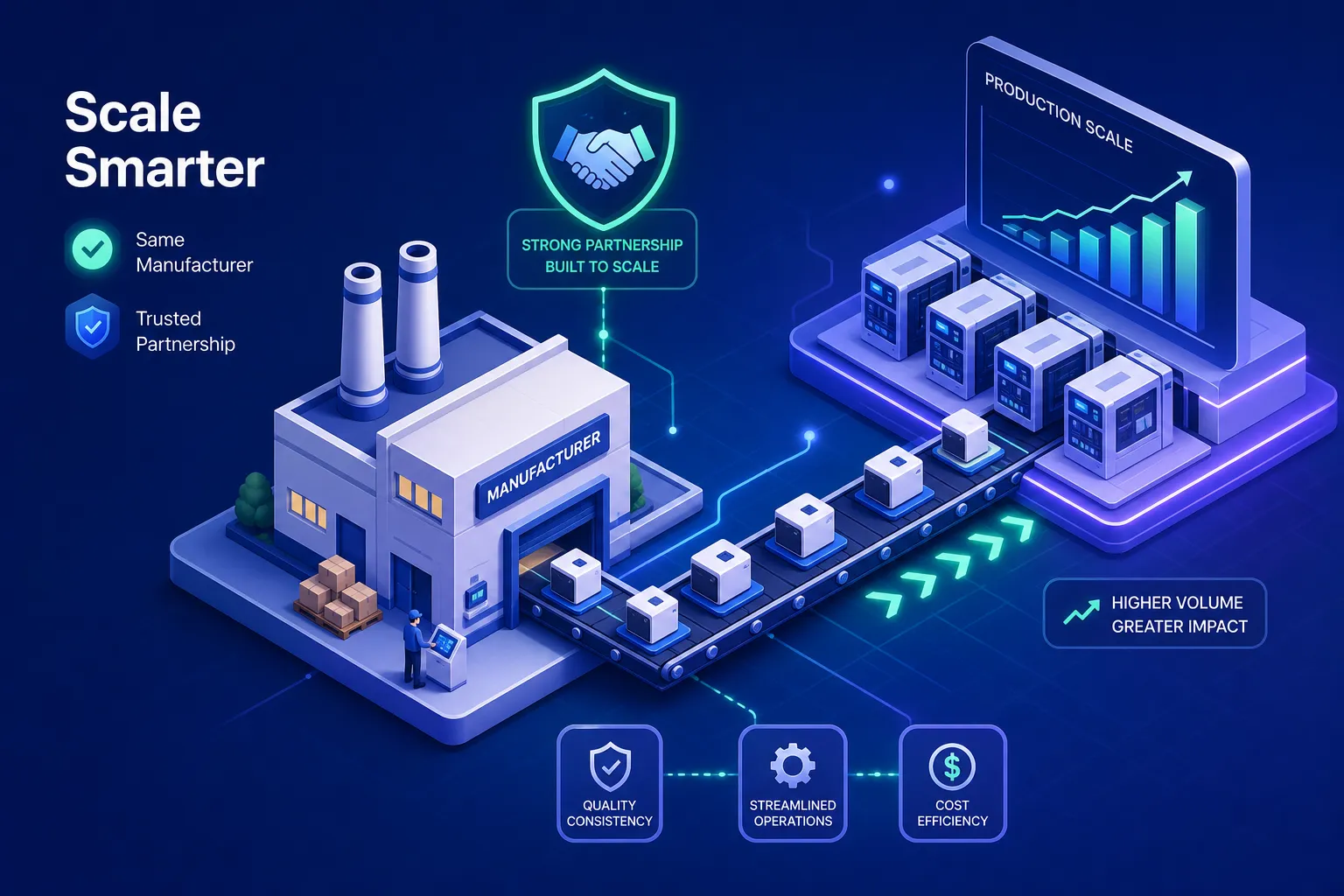
Your first real purchase order lands, and suddenly the prototype shop that built your validation units looks completely different. The process that worked fine at 50 units starts to look fragile at 5,000. The instinct most hardware teams have at that moment is to find a “real” manufacturer, a bigger facility, a more industrial-looking floor, a supplier that seems built for scale. That instinct is usually wrong, and acting on it typically costs more than the problem it was meant to solve.
Scaling prototype to production without switching manufacturers is cheaper, faster, and lower-risk than starting over with someone new, but only when you approach the transition with a clear framework. This article lays out that framework: how to measure your current manufacturer’s real capacity, what DFM work has to happen before tooling is cut, which quality gates cannot be skipped, and what a manufacturing partner who can go the full distance looks like before you actually need them to.
The Real Cost of Switching Manufacturers Mid-Lifecycle
When you switch manufacturers, you’re not just moving a bill of materials to a new facility. You’re abandoning everything that took time to build: process parameters tuned to your specific product, supplier relationships, custom fixtures, test setups, and the accumulated knowledge that keeps first-pass yield where it needs to be. None of that transfers in a spreadsheet.
The timeline hit is what most business cases omit. A new manufacturer onboarding cycle for a production-ready electronics product typically runs 12 to 20 weeks before first article approval, though complex transfers can stretch longer. Add PPAP documentation, FAI validation, supply chain requalification, and new tooling builds, and you’re looking at a four-to-six-month window before stable volume production resumes. That window rarely appears in the launch roadmap, but the revenue it delays always shows up in the financials.
First-pass yield drops when a new line runs your product for the first time. This isn’t pessimism; it’s a predictable outcome. At prototype stage, every part gets individual attention and individual correction. At volume, the process has to carry itself. When a new manufacturer encounters your product for the first time, they diagnose yield problems without the context your current partner spent months accumulating. In automotive contexts, requalification costs can regularly exceed 10% of annual program spend. In electronics, the combination of scrap, rework, expedited airfreight, and management time follows similar logic.
The compounding factor is that by the time a switch is under consideration, the design is typically locked. The DFM window has closed. A new manufacturer inherits a product they didn’t help design and cannot easily optimize, which limits what they can do to improve yield quickly. The better move is almost always to fix the relationship you have, not find a new one.
How to Assess Whether Your Current Manufacturer Can Scale With You
The first step in any ramp decision is an honest capacity assessment. Map every process step from incoming material through ship, identify the bottleneck workstation, and calculate maximum effective capacity adjusted for real-world OEE (Overall Equipment Effectiveness = Availability × Performance × Quality) and first-pass yield. A world-class facility runs at roughly 85% OEE; a typical manufacturing floor runs closer to 60%. If your supplier’s bottleneck capacity, adjusted for their actual OEE and yield, cannot cover your target annual volume divided by available productive hours, there is a gap that needs to be addressed before you commit to the ramp.
Volume magnifies every process weakness. Equipment maintenance status and workforce training stability determine whether the floor can run consistently. Quality management system rigor and supply chain integration determine whether problems get caught and corrected at scale. Management will give you a clean answer to each of these. The floor usually tells a different story. On-site verification and line-level interviews are where scaling problems actually get discovered. Ask production workers, not just operations managers, what their typical daily output looks like and where the line usually stops.
Before committing to a ramp, assess your supplier’s risk profile across three categories. Financial stability determines whether they can invest in the capacity upgrades your volume requires. Supply chain dependencies reveal whether they are dangerously concentrated on components critical to your BOM. On-time delivery history under demand spikes shows how they perform when things get difficult, not just when they’re routine. This assessment either gives you confidence to invest in the ramp together, or it surfaces specific gaps that need to be contractually addressed before production starts.
DFM Changes That Convert Prototype Parts Into Production-Ready Designs
Prototype geometry optimizes for function. Production geometry optimizes for process. These are not the same thing, and the gap between them is where most ramps lose yield.
For injection-molded parts, the most consequential changes involve wall thickness uniformity, draft angles on all vertical surfaces (minimum 1 to 3 degrees; 3 to 5 for textured surfaces), and internal corner radii at least 0.5 times wall thickness. Prototypes often carry variable wall sections and zero draft because flexible tooling could accommodate them. Hard production tooling cannot. For sheet metal, minimum bend radii, corner reliefs at bend intersections, and hole placement away from bend lines are non-negotiable at volume. For PCBs, thermal reliefs in copper pours, fiducials for AOI and robotic placement, and dedicated test points for ICT access all need to be present before the first production panel runs.
Tolerance Strategy for Production Scale
The tolerance problem is subtler but equally consequential. Prototypes pass with tight tolerances because every part gets individual attention. Production cannot sustain that. The shift you need to make is from prototype-achieved tolerances to process-based tolerances, using ISO 2768 general standards as your reference point for non-functional features. If non-functional cosmetic specs aren’t relaxed before the ramp, your manufacturer’s quality team will chase dimensions that don’t affect product performance while real process drift goes undetected.
The structural advantage of staying with the same manufacturer is that DFM review happens with context. They know your product’s history, which makes the conversation faster and more accurate than starting fresh with a supplier who has never seen the design. A new product introduction (NPI) checklist covering all DFM items should be completed before any production tooling is cut, not after.
Tooling Decisions That Define Your Production Economics
The soft-to-hard tooling breakpoint is where most production economics decisions get made. Below 5,000 units per year, soft tooling typically wins: laser cutting and press brake fixtures carry minimal NRE, and aluminum prototype molds, while they do carry upfront tooling costs in the range of $4,000 to $15,000, offer far greater design flexibility than hard tooling. Between 5,000 and 20,000 units per year, the right choice depends on design stability and part complexity. Above 20,000 units per year, hard tooling almost always wins despite $20,000 to $200,000+ NRE investment, because per-part cost drops 60 to 90% compared to soft tooling alternatives.
Upgrade Costs vs. Switching Manufacturers: Running the Numbers Honestly
Comparing upgrade costs against switching to a new partner is an analysis most teams don’t run honestly. Minor CNC fixture tweaks run $500 to $3,000. Re-machining an injection mold cavity runs $2,000 to $20,000. A full hard tooling die for sheet metal hits $20,000 to $200,000+. These are real costs, but they are often lower than the combined cost of switching manufacturers and rebuilding all qualification from scratch. Multi-cavity tooling adds 30 to 50% to initial tooling cost but dramatically reduces cycle time; at roughly 100,000 parts per year, the economics clearly favor that investment. This is a conversation to have with your existing manufacturer, not a reason to find a new one.
Design must be locked before any hard tooling investment. Production tooling modifications are expensive and slow. If the design is still in flux, neither you nor your manufacturer should be committing to hard tooling. A short DFM freeze review before any tooling commitment protects both parties and keeps the ramp timeline predictable.
Quality Gates That Protect Your Production Ramp
The gate sequence that matters is FAI first, then PPAP, then process capability validation, then steady-state production controls. First Article Inspection validates that tooling produces parts within all critical dimensions before any volume runs. PPAP compiles the full evidence package: FAI reports, PFMEA with RPN closures, a Control Plan, and material certifications. This package is what unlocks mass production, and it requires data, not opinions, at every element.
Process Capability and Pilot Run Standards
Process capability studies run on all critical dimensions using Cp/Cpk targets of 1.33 or higher. If a critical dimension doesn’t hit that threshold during the pilot build, the process isn’t ready for volume regardless of what the schedule says. The pilot run gate should also require first-pass yield of 90% or higher before proceeding, with the top three failure modes documented and closed.
In-process quality controls during the ramp monitor key assembly steps, SMT placement accuracy, solder joint quality, and reflow profile stability to catch drift before it becomes scrap. AOI and SPC data from these checkpoints serve as the early warning system. The first two production shipments should run under enhanced inspection protocols before relaxing to steady-state AQL levels. That data either confirms the process is stable or surfaces problems early enough to fix them without a major quality event.
The documentation stack supporting all of this includes a Control Plan tied to each inspection point, SOPs at every station with signed training records, and full traceability linking incoming lot numbers to shipped batch numbers. Good documentation makes it possible for your manufacturer to defend quality decisions, and for you to trust the product going out the door.
What a Manufacturing Partner Built for the Full Journey Actually Looks Like
Most contract manufacturing relationships are transactional. The customer brings a design; the manufacturer builds it. This works for simple, stable products. It breaks down when the product needs to evolve, when volumes shift, or when supply chain disruptions require fast pivots. The cost of that transactional structure shows up most clearly at the prototype-to-production transition, when everything needs to change at once and the manufacturer has no context to help navigate it.
Amtech’s engagement model is structured around a single continuous relationship rather than a series of handoffs between suppliers. Early-stage work covers co-development, DFM reviews, and production readiness planning. Design iteration, supply chain strategy, and component risk management happen alongside your engineering team, not independently of it. Volume manufacturing then executes with the full context of everything built in earlier phases. Because the relationship is continuous, scaling prototype to production without switching manufacturers isn’t a workaround; it’s how the model is designed to work.
When evaluating any manufacturing partner for long-term scalability, the criteria are specific. Do they offer DFM support before tooling is cut? Do they have capacity visibility tools that let you plan a production ramp-up with your incumbent supplier 12 or more months out? Do they have a formal NPI process that bridges prototype and production quality systems? The companies that avoid the mid-scale manufacturer switch aren’t lucky. They made a deliberate partner decision early and held to it.
Build the Ramp Before You Need It
The real risk in scaling prototype to production isn’t staying with your current partner. It’s not having the right framework to evaluate whether they can make the journey with you, and not starting that evaluation until the purchase order is already in hand.
The action sequence is straightforward. Assess your manufacturer’s capacity using OEE-adjusted numbers, not their quoted maximums. Complete the DFM review before any tooling investment and lock the design before committing to hard tooling. Run the quality gates in sequence with data at every checkpoint. Negotiate capacity commitments that reflect your full ramp volume, not just your first order. Hold your partner accountable to the data, not the relationship.
Scaling prototype to production without switching manufacturers is achievable for most hardware programs, provided the right assessment, DFM, and quality gate work happens before the ramp, not during it. If you’re planning a production ramp and want to know whether your current setup can support it, or want to start a product relationship with a partner built to go the full distance, reach out to Amtech. The framework is proven. The variable is whether it gets applied before the purchase order lands, or after.