
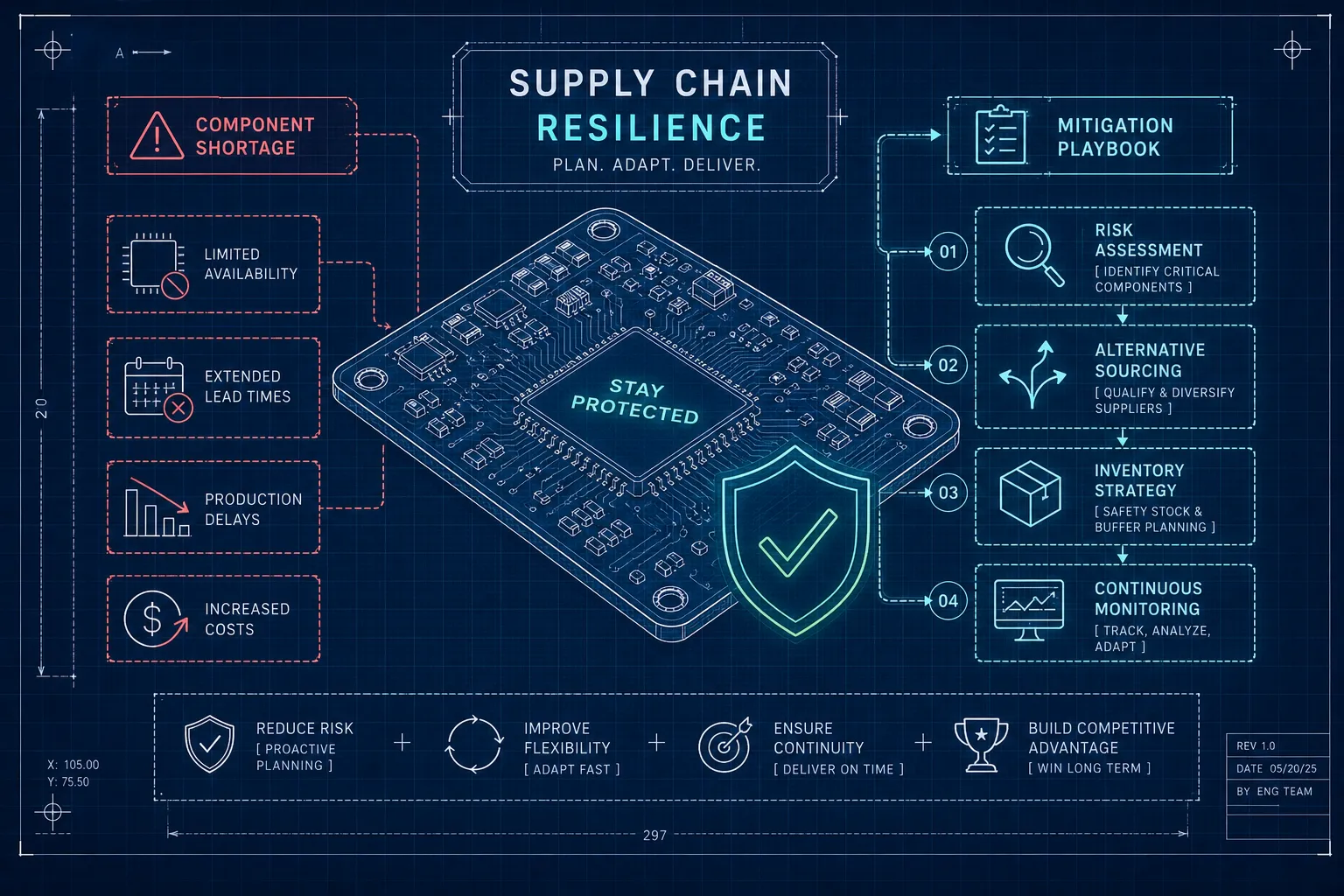
Component shortage mitigation for PCB manufacturers is not optional in 2026, it’s a baseline operating requirement. Memory ICs (DDR4/DDR5, eMMC, and HBM) are running 39 to 55 week lead times, according to distributor lead-time guides and component intelligence platforms including Z2Data and SiliconExpert. Automotive MCUs from STMicro and Infineon are sitting at 52 to 55 weeks per current distributor allocation notices. High-reliability MLCCs at major distributors are averaging 18 to 24 weeks, with some automotive-grade categories running longer. These aren’t echoes of the 2020 panic. They’re the 2026 reality, and they’re hitting automotive, industrial, and AI-adjacent BOMs hardest.
The manufacturers who get hurt in this environment are the ones treating component risk as a purchasing problem to solve when it surfaces. By that point, the options narrow to gray-market parts, forced redesigns, or a production line sitting idle, outcomes that are consistently documented in industry cost studies. The manufacturers who stay protected have built shortage mitigation into how they operate, long before a constrained part number reaches the floor. A contract manufacturer like Amtech takes that logic further, embedding component shortage mitigation for PCB manufacturers directly into standard program workflow so the risk doesn’t fall back on the customer at the worst possible moment.
This article gives you a practical three-part framework: build a governed, multi-source approved vendor list before you need it; identify and buffer your top 10 to 20 high-risk BOM lines; and monitor availability and lifecycle status continuously so EOL and allocation events surface early. Each section covers the specific tactics, tools, and governance structures that separate a proactive program from a reactive one.
Why 2026 component constraints are different from the last cycle
The 2020 to 2022 shortage was broad and global. Virtually every component family was affected, which meant purchasing teams across the industry ran full-BOM risk reviews as a matter of survival. The 2026 environment is structurally different: constraints are selective, concentrated in specific component families, and driven by forces that prior shortage playbooks didn’t account for.
Three dynamics are creating the current pressure. AI data-center buildout has redirected wafer capacity toward HBM3E, HBM4, and enterprise DRAM, placing HBM on allocation-only status for the year and pushing DDR4 and eMMC toward scarcity as fabs retire mature-node production lines. Raw material spikes, particularly gallium prices up more than 100% based on commodity market data, are driving 10 to 30 percent price increases across power semiconductors, passives, and MLCCs, a trend discussed in recent analyses of electronic component cost increases in 2026. And mature-node retirement is accelerating faster than redesign cycles can absorb, forcing firmware migrations and second-source qualifications on MCU and analog families that product teams assumed were stable.
The component families carrying the most risk right now
Memory ICs, DDR4/DDR5, eMMC, and HBM, are running 39 to 55 week lead times, with legacy automotive-grade memory reaching 70 weeks in some cases. Automotive MCUs from STMicro and Infineon are sitting at 52 to 55 weeks per current distributor allocation data. Power semiconductors and SiC devices fall in the 25 to 40 week range. High-reliability and automotive-grade MLCCs are averaging 18 to 24 weeks at major distributors, with some categories running longer, see recent capacitor lead times reports for category-level detail. If your BOM includes any of these families, the clock is already running.
What makes this cycle harder to manage than 2020 to 2022
The selective nature of 2026 shortages is exactly what makes them dangerous. Because the shortage isn’t everywhere, many purchasing teams aren’t running mitigation across the full BOM. They discover the risk only when a specific part number disappears from distributor stock, by which point the lead time to qualify an alternate or build buffer inventory has already passed. Selective, SKU-level scarcity requires component-level monitoring, not category-level awareness. That’s a fundamentally different operating discipline than what most manufacturers built during the last cycle.
The real cost of getting caught without a component shortage mitigation plan
The financial case for building a mitigation system is concrete once you look at the published data. Flip Electronics puts forced PCB redesigns at $50,000 to $250,000 per change event for typical programs. For complex aerospace, defense, and automotive assemblies, that ceiling climbs above $250,000. When engineering time, re-prototyping, re-testing, and production delay costs are factored in, Z2Data case studies show totals ranging from $135,000 to over $930,000 for a single obsolescence event. Across program complexity levels, Flip Electronics and Z2Data cite a range as wide as $20,000 to $1.8 million. Industry write-ups that break down the cost of forced redesigns and component shortages provide helpful context for these ranges, for example, see this analysis on PCB redesign and component shortage cost. What drives costs to the high end is discovering the constrained or obsolete component late, after the design is frozen and validation cycles are underway.
How a single constrained part stops a production program
PCBA is a system. You can have 99 percent of your BOM available and still face a line-down event because one allocation-only MCU or a single constrained memory device is missing. The math changes when you frame it as a binary outcome: either the board builds or it doesn’t. Investing in a proactive AVL and buffer-stocking strategy for your top 10 to 15 high-risk BOM lines typically costs a fraction of one forced redesign or one week of production downtime when measured against the redesign cost ranges cited above. The question isn’t whether mitigation is worth the effort. It’s whether the cost of not doing it is acceptable.
How to implement component shortage mitigation for PCB manufacturers: building a multi-source AVL
Approved Vendor List (AVL) Strategy is only useful if it’s validated before you need it. The core discipline is treating alternates as controlled engineering objects, not informal backup options that procurement improvises under pressure.
How to qualify an approved alternate correctly
An alternate qualifies only when it meets form-fit-function equivalence. That means confirming electrical, mechanical, environmental, and regulatory equivalence separately for the intended application, each is a distinct engineering determination, not a single checkbox. Approved alternates should be preference-ranked, with rank 1 as the primary source and rank 2 and below as qualified fallbacks, so planning and procurement systems know which source to pull first without requiring an engineer to make a judgment call mid-shortage. Qualification evidence, test data, compliance records, or traceable prior usage history, must be tied to a specific part number, revision, and application scope.
Distinguish clearly between an alternate and a substitute. A true alternate is fully interchangeable across all configurations. A substitute is conditionally valid for specific BOM instances or product variants only. Govern each with different approval requirements and make those constraints explicit in the part master record so they can’t be applied outside their intended scope. For governance patterns and recommended practice on alternate parts on bills of materials, see this practical guide on alternate parts on bills of materials.
Governance and change control: why informal lists fail
Most alternate lists fail not because of poor technical judgment but because of poor governance. Alternates should be managed in PLM or PDM at the part master level, tied to revision control, and released through an engineering change order workflow. Effective-dating, approval authority tracking, and obsolescence handling must be built into the process from the start, not added as manual workarounds later. Planners or buyers accessing an alternate without engineering sign-off is a quality and traceability risk, not just a supply risk. Retired or superseded alternates should be formally closed out with a change record, not quietly deleted, so the audit trail stays intact.
Connecting your AVL to ERP and MRP systems
A qualified alternate list that lives only in PLM doesn’t help the production floor. Alternate BOM structures, alternative item groups, or production versions in ERP and MRP allow planning to automatically select the correct valid component based on availability, preference rank, and effectivity dates. This operational step is what converts a governance document into an active shortage-mitigation tool. Without it, the AVL is a reference document that gets ignored under pressure. For tactical-level measures that complement AVL governance, see the Component Shortage Strategy: 9 Tactics That Actually Work.
Buffer stocking and lead-time management for high-risk components
The AVL tells you what you can use. Buffer stocking ensures you have enough of it on hand when supplier lead times exceed your production planning horizon.
Which BOM lines actually need safety stock
Not every component warrants strategic inventory. Flag any component with a lead time above your planning horizon (commonly 12 to 16 weeks), any component with a single approved source, any component approaching end of life, and any automotive-grade or high-reliability component where second-source qualification is slow. For most programs, this narrows the high-risk list to 10 to 20 BOM lines. A practical starting formula for buffer quantity, aligned to the maximum-usage, maximum-lead-time method documented by ASCM, is: safety stock equals the maximum lead time minus the average lead time, multiplied by the average daily usage rate. For allocation-driven parts like memory ICs or automotive MCUs, this variant builds in extra protection against supplier delays compared to simpler average-based approaches.
Forecasting tools that flag component risk before it becomes a crisis
Leading manufacturers in 2026 are moving away from spreadsheet-driven MRP toward AI-based demand forecasting and inventory optimization platforms. Several tools have established track records in this space:
- Kinaxis RapidResponse, handles complex supply chains with real-time scenario planning
- ToolsGroup SO99+, performs well in intermittent-demand environments where standard averages underestimate exposure
- NetSuite Demand Planning, suits ERP-native users who want multi-location forecasting within a single data model
- Z2Data, SiliconExpert, and Luminovo, aggregate distributor stock levels, EOL notifications, and allocation status across multiple sources and surface alerts before they become production emergencies
The goal is an early warning system that gives you weeks or months of lead time, not days.
Real-time availability monitoring and BOM risk scoring
Monitoring closes the loop. A well-built AVL and a well-stocked safety inventory can still be eroded by slow EOL transitions and allocation changes if no one is watching the signals. This is where many otherwise-solid mitigation programs break down.
Setting up a component availability monitoring process
Real-time availability monitoring means tracking distributor stock levels, allocation status changes, lifecycle phase transitions from active to last-time-buy to EOL, and price movement for every flagged BOM line. Major distributors including Avnet and Arrow provide lifecycle and availability data through APIs and component intelligence integrations, refer to the Avnet lead-time guide for examples of distributor lead-time reporting. Z2Data, SiliconExpert, and similar component lifecycle management platforms aggregate this data across sources and send EOL alerts before they become scheduling problems. Many teams find that at least a quarterly BOM risk review cadence works well, scoring each flagged component line by lead time, source count, lifecycle phase, and price trajectory, though higher-risk programs may warrant monthly reviews.
Turning availability data into a BOM risk score
A BOM risk score gives planners and program managers a single number representing total supply chain exposure for a program. The scoring model weights each component line by lead time, number of approved sources, lifecycle status, and demand volatility, then flags any line above a defined threshold for immediate sourcing review. This converts a passive data stream into an actionable workflow. That distinction, between teams that react to shortages and teams that prevent them, is where the real competitive separation happens in 2026.
How Amtech builds component shortage mitigation into every customer program
Component shortage mitigation for PCB manufacturers is most effective when it’s part of the manufacturing contract, not a separate consulting engagement that customers manage on their own. Amtech’s approach operationalizes everything covered above at the CM level, so customers benefit without having to build and maintain a separate internal function.
Proactive AVL management as a standard production deliverable
At Amtech, AVL development isn’t a document handed off at project kickoff and filed away. It’s a living program asset managed through Amtech’s Design for Volatility program, which addresses component risk, tariff-mitigating alternate sourcing, and lifecycle planning as part of standard production workflow. Amtech develops multi-source AVLs for customer programs, monitors component availability throughout the program lifecycle, and flags EOL and allocation events before they affect the production schedule, built into the standard engagement from day one. This operational approach aligns with broader Electronics Supply Chain Risk Management: The 2026 Playbook thinking.
What this means for program risk and customer outcomes
When shortage mitigation is embedded at the CM level, production planners and supply chain managers receive qualified alternates, buffer stock recommendations, and BOM risk monitoring as part of the manufacturing partnership. The result is reduced program risk, fewer forced redesigns, and faster response when a shortage does appear, because the alternate qualification work was completed months earlier. For customers managing high-mix programs, navigating tariff-driven sourcing changes, or onshoring production from Asia, this structure is what separates a strategic manufacturing partner from a build-only vendor.
Build the system before you need it
The framework comes down to three disciplines: build a governed, preference-ranked multi-source AVL before a shortage hits; identify and buffer your top 10 to 20 high-risk BOM lines based on lead time, source count, and lifecycle status; and monitor availability and lifecycle transitions continuously so EOL and allocation events surface weeks or months before they reach the production schedule.
Component shortage mitigation isn’t a one-time project for manufacturers at any level of program complexity. It’s an operating discipline. The manufacturers who treat it that way protect their production schedules and avoid the $50,000-plus redesign events that consistently catch reactive teams off guard. The ones who treat it as a purchasing problem keep solving it at the worst possible time.
If you’re evaluating whether your current CM has this discipline built in, Amtech’s Design for Volatility program is a practical starting point. It’s structured for programs where discovering a constrained part after the line is down is not an acceptable outcome. Reach out to Amtech to see how shortage mitigation fits into your next program from day one.