
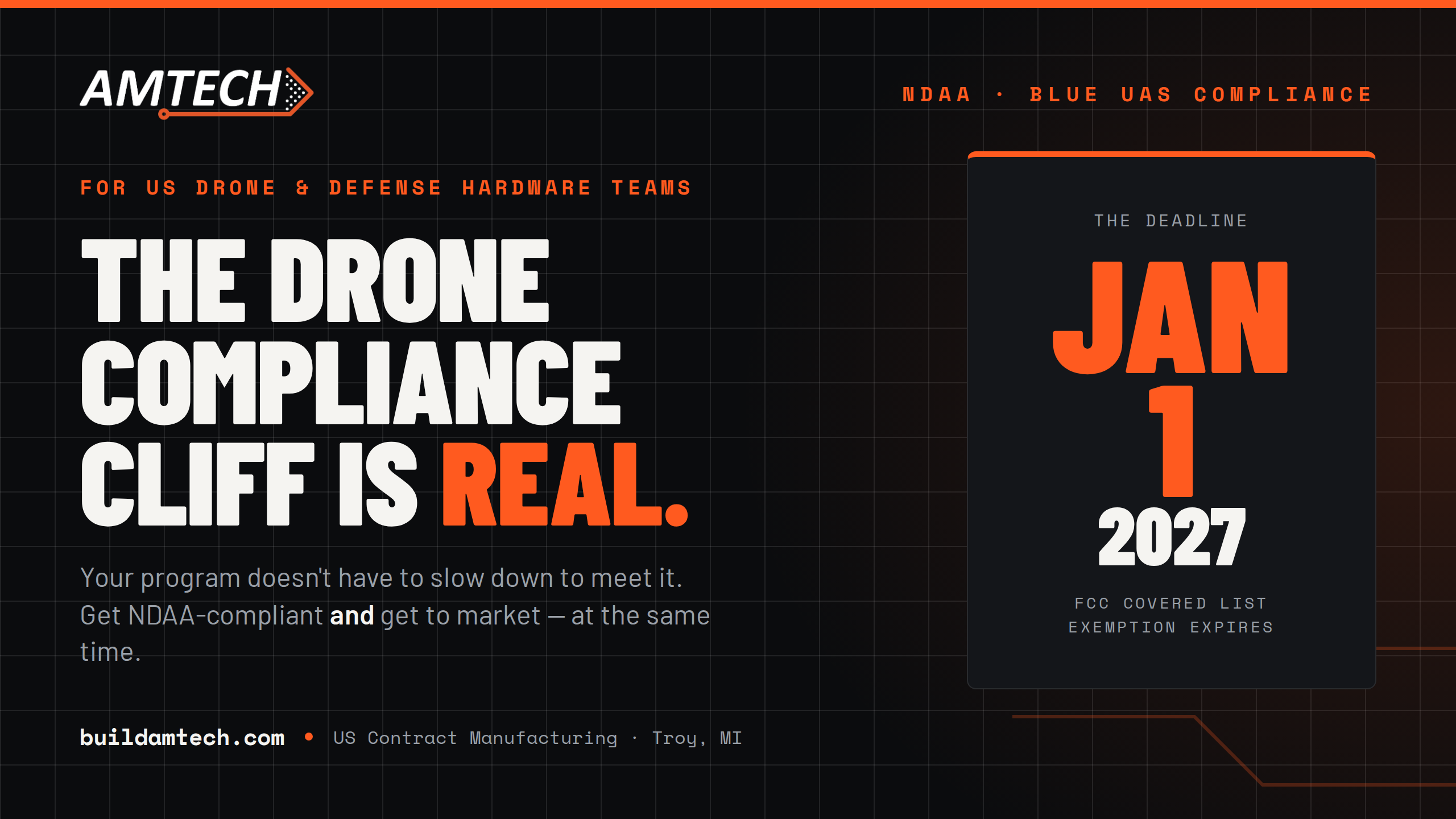
On January 1, 2027, the temporary exemption keeping foreign-made drones and critical components off the FCC Covered List expires. After that date, the Blue UAS carve-out is gone. If your flight controller, GNSS receiver, RF data link, or the carrier board they sit on traces back to a covered nation — China first among them — you’re locked out of defense, federal, and federally-funded buyers. Section 848 and the American Security Drone Act already pulled that trigger government-wide back in December 2025. The 2027 date is when the last temporary cover comes off.
For most teams building on ArduPilot, PX4, or Pixhawk, the instinct is to treat compliance as a tax — the thing that makes everything slower and more expensive. It doesn’t have to be. Compliance is a front-end engineering and supply-chain problem. Solve it where the board is designed instead of after it’s built, and you move faster than the teams still pretending the deadline isn’t coming.
Here’s how we do it at Amtech.
1. Don’t get disqualified by one line on your BOM — BOMsense
Country-of-origin is where compliance lives or dies. One covered-nation MLCC, a flight-controller IC pulled through a gray channel, a module with a supply chain you can’t verify — any single line can disqualify the whole platform.
BOMsense is our free, self-serve tool. Upload your BOM and it flags country-of-origin and supply-chain risk line by line, so you catch the covered-nation parts while they’re still cheap to swap — at the schematic, not after layout and first build. You manage COO on the way in, not in an audit on the way out. It flags tariff and sole-source exposure at the same time, so the part you design in is clean on every axis that matters.
2. Don’t let slow quotes stall your design — RapidRFQ
Every design spin that waits a week on a quote is a week you’re not in the field. RapidRFQ gives you instant online quoting on your assembly: upload, get real pricing back fast, change the design, re-quote. The quote loop stops being the bottleneck. You spend your time on the product instead of chasing a number — and a compliant alternate part is never more than a re-quote away.
3. It’s a land grab — don’t get there second — RapidNPI
The 2027 cliff isn’t only a compliance deadline — it’s a land grab. Timing is everything here, and right now this is a land grab, not a best-in-class contest. The teams that ship NDAA-grade hardware first will lock in the programs, the Blue UAS positions, and the buyer relationships before the field fills up — and once those spots are taken, the better product that shows up two quarters late has nowhere to land. First-mover advantage compounds in this market: get designed into a program early and you become very hard to displace.
Our RapidNPI approach compresses the path from prototype to production build so you reach the market while the window is wide open. The company that gets there first has the better odds of still being there a decade from now.
4. Don’t let process development derail your launch — Vapor Phase + AI-Enabled Manufacturing
Most contract manufacturers run a process-development cycle on every new board — tuning the reflow profile, dialing in the line, burning your schedule and budget before a single unit ships. We don’t.
Vapor phase reflow gives us an exceptionally wide process window. The physics cap the peak temperature, so complex, mixed-mass, high-reliability boards solder cleanly the first time without a custom profile. Pair that with AI-enabled inspection catching defects in-line, and you launch without the process-development detour standing between you and your first production run.
It matters even more once the drone leaves the bench. Vapor phase produces low-void, fully-wetted joints that survive the vibration, thermal cycling, and RF-dense environment your hardware lives in. The product launches clean — and it lasts in the field.
The window is open right now
The exemption closes January 1, 2027. The teams that win the next decade of US drone hardware are getting compliant and getting to market at the same time — not trading one for the other.
Amtech is a US contract manufacturer built for exactly this: NDAA-grade builds for the open-hardware ecosystem, ISO 9001 / 13485 quality, IPC-A-610 workmanship, and front-end engineering that designs the risk out before it reaches the line. You can dig deeper into our tooling and process in the Resource Center.
Start with your BOM. Run it through BOMsense to see where your compliance exposure sits, then get a RapidRFQ quote back the same week. The deadline is fixed. Your timeline doesn’t have to be.