
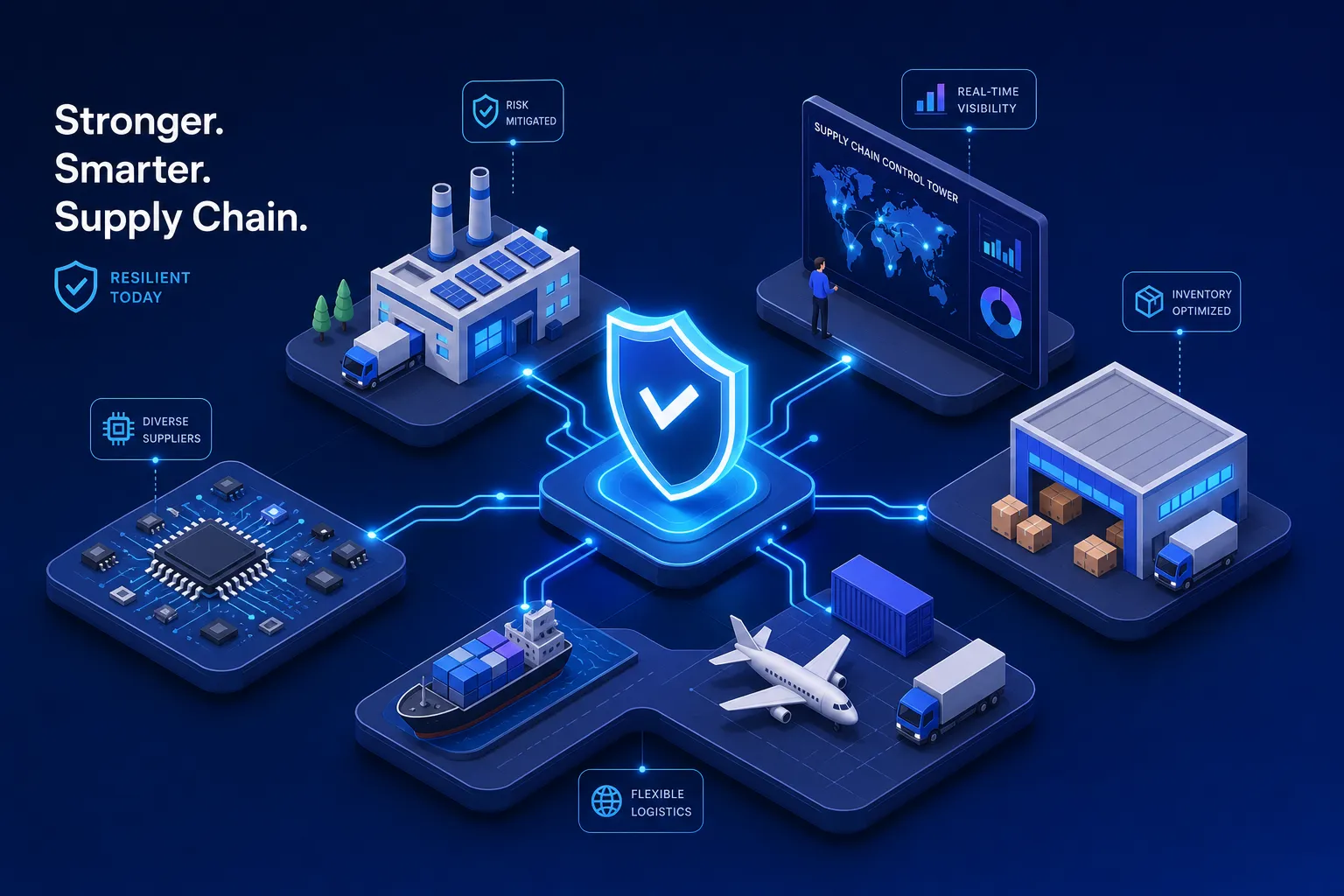
Supply chain resilience for electronics OEMs in 2026 is no longer a contingency plan you dust off after a crisis, it’s a design requirement. High-tech disruption incidents rose 42% year-over-year in 2024, with 13,945 recorded events recorded globally. The average disruption now costs manufacturers approximately $0.61 million per day. And 72% of trade professionals cite U.S. tariff volatility as the most impactful regulatory challenge they face, up from 41% the year prior, according to the Thomson Reuters Global Trade Report. While pinpointing exactly where 2026 ranks against every prior year requires multi-year index data still being compiled, the compounding of tariff shocks, geopolitical risk, and elevated lead times makes the current environment among the most demanding electronics OEMs have navigated in recent memory.
For OEMs and hardware companies, building a resilient supply chain is now a core engineering and operational discipline. Some manufacturers have moved beyond treating resilience as an add-on service and have embedded it directly into production and program management workflows, making supply chain continuity a structural feature of how programs are run, not a reactive response to disruption.
This article walks through exactly what resilience looks like for electronics manufacturers: multi-sourcing, AVL construction, lead time buffering, and lifecycle risk planning. The goal is to move your organization from reactive firefighting to a proactive posture before the next disruption hits your program.
Why electronics supply chains face a different kind of pressure
The semiconductor shortage of 2021 through 2023 exposed structural fragility that hasn’t fully resolved. Tariff shocks, geopolitical tensions, and climate-related logistics disruptions have layered on top of still-elevated lead times. Average production-material lead times in manufacturing hit 79 days in April 2024, well above the 65-day pre-pandemic norm, according to Deloitte’s industry reporting. Climate disruptions alone were up 33% year-over-year, and flood-related logistics alerts jumped 214%.
What makes electronics programs uniquely vulnerable is component interdependency. One missing passive component can halt an entire PCB assembly. Unlike retail or consumer goods supply chains, you can’t substitute or reformulate: the part either exists in the BOM or production stops. This concentration risk compounds when you factor in long commodity lead times, single-sourced components, and frequent EOL events in component catalogs. For more on why long and variable lead times are now the default operating condition for many OEMs, see Why Lead Time Volatility Is the New Normal (And What OEMs Must Do About It).
Resilience, practically defined, is the capacity to absorb disruption without halting production. It’s not about stockpiling every component in your warehouse or hoarding inventory. It’s about building systems that maintain supply chain continuity during supplier transitions and recover quickly when a disruption does hit. That distinction matters because the wrong definition leads to the wrong investments.
Supply chain resilience strategy #1: Multi-sourcing and AVL development
Most electronics programs inherit single-source components during the design phase. A particular part offered the best performance or price at the time, so it made the BOM. That decision becomes a liability the moment that supplier faces capacity constraints, geographic disruption, or tariff exposure. Section 301 duties have added up to 25% to covered semiconductors and other China-origin tech inputs, and 2025 tariff changes layered on additional pressure for certain imports.
Effective AVL development in 2026 means evaluating alternate components across geographic origin, lead time profile, and total landed cost under current tariff schedules. Shifting approved sources from China-origin to Taiwan, Vietnam, or domestic U.S. suppliers can reduce tariff-related cost exposure, though it’s worth noting that supplier qualification cycles often lengthen during origin transitions, which means this is a procurement and engineering effort that belongs at the design and pre-production stage, not during a shortage when options are limited and time is short. Embedding these considerations into product planning is a core tenet of Designing Electronics for Volatility, Not Stability.
An alternate source that hasn’t been qualified is not really an alternate source. A real AVL qualification covers form, fit, and function testing; BOM verification; and supplier financial and lead time vetting. It also requires engineering-controlled change management so that post-launch AVL updates don’t introduce reliability or compliance risk. The engineering discipline required to do this properly is what separates resilient programs from paper plans.
AVL verification steps and tariff-aware sourcing
Supply chain agility at the AVL level starts with a structured qualification workflow. Verify alternate components against the same performance and compliance criteria used for primary sources. Map each alternate’s country of origin against current tariff schedules before finalizing the AVL. And document lead time profiles for each qualified source so procurement can shift between them without triggering a new qualification cycle under pressure.
Supply chain resilience strategy #2: Lead time buffering and inventory strategy for volatile markets
Just-in-time was designed for predictable, short-lead-time environments. Electronics components, particularly microcontrollers, power management ICs, and specialty passives, regularly carry extended lead times. Microcontrollers averaged 10 to 26 weeks in 2025; analog ICs averaged 23 weeks in 2024. These figures reflect different reporting periods, but both confirm that ordering to current demand means ordering to yesterday’s reality.
The goal of buffering isn’t to warehouse every component in the BOM. It’s to identify the high-risk, long-lead-time components with limited alternate sources and build targeted safety stock specifically for those items. A practical approach ties buffer depth to three variables: lead time variability, alternate source availability, and the production impact of a shortage. Components that score poorly on all three warrant the deepest buffers. Statistical safety stock methods using service-level Z-scores and lead time variance provide a more accurate buffer target than a simple fixed-days rule; for a practical walkthrough of safety stock formulas and variations, see this safety stock formula guide.
Lead time buffering works best when it’s coordinated between the OEM and the contract manufacturer rather than managed in isolation. When the CM holds buffer inventory and actively monitors consumption rates against forecast, the OEM gets earlier warning signals and lower working capital exposure. This kind of shared supply chain visibility is a structural feature of resilient CM relationships. If your manufacturing partner isn’t part of that conversation, you’re missing half the picture.
Lifecycle and component risk planning for long-term program stability
EOL notices from component manufacturers don’t always arrive with enough lead time for an orderly redesign. A microcontroller or power management IC reaching EOL mid-production can force an expensive last-time-buy decision, a board redesign under pressure, or a full production halt. Programs that don’t track component lifecycle status proactively are one EOL notice away from a scramble that consumes engineering bandwidth and damages customer commitments. For practical guidance on managing obsolescence and lifecycle risk, read this piece on managing electronic component obsolescence.
DFM reviews aren’t just about reducing assembly cost. They’re also an opportunity to evaluate component selection against supply chain risk criteria: lead time profiles, single-source dependencies, geographic concentration, and lifecycle status. A proactive CM partner should be raising these flags during design review, not after the BOM is locked and in production. That’s where Amtech’s approach differs from the standard contract manufacturing model: supply chain risk analysis is part of the DFM conversation, not a separate engagement.
Long-running hardware programs require periodic supply chain health reviews, not just upfront risk assessment. As a program matures, components age, suppliers consolidate, and tariff environments shift. A lifecycle risk review cadence, roughly annual for stable programs and more frequent for complex or high-volume builds, keeps the AVL current, the buffer strategy aligned, and the redesign roadmap ahead of forced transitions. A four-stage process of forecast, detect, decide, and act gives engineering and procurement teams a repeatable framework rather than a reactive one.
How Amtech’s Design for Volatility program operationalizes resilience
Most contract manufacturers treat supply chain disruptions as the customer’s problem until production stops, at which point it becomes everyone’s problem. Amtech built its Design for Volatility program specifically to change that dynamic. The program embeds supply chain risk management into the pre-production and ongoing production workflow: AVL development, tariff-mitigating sourcing, and lead time buffer coordination are structured into the engagement from day one, with component lifecycle tracking running continuously across the program’s life.
In practical terms, Design for Volatility means a customer’s program is reviewed against current tariff schedules and component lead time data before production starts. Alternate sources are qualified during the DFM phase, not during a shortage. Buffer inventory thresholds are set based on BOM risk analysis rather than intuition. And when a component faces an EOL event or a supplier faces capacity issues, the customer receives an early alert with options already developed, not a last-minute problem dropped in their lap.
The distinction between a reactive CM and a resilient one is whether your manufacturing partner is watching your supply chain or waiting for you to report a problem. For OEMs managing complex, long-lifecycle programs, the value of proactive supply chain management compounds over time: fewer line stops, lower expedite costs, and more predictable program execution across every production cycle. That’s the operational reality of supply chain resilience when it’s built into the service model rather than bolted on as a crisis response. For broader industry perspectives on preparing organizations for the next major disruption, see this analysis on how to prepare your organization for the next supply chain disruption.
Measuring supply chain resilience: KPIs and recovery times
Fill rate and OTIF tell you how the supply chain performed after the fact. Resilience metrics need to measure risk exposure before the disruption hits. The most useful indicators for electronics programs are alternate source coverage, supplier lead time variability, component lifecycle risk score, and time-to-recover from past disruption events. According to Gartner’s Supply Chain Top 25 analysis, leading performers consistently achieve OTIF rates above 90%, but that metric alone won’t tell you whether your program is structurally protected against the next shortage. For corporate-level thinking about supply chain continuity and resilience practices, refer to industry resources such as Amazon’s discussion of supply chain resilience.
Building that measurement infrastructure doesn’t require a complete overhaul from day one. The first 90 days of a resilience program shouldn’t try to solve everything. Start with a BOM-level audit against three criteria:
- Single-source components with no qualified alternate
- Components with lead times over 20 weeks
- Components within three years of a published or projected EOL
That audit surfaces the highest-concentration risks across your program and gives procurement a prioritized action list for AVL development and buffer strategy. It also creates a baseline against which future resilience improvements can be measured objectively.
The electronics supply chain environment will continue to shift: new tariff pressures, new component generations, and new geopolitical variables arrive on a cycle that doesn’t align with your product roadmap. The manufacturers who build supply chain resiliency into their standard operating model, rather than treating it as a crisis response, protect margins and meet customer commitments regardless of what the market does next. Supply chain disruption response is faster and less costly when the infrastructure is already in place. Treat resilience as an ongoing operational discipline, and disruptions become manageable events rather than program-threatening crises.
Ready to build resilience into your program before the next disruption?
If your current CM isn’t proactively managing your AVL, tracking component lifecycle status, or coordinating buffer inventory with your forecast, you’re carrying risk that doesn’t need to be there. Amtech’s Design for Volatility program addresses all of these gaps within a single, integrated engagement model. Whether you’re launching a new product, reshoring production, or stabilizing an existing program, the conversation starts with your BOM.
Reach out to Amtech to request a supply chain resilience review for your program. That review is the first step toward a posture that absorbs disruption rather than one that reacts to it. For further reading on supply chain disruption management and practical steps companies are taking to manage interruptions, see this overview of supply chain disruption and how to manage it.