
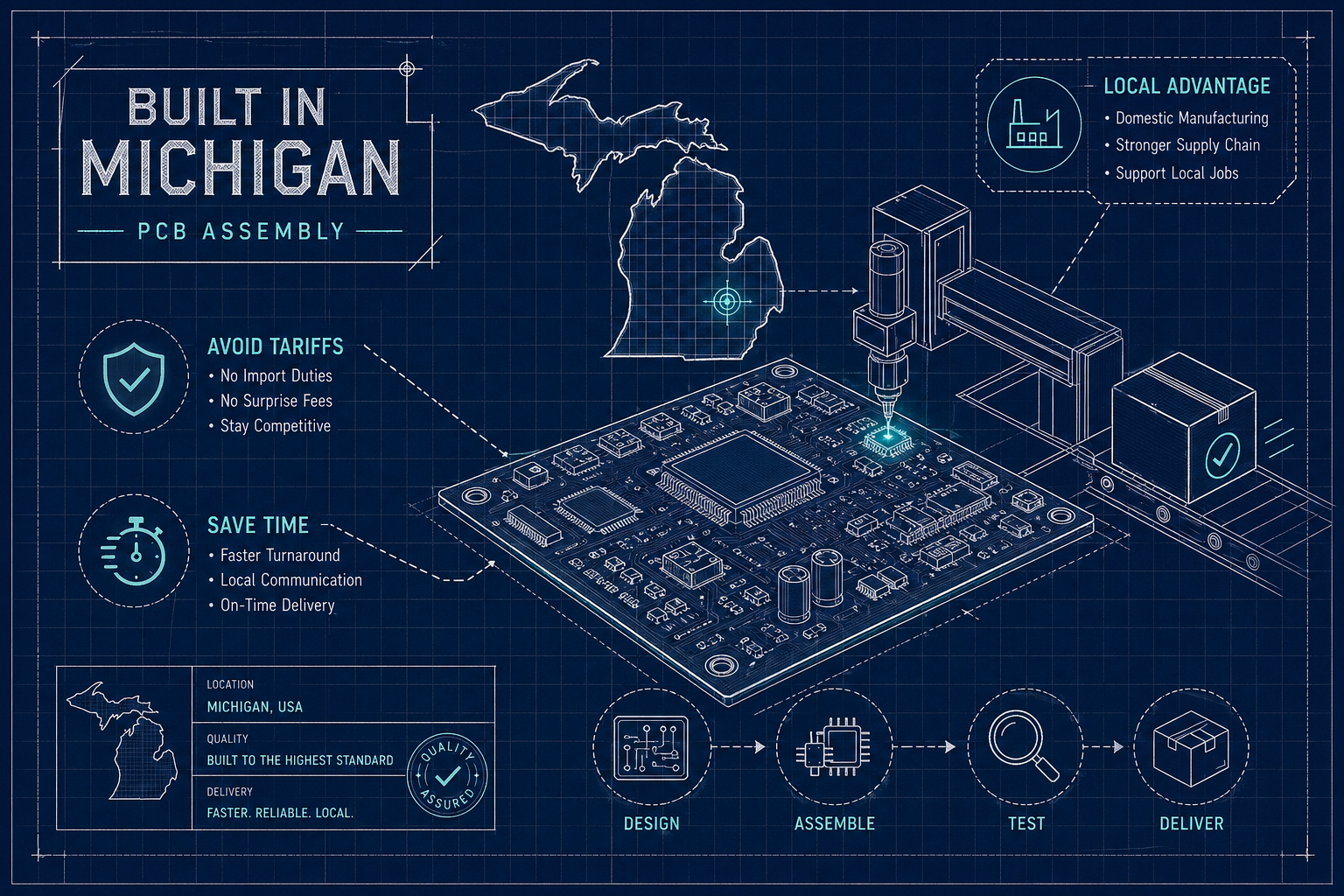
Companies sourcing PCBs from overseas are quietly paying 40% more per board than they realize once Section 301 tariffs, brokerage fees, and customs delays stack up. A board quoted at $10 from a Chinese manufacturer lands at over $14 after a 35% tariff plus freight and broker fees. The math used to favor overseas pricing. At current tariff rates, it doesn’t anymore.
PCB assembly from Michigan-based shops is now a cost-competitive reality for hardware teams that need reliable boards without the import drama. Shops like Amtech are fielding more inquiries than ever from buyers who are done calculating duty fees every quarter and waiting six weeks for ocean freight.
This article breaks down exactly how much overseas sourcing is costing you right now, what domestic circuit board assembly in Michigan actually delivers, how to evaluate a shop’s real capabilities, and the precise files and questions you need to shortlist vendors and get a useful quote. If you’re reconsidering your supply chain, this is the clearest starting point.
The real cost of importing PCBs right now
Section 301 tariffs have reset the overseas pricing calculation. Most PCB categories from China now carry tariffs ranging from 25% to 55% depending on board type, with 6-layer and above multilayer boards, flex, rigid-flex, and specialty substrates hitting the higher end. When you add customs brokerage fees of $150 to $300 per shipment and freight insurance, a $15 per board overseas quote routinely lands at $19 to $21 per board. A domestic board quoted at $18 lands at exactly $18. That pricing gap, the one that justified overseas sourcing for most mid-volume programs, has closed.
The tariff math alone should prompt a sourcing review, but schedule risk compounds the problem further. Customs holds, port congestion, and documentation errors add two to four weeks of uncertainty to every import cycle. If your overseas supplier ships on time 85% of cycles, that 15% miss rate creates real planning risk: missed retailer deadlines, idle assembly lines, and expediting costs to compensate. For hardware companies managing tight launch windows or just-in-time production, a single customs delay can cascade across your entire operation in ways that a tariff line item doesn’t capture.
What domestic PCB assembly actually delivers
Domestic lead times are one of the clearest advantages of assembling boards in the U.S. Prototypes come back in one to five days. Small batches of 50 to 500 units run seven to fourteen days. Full production runs of 1,000 or more units ship in fifteen to thirty days. Compare that against typical overseas timelines of four to eight weeks for production, and the difference shows up not just in weeks but in product iterations, market responsiveness, and launch confidence. These domestic timelines assume complete design files and in-stock components, which is why knowing what to send matters before you contact a shop.
Beyond speed, domestic assembly gives you customs-free shipping with full supply chain visibility. No broker fees, no duty calculations, no documentation risk, and no surprise holds at the port. Your boards ship UPS, FedEx, or freight carrier with real-time tracking and zero regulatory friction. For companies that lived through the 2020 to 2022 supply chain crisis, the stability of a domestic supply chain has become a procurement priority, not just a preference. Boards assembled in Michigan aren’t subject to geopolitical disruption, trade policy shifts, or manufacturing shutdowns on the other side of the world. For hardware teams searching for PCB assembly near me, Michigan-based manufacturers offer a practical answer with lead times that overseas suppliers simply can’t match.
Core capabilities to verify before choosing a Michigan assembler
SMT (Surface Mount Technology) is table stakes for any modern assembler, but the questions to ask go deeper. Does the shop handle fine-pitch components, BGAs, and high-density layouts? Can they manage mixed-technology boards that include thru-hole connectors, large capacitors, or legacy components? Box build capability, where the shop handles enclosure integration, wire harnesses, and functional assembly, is the signal that a vendor can take your product from bare board to shippable unit without involving a second supplier.
SMT, thru-hole, and turnkey assembly
Michigan PCB manufacturers offering mixed-capability sets that cover SMT, thru-hole, and turnkey assembly will immediately narrow your shortlist. Knowing what you need across those categories before you reach out saves time on both sides of the RFQ process.
NPI support and testing
New Product Introduction (NPI) support is what separates a real manufacturing partner from a simple board house. A shop with genuine NPI capability will flag DFM issues before they become defects on the production floor, not after you’ve already committed to 500 units. On the testing side, confirm whether the shop offers X-ray inspection (critical for BGA and hidden solder joints), automated optical inspection (AOI), and functional testing. A shop that omits testing in a quote to lower price is transferring risk back to you, not saving you money. These aren’t premium add-ons for aerospace programs; they’re baseline requirements for any electronics product that needs to work reliably in the field.
Certifications that tell you whether a shop can handle your program
ISO 9001 is the minimum signal that a shop has documented quality processes. IPC-A-610 compliance is the workmanship standard for PCB assembly, defining what acceptable solder joints, component placement, and board cleanliness look like. The three classes matter for your specific application: Class 1 covers general consumer products, Class 2 covers industrial controls and telecommunications requiring extended durability, and Class 3 covers high-reliability applications like automotive electronics, medical devices, and safety-critical industrial systems.
Regulated and high-reliability applications
When a shop cites IPC-A-610, ask which class they regularly certify to. That single question tells you their real production standards. For regulated applications, the requirements get more specific. Aerospace and defense programs require AS9100, which adds traceability, configuration management, and risk controls on top of the ISO 9001 baseline. ITAR registration is required if your product contains controlled defense technology. Medical device applications call for ISO 13485 combined with FDA registration under 21 CFR 820. Knowing which certifications your application demands before you contact vendors will eliminate unqualified shops from your shortlist before you spend a single hour on calls.
Cost and lead time benchmarks for Michigan PCB assembly
Prototype pricing for one to ten boards in the U.S. typically runs $100 to $500 per board, with setup fees of $100 to $500 adding to the first-run cost. Small batch runs of ten to one hundred boards drop to roughly $50 to $150 per board as setup cost amortizes across the quantity. These figures reflect full turnkey assembly where the shop sources components. Consigned assembly, where you supply components, can lower the per-board price but shifts sourcing and lead time risk back to your team. For accurate quotes from Michigan PCB manufacturers, come with Gerber files, your BOM, and X-Y placement data. Shops price from real files, not specifications described in an email.
At medium volume (100 to 1,000 boards), domestic pricing moves into the $20 to $80 range per board, and at 1,000 or more units it reaches $10 to $40. Consider a real scenario: 500 boards at $35 each domestically versus an apparent $28 per board overseas quote. After a 35% tariff plus freight, that overseas board lands at approximately $38 to $40 per board, and it arrives four to six weeks later with customs uncertainty built in. The domestic option wins on both total cost and schedule, which is the exact reversal of the calculation most procurement teams made three years ago. For teams evaluating quick-turn PCB options in Michigan, those domestic timelines also reduce the carrying cost of safety stock.
How to shortlist your Michigan PCB assembly partner: files, questions, and the Amtech advantage
Every RFQ you send to a Michigan assembler should include the same core package: Gerber RS-274X files, a complete BOM with manufacturer part numbers and approved alternates, X-Y centroid (placement) files, fab notes with stack-up requirements, and your IPC class designation or test requirements. Sending an incomplete package doesn’t save time. It guarantees a back-and-forth that adds days to your quote cycle and produces a number the shop will revise anyway once they see your actual files.
Beyond the file package, five questions reveal whether a shop’s capabilities match your program:
- Do you offer DFM review before production starts?
- What is your current lead time for my volume tier with today’s component availability?
- Which certifications do you hold and can you provide documentation on request?
- What is your defect rate and yield on comparable programs?
- Do you support alternate component sourcing if my primary parts are constrained?
A shop that answers these questions with specifics is a shop worth engaging further. Consider it a preview of how that vendor will communicate when real problems surface on the production floor, because they will. Shops that respond with vague assurances at the quoting stage rarely get more specific once your order is running.
Domestic PCB assembly partners like Amtech are U.S.-based electronics contract manufacturers built for the situation most hardware teams are navigating right now: tariff exposure, supply chain volatility, and the transition away from overseas dependence. Their end-to-end model covers PCB assembly, box build, wire harnessing, DFM review, and functional testing under one roof. Their Design for Volatility program includes tariff-mitigating approved vendor list (AVL) development, alternate sourcing, and lifecycle planning that keeps your program running even when specific components go constrained or end-of-life. For Michigan-area companies and U.S. manufacturers evaluating domestic PCB assembly partners, Amtech delivers the production capability of a seasoned EMS provider alongside the supply chain intelligence of a strategic partner. Submit your Gerber files and BOM to receive a detailed quote based on your actual files, not preliminary estimates.
The import math has changed. Your sourcing strategy should too.
Every quarter you spend importing boards is a quarter you’re paying tariffs, waiting on customs, and accepting schedule risk that a domestic supplier eliminates. Michigan PCB assembly is no longer the premium option. At current tariff rates, with domestic lead times measured in days and landed cost calculations that now favor domestic production at mid-volume, it’s the smarter default for most hardware programs.
The practical steps are clear: verify capabilities against your technical requirements, confirm the certifications your application demands, benchmark costs using the figures in this article, and send complete RFQ packages to the shops on your shortlist. If you want a domestic partner that handles everything from DFM to production and actively manages your tariff exposure across the product lifecycle, Amtech is the starting point. Run the landed-cost calculation on your next order before you send the PO.
Frequently asked questions
Is domestic PCB assembly cost-competitive with overseas sourcing now?
In many cases, yes. Section 301 tariffs on most PCB categories from China now range from 25% to 55%, and customs brokerage adds $150u2013$300 per shipment plus freight and insurance. A $15 overseas board routinely lands at $19u2013$21, while an $18 domestic board lands at exactly $18 u2014 the gap that justified offshore sourcing has largely closed.
How much do tariffs add to imported PCBs?
Most PCB categories from China carry Section 301 tariffs of 25% to 55% depending on board type, with 6-layer and above multilayer boards, flex, rigid-flex, and specialty substrates at the higher end of that range.
What schedule risk does Michigan PCB assembly eliminate?
Domestic assembly removes customs holds, port congestion, ocean freight, and documentation errors u2014 factors that add two to four weeks of uncertainty to every import cycle. For teams with tight launch windows or just-in-time production, that predictability is often worth more than the unit price difference.