
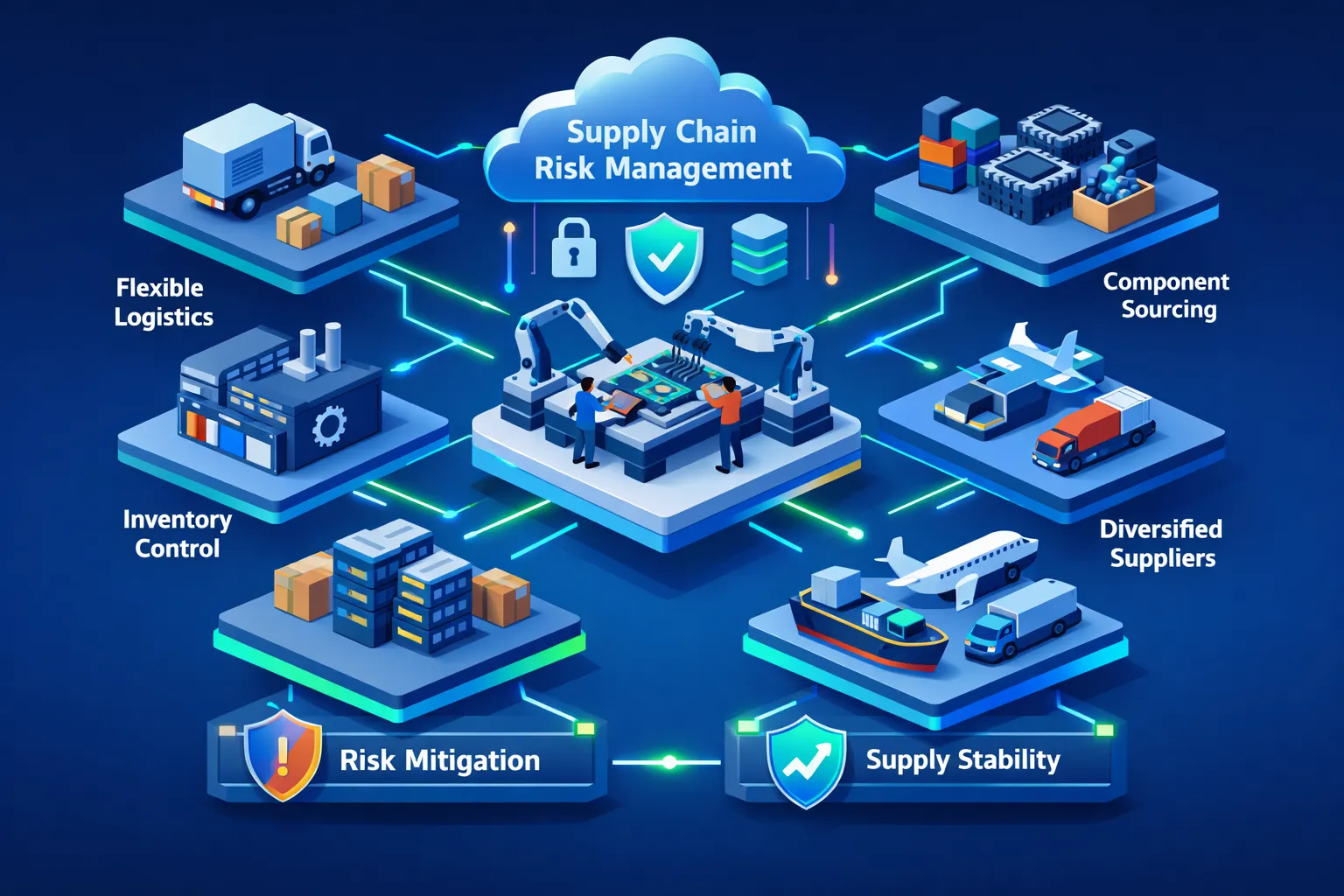
Component shortages. Tariff spikes. EOL surprises that kill a production run with three weeks’ notice. These are not edge cases anymore. They are the operating environment every electronics OEM lives in right now. The question isn’t whether a disruption will hit your supply chain. The question is whether your production infrastructure, and your approach to contract electronics manufacturing, can absorb the hit or whether it stops your line cold.
Working with a contract electronics manufacturer, specifically a capable EMS provider with genuine supply chain infrastructure, is one of the most structurally sound answers to that question. Not because it eliminates risk, but because it distributes it across a network built to handle it. Amtech’s Michigan EMS operation is a direct example of what that looks like in practice: an end-to-end domestic manufacturer built around supply chain resilience from the ground up.
What contract electronics manufacturing actually covers
Most OEMs approach an EMS engagement thinking they’re buying PCB assembly capacity. That’s understandable, but it’s a narrow view of what a mature electronics manufacturing services partner actually brings to the table. The scope runs from design through delivery, and every layer of that scope carries supply chain implications.
Core production services: from PCBA to full box build
A full-service contract electronics manufacturer handles SMT and through-hole PCB assembly, wire harness fabrication, overmolding, functional and in-circuit testing, and complete box build integration. When all of those capabilities live under one roof, you eliminate the handoff risk that comes with using separate vendors for each stage. Fewer handoffs mean fewer points where parts go missing, schedules slip, and quality escapes.
End-to-end capability also compresses your production cycle. Instead of managing three or four vendor relationships across a build sequence, you’re working with one team that owns the outcome from first article through final shipment.
Supply chain and NPI services baked into the partnership
The services that often go unnoticed are the ones that protect you before production even starts. Component sourcing, procurement, design for manufacturability (DFM) and design for assembly (DFA) reviews, and new product introduction (NPI) support are where supply chain vulnerabilities get caught early or get ignored until they’re expensive. A strong EMS partner runs a DFM review on your BOM and flags single-source components, long-lead parts, and EOL risks before the first board hits the line. That’s not overhead. That’s risk mitigation built directly into your production readiness process.
Why going it alone exposes OEMs to more volatility
When an OEM manages its own BOM sourcing, it typically maintains one purchasing relationship per component category. That concentration creates a direct line between supplier disruption and production stoppage. There’s no buffer, no qualified alternate, and no leverage with distributors when allocation hits.
The single-source trap and EOL exposure
Single-source components are the most common fragility point in electronics production. When a legacy microcontroller goes NRND or a memory device reaches formal EOL, an OEM sourcing independently often finds out through a PCN notice with 60 days of runway. Qualifying an alternate, testing it, and updating the BOM under time pressure is expensive and disruptive. The downstream impact is significant: unplanned downtime in electronics-dependent industries can cost millions per hour, and research from IPC and industry analysts has consistently documented that sector-wide component shortage events generate billions in annual production losses across the supply chain.
How tariff exposure compounds the risk
U.S.-China tariffs escalated sharply through 2024 and into 2025, with effective total rates on electronics components reaching as high as 125% on Chinese-origin goods by April 2025. For OEMs sourcing directly from Asian suppliers without mitigation strategies, that translates to a 2-5% COGS increase on targeted SKUs and forces procurement teams into reactive mode: dual BOMs, emergency re-sourcing, and supplier qualification under pressure. Companies that had already offloaded sourcing to a domestic EMS partner with diversified supplier relationships absorbed far less of that impact directly. For more on the market effects, see this analysis of the implications of U.S.-China tariff escalations.
How a contract manufacturer’s supplier network buffers your production
The defining advantage of working with a mature EMS provider is access to a supplier network that took years to build. You get that network on day one of the partnership, without having to build or maintain it yourself.
Diversified sourcing and pre-qualified alternates
A capable EMS provider carries approved vendor relationships across multiple distributors and maintains pre-qualified alternate sources for critical component categories. When a primary source goes into allocation, the alternate is already validated. There’s no emergency re-qualification, no spot-market scramble, and no exposure to counterfeit parts from gray-market channels. For an OEM managing its own sourcing, that same scenario means stopping production or accepting unvetted substitutions. Neither outcome is acceptable when you’re up against a customer delivery commitment.
Real-time parts inventory and proactive shortage flagging
Amtech’s Michigan EMS center runs a live inventory visibility system that monitors stock levels continuously against production schedules. When a component supply position starts narrowing, the team flags it weeks before it affects a production run. That early warning gives customers time to authorize a substitution, adjust order quantities, or accelerate a purchase order before the shortage creates a stoppage. Cloud-based dashboards, IoT-enabled tracking, and AI-powered demand forecasting are the infrastructure behind that kind of proactive visibility. It’s the difference between managing a shortage and being managed by one. For examples of industry approaches to real-time inventory tracking, see the work being done on live tracking and synchronization.
Flexible capacity as a continuity tool
EMS providers can adjust production schedules, shift line capacity, and run smaller lot sizes during supply disruptions without passing the capital cost burden back to you. An OEM maintaining its own production floor carries fixed overhead regardless of throughput. A contract manufacturing partner absorbs demand volatility as part of the service model. When supply is uncertain and demand is shifting, that flexibility is a direct continuity asset.
Cost and lead-time realities of domestic contract manufacturing
The “offshore is cheaper” assumption is persistent and, in most real-world comparisons, wrong. Unit cost is one variable. Total landed cost is the number that actually shows up on your income statement. For a perspective on why the industry is moving from pure cost-optimization to risk-aware decisions, see Electronics Manufacturing Is No Longer Cost-Optimized, It’s Risk-Optimized.
Pricing models and what drives per-unit cost
Contract electronics manufacturing pricing typically runs across three models. Turnkey, where the EMS provider sources all components and handles full assembly, runs roughly $20-$80 per board for small production runs. Consignment, where you supply the parts and pay only for assembly labor, typically runs $5-$25 per board. Hybrid models split sourcing responsibilities for greater flexibility. Key cost drivers across all three include volume, PCB layer count and component density, NRE fees for first-run setup, and tooling. Rush orders commonly carry a 20-50% premium over standard lead times. For a detailed breakdown of common pricing models for electronics assembly, see this industry guide.
Total landed cost: why domestic often wins on the math
Offshore unit pricing savings erode quickly when you calculate the full picture: ocean freight, customs brokerage, tariff exposure, longer lead times requiring higher inventory carrying costs, and quality rework costs from complex multi-vendor handoffs. Domestic and nearshore EMS in North America consistently delivers faster lead times than offshore alternatives, a meaningful advantage when you factor in current tariff structures at or near historic highs for Chinese-origin goods. OEM outsourcing electronics production to a domestic partner also reduces the hidden costs of cross-border program management: communication delays, IP exposure, and the overhead of maintaining overseas supplier relationships. When your landed cost model includes all the real variables, domestic EMS is frequently the more defensible number.
Certifications that signal a supply-chain-resilient EMS partner
Certifications are the baseline filter when evaluating EMS candidates. They signal operational discipline and regulatory readiness before you’ve seen a single production run.
Non-negotiable baseline certifications
ISO 9001:2015 is the floor for general quality management. IPC-A-610 certification for assembly and inspection standards is equally non-negotiable: it ensures that the technicians and inspectors on your production line are working against a consistent, internationally recognized quality benchmark. RoHS compliance documentation, covering restricted substance screening and component verification, should be treated as standard paperwork, not an exception request. For an overview of formal EMS certification expectations, see this primer on EMS certifications in electronics manufacturing.
Industry-specific certifications worth requiring
Beyond the baseline, your requirements should match your product’s target market. Medical device OEMs should require ISO 13485:2016. Aerospace programs require AS9100D. Defense work requires ITAR registration, and that requirement is not negotiable: it covers controlled access, employee screening, and data security for military-relevant technology. ISO 14001 applies where environmental compliance and chemical substance management are part of your regulatory picture. Verify that certifications are current and ask for the last audit date and scope before adding any provider to your shortlist.
How to evaluate a contract electronics manufacturing partner and move toward production
What separates a capable EMS provider from a commodity assembler isn’t the equipment list, it’s the supply chain infrastructure behind it. Converting that understanding into a practical evaluation means asking the right questions before you commit to a program.
The RFQ questions that reveal supply chain capability
The questions that separate capable EMS providers from commodity assemblers are the supply chain-specific ones. Ask directly: How many approved vendors do you carry per component category? Do you operate a real-time inventory management system, and can you show us how shortage alerts are triggered? What is your alternate source qualification process and timeline? What is your standard lead time versus your expedite capability? These questions surface whether a provider has real supply chain infrastructure or whether they’re running a single distributor relationship with a contract electronics manufacturer label attached.
What to send in your first package to an EMS provider
A well-prepared first package shortens the quote cycle and surfaces risks early. Send your full BOM with current approved sources identified, Gerber files, assembly drawings, your target volume and production schedule, and any known constraints: critical long-lead components, EOL flags, or minimum order quantities you’ve already encountered. The more complete your initial package, the faster the EMS team can run a DFM review and return a quote that reflects your actual production situation, not a best-case scenario.
Why Amtech’s Michigan EMS center is built for this
Amtech provides the full stack, from PCB contract manufacturing and wire harness fabrication to box build, functional test, and DFM co-development, backed by supply chain infrastructure specifically designed around resilience. The Michigan location means North American lead times, domestic IP protection, and direct access to the engineering and production team throughout your program. No time zone gaps, no communication barriers during critical production phases. Read more about How a Domestic Electronics Manufacturer Strengthens Your Supply Chain for details on the operational advantages of a local EMS partner.
If you’re evaluating EMS options or moving a program from prototype to production, start with a conversation. Bring your BOM, your volume targets, and the supply chain constraint that’s keeping you up at night. That’s the right starting point for a partnership built to last.
The real value of contract electronics manufacturing is risk architecture
Contract electronics manufacturing is not just a cost decision. It is a supply chain resilience decision. The OEMs that moved through recent disruptions with the least damage were the ones with diversified sourcing and real-time inventory visibility already baked into their production partnerships. They weren’t scrambling on the spot market because their EMS partner had pre-qualified alternates ready to go. For additional reading on why supply chain resilience matters, see Why Supply Chain Resilience Matters in Electronics Manufacturing.
The right EMS partner gives you diversified suppliers, proactive shortage management, domestic production flexibility, and a team that’s accountable to your production schedule as much as you are. That’s the structural answer to a supply chain that no longer behaves predictably.
Amtech’s Michigan EMS team is ready to show you how that infrastructure works in practice. Reach out, share your program details, and we’ll build a production plan engineered to hold up when the supply chain doesn’t.