
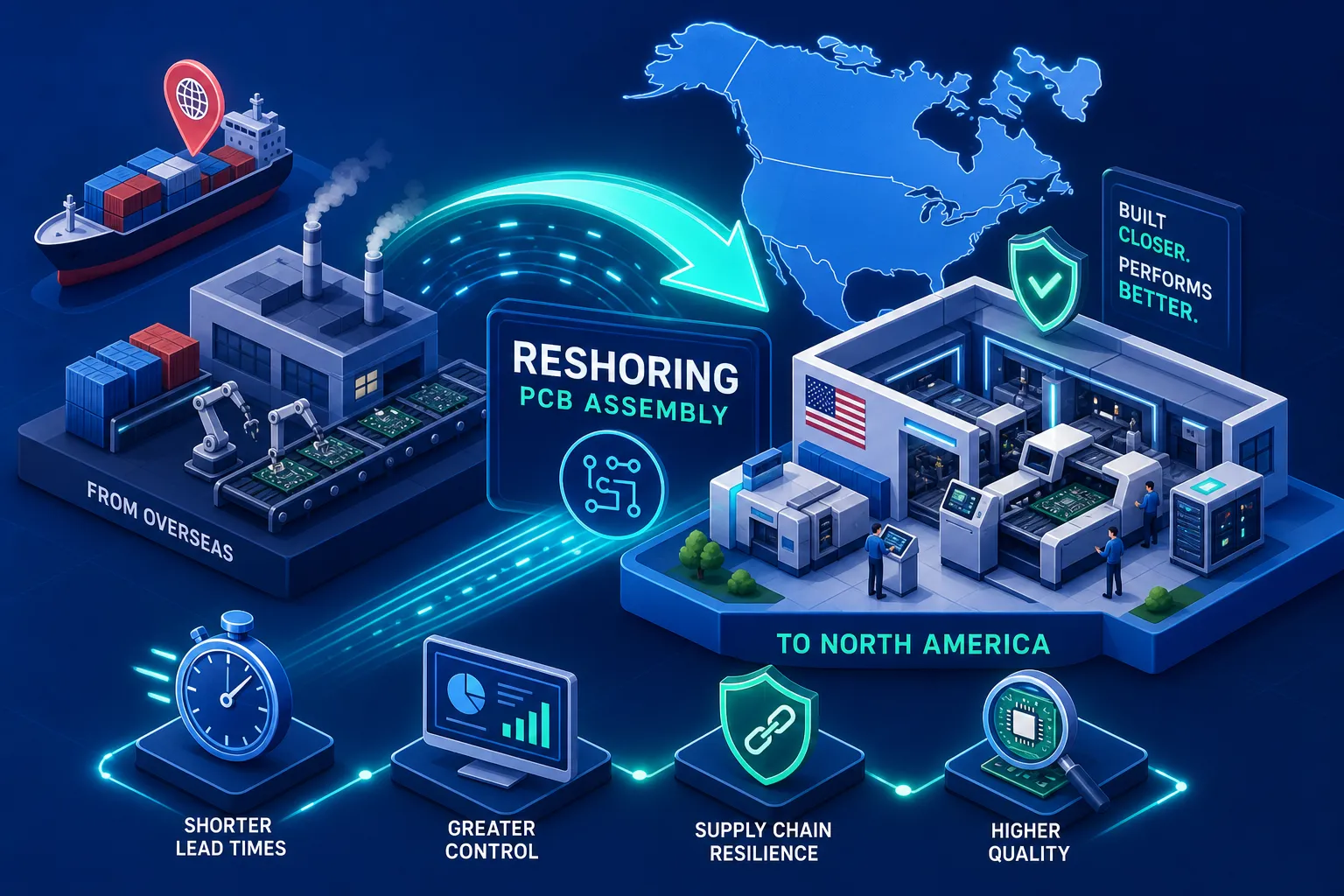
Section 301 tariffs driving a 32, 45% effective landed cost increase on China-sourced PCBAs in 2026 have pushed reshoring PCB assembly from China to North America from a “nice to have” conversation into a boardroom decision. For years, the math on keeping production in China looked settled. Now, it isn’t. A $100 FOB assembly that once cleared customs for roughly $105 now lands closer to $132, $135, sometimes higher when state taxes and broker fees stack on top.
The practical reality is that moving production back to North America isn’t as simple as switching a purchase order. It requires a structured transition: cost modeling, vendor qualification, supply chain re-mapping, tooling transfer, and a production ramp plan. Companies that skip steps end up with disrupted programs, not rescued ones. The guidance in this article draws from real reshoring transitions, the kind Amtech has managed alongside customers navigating exactly this decision. What follows is a working framework: where the cost math actually lands, how to qualify a North American EMS partner, what the tooling transfer requires, and how to execute a four-phase timeline that holds up under real production conditions.
The Real Total Cost of Ownership for China-Sourced PCBAs in 2026
The headline tariff is 25% under Section 301, but that’s not where the cost calculation ends. Add customs merchandise processing fees (roughly 3%), broker fees, trans-Pacific freight, and the now-suspended de minimis threshold, and the effective landed cost increase runs 32, 45% depending on order size and state of delivery. Pre-assembled PCBAs do not qualify for most Section 301 exclusions, unlike bare boards, which means there’s no carve-out to plan around for finished assemblies.
China’s cost advantage compresses significantly depending on volume. For ultra-low volumes of 1, 100 units, onshoring PCB manufacturing is already cost-competitive or superior because you eliminate tariff exposure, ocean freight delays, and the inventory buffers that come with a 4, 6 week shipping window. At volumes around 1,000 units, research shows China’s cost advantage can run roughly 25, 40% on a full landed cost comparison, larger than many sourcing models reflect, because those models typically stop at FOB. At 10,000 units, that advantage narrows to approximately 15, 25%. The cushion is materially smaller than it was two years ago when you run a complete TCO model rather than a straight FOB comparison, but it doesn’t disappear at volume. For additional context on direct China vs. U.S. assembly comparisons, see the China vs. US PCB assembly analysis.
The carrying cost of that 4, 6 week ocean freight window rarely appears in the initial sourcing comparison. Maintaining larger inventory buffers to cover lead time means capital tied up in stock, warehouse square footage, and excess/obsolescence exposure. North American quick-turn prototype turnaround of 24, 72 hours and 1, 2 week small-batch production cycles enable just-in-time models that reduce working capital requirements in ways that don’t show up on a per-unit cost sheet but matter significantly on a cash flow statement. For reading on how per-unit and program-level costs combine, industry discussions of PCB assembly cost drivers are useful background.
IP Protection, Quality Standards, and Compliance: The Non-Financial Reshoring Arguments
IP exposure in Chinese EMS arrangements is a documented operational risk, not a theoretical concern. Design files, Gerber data, BOM structures, and firmware can be replicated or leaked without meaningful contractual recourse under Chinese law. For companies with patented designs, regulated products, or ITAR-adjacent programs, this exposure alone can make reshoring PCB assembly a mandatory move rather than a financial one. The cost model doesn’t even need to close.
On quality, the structural difference between North American and Chinese EMS approaches comes down to where quality lives in the process. Chinese suppliers at many tiers tend to operate at batch-level traceability and apply quality at end-of-line inspection. North American EMS providers typically deliver serial-level MES traceability, meaning each board’s full production history is captured, retrievable, and auditable. That distinction matters enormously for medical, automotive, and industrial programs where a field failure requires traceability back to a specific production run, specific component lot, and specific operator.
For certain programs, the regulatory environment closes the reshoring decision before the cost model is even opened. ITAR-controlled assemblies cannot legally run through Chinese suppliers under U.S. export control regulations. FDA-regulated medical device assemblies require supply chain documentation that many Chinese EMS tiers struggle to produce at the required consistency level. Export control requirements under the EAR further restrict what can go offshore. If your program falls into any of these categories, the question isn’t whether to reshore. It’s how fast you can execute the transition.
How to Qualify a North American EMS Partner for a Reshoring PCB Assembly Transfer
Not every North American contract manufacturer has the infrastructure to absorb a live production transfer from an established Chinese line. Handling steady-state production and managing a transfer are genuinely different capabilities. Look specifically for partners with documented NPI and production transfer workflows, DFM/DFA review capability, and active AVL management experience. A shop that runs clean production on programs it built from scratch is not automatically equipped to take over a program someone else built.
The certification baseline is non-negotiable by sector. ISO 9001 is the floor for general programs. ISO 13485 is required for medical. IATF 16949 covers automotive. Beyond certifications, ask for first-pass yield data on comparable programs, test fixture capabilities, and the depth of their MES traceability system. IPC-A-610 compliance should be the assumed workmanship standard, not a differentiator. For regulated programs and any transfer of significant scale, a site visit before committing is strongly recommended, no amount of documentation fully replaces seeing the production floor. For a quick checklist of key certifications to request during qualification, review a summary of certifications to look for in a PCB assembly company.
Certain responses in the qualification process should end the conversation early. No defined onboarding process, inability to red-line your BOM for North American component availability, no demonstrated DFM capability, vague answers about traceability depth, and unclear NRE terms are not negotiating points. They are indicators of a partner that will create disruption rather than reduce it. A well-run EMS provider should be able to walk you through exactly how they handle a production transfer before you ask them to prove it on your program.
Tooling Transfer and Supply Chain Re-Mapping for PCB Fabrication in North America
The biggest operational challenge in reshoring PCB assembly isn’t the production floor. It’s the supply chain. Many BOMs built for Chinese production rely on components that are either unavailable through North American distributors, discontinued, or long-lead domestically. A thorough BOM audit before transfer is the most important pre-work step in the entire process. A qualified partner will cross-reference every line item against North American distributor availability, including Digi-Key, Mouser, and Arrow, and flag gaps before the first production run starts, not after.
The technical transfer package extends well beyond CAD files. Test fixture designs, bed-of-nails schematics, flying probe programs, ICT specs, and functional test procedures all need to migrate cleanly. If the Chinese manufacturer owns any of this documentation, you need to establish your documentation rights before initiating the transition. Component-level process notes, solder profiles, and inspection criteria for unique assemblies also belong in the transfer package. Gaps here show up as defects in the pilot run, that’s the best-case scenario. The worst case is a delayed cutover.
During the transfer window, you’re simultaneously running down existing China-produced inventory while building the North American supply pipeline. This is when EOL component issues and long-lead parts cause the most disruption. Early identification of the top 20% of BOM line items by supply chain risk, followed by strategic bridge buys and certified alternates, is how you prevent the transition from stalling mid-process. Building a tariff-mitigating AVL alongside the BOM audit reduces both cost exposure and supply risk at the same time; Amtech’s analysis of tariff mitigation strategies explores these mechanics in more detail in Reshoring as a Tariff Mitigation Strategy, Amtech.
A Realistic Reshoring Transition Timeline: Four Phases
A full production transfer from a Chinese EMS supplier to a North American contract manufacturer typically takes three to six months when executed properly. The range depends on BOM complexity, supply chain gaps, and how complete the technical documentation is coming out of the current supplier. Compressing any of the four phases below doesn’t save time. It moves the risk downstream into production. The week ranges below reflect a representative timeline based on Amtech’s transfer experience; specific programs may run longer depending on BOM depth and documentation completeness.
- Phase 1 (Weeks 1, 6): BOM audit, DFM review, and partner onboarding. This phase sets the quality of everything that follows. Full BOM audit against North American availability, DFM/DFA review against the new production environment, supply chain gap identification, alternate component certification, and NRE term finalization all happen here. Skipping or shortening Phase 1 is the single most common reason reshoring transitions stall.
- Phase 2 (Weeks 7, 14): Pilot production run and first-article inspection. Run a limited quantity, typically 25, 100 units, through the North American line before cutting over. Use this run to validate test fixtures, confirm yield rates, and surface any DFM issues not caught in review. Compare first-article results directly against established quality benchmarks from the Chinese line.
- Phase 3 (Weeks 15, 24): Parallel production and full cutover. Overlap the Chinese and North American lines briefly during ramp-up to maintain inventory continuity. Define a cutover trigger based on production readiness data, not schedule. Multiple consecutive North American runs demonstrating stable yield and quality are a more reliable basis for cutover than a calendar date. Cutting over based on schedule rather than yield data is how programs get into trouble.
- Phase 4 (Ongoing): Continuous improvement and supply chain stabilization. Post-cutover focus shifts to lead time optimization, AVL expansion, and yield trend monitoring. A reshoring-experienced partner will proactively flag component risk, track yield data, and revisit DFM as your product evolves through its lifecycle.
For a practical, step-by-step procedural reference on moving your electronics assembly to a new EMS partner, see the industry guide to a production transfer in a step-by-step guide to transferring your electronics assembly to a new EMS partner.
How Amtech Structures Reshoring PCB Assembly Transitions for North American Manufacturers
Amtech’s contract manufacturing practice is built around exactly this scenario: a company with a live program running offshore that needs to move PCB fabrication to North America without losing ground on quality, cost, or delivery. The onboarding process is structured around the four-phase timeline above, with dedicated engineering support at every stage. Based on Amtech’s transfer experience, conducting the BOM audit and AVL development before the first PO is issued is what separates a managed transition from an improvised one, and it’s why the transition holds up through ramp rather than collapsing when the first supply gap appears. For a broader comparison of domestic production tradeoffs, review Domestic PCB Production vs. Offshore: The Real Tradeoffs, Amtech.
Amtech’s Design for Volatility program addresses the supply chain risk that makes nearshoring PCB assembly transitions fragile. It covers alternate component sourcing, tariff-mitigating AVL development, EOL lifecycle planning, and component risk scoring across the full BOM. For companies moving production back from China, this program is integrated into the transfer process rather than treated as an optional add-on. The goal isn’t simply to relocate your production line. It’s to ensure that North American production becomes more resilient and competitive as the program matures. Learn more about practical reshoring steps in Reshoring PCB Assembly: Costs, Benefits, and How to Start, Amtech.
Making the Reshoring Decision with Confidence
Reshoring PCB assembly from China to North America is a legitimate strategic move in 2026, not just a policy response to tariff pressure. The cost math has shifted enough to close a significant portion of China’s traditional advantage at many volume tiers, and the quality, IP, traceability, and compliance arguments for domestic production have only strengthened. The transition is structured and manageable when approached correctly.
A thorough BOM audit, the right EMS partner, a disciplined four-phase timeline, and proactive supply chain re-mapping are the ingredients that separate successful reshoring transitions from costly program disruptions. The companies that struggle aren’t the ones with difficult programs. They’re the ones that treat this like a procurement change rather than an engineering and operations project.
If you’re evaluating this move, the best first step isn’t a cost model. It’s a conversation with a partner who has run this process before. Reach out to Amtech to walk through your current program and identify the fastest viable path to a North American production transfer for your program.