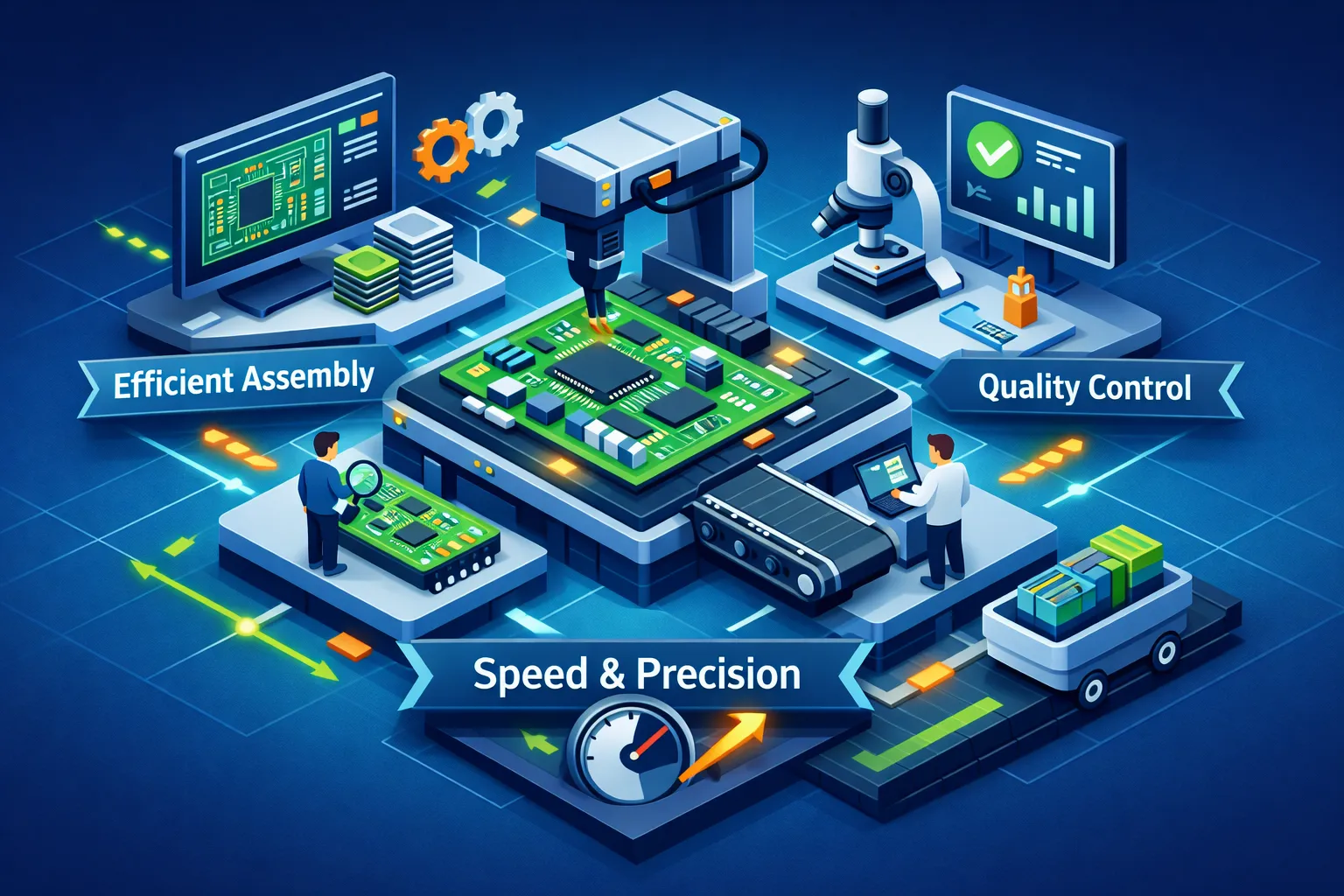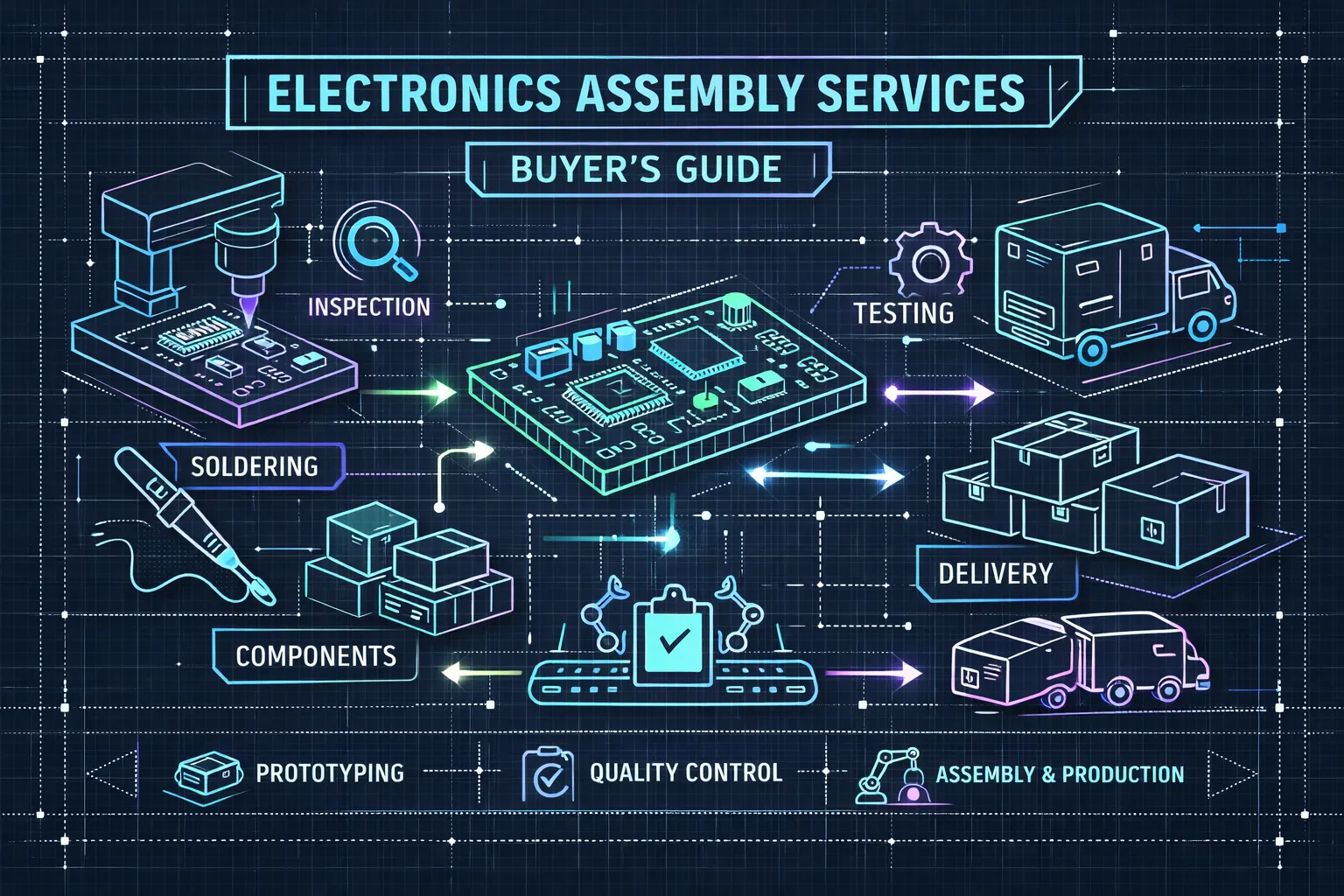
Electronics manufacturing services turn lab prototypes into reliable production, converting fragile one-offs into repeatable products that meet quality and delivery targets. Too often, first builds work on the bench but fail on the line because of poor design for manufacturability, insufficient test coverage, incorrect tolerances, or single-supplier pinch points that cause rework and missed launches. A seasoned EMS partner removes those risks with production-grade tooling, standardized processes, and test plans proven at scale. It also converts bespoke builds into lower-cost, faster programs through automation, panelization, and supplier leverage, and provides integrated new-product introduction to speed qualification so you reach customers sooner without burning engineering hours on manufacturing problems.
Moving manufacturing off your roadmap lets your team focus on product-market fit. Start the conversation early so production becomes a growth lever instead of a bottleneck.
Key takeaways
- Design for manufacturability: Early DFM reviews catch tolerance and panelization issues, reducing rework and speeding qualification.
- Production-readiness workflow: A defined NPI process, including tooling, test plans, and traceability, turns prototypes into repeatable builds.
- Cost and NRE control: Break out BOM choices, tooling, and volume pricing on quotes so you can see where changes affect unit cost.
- Quality and testing: Require appropriate certifications and robust inspection, including automated optical inspection and data-driven defect reporting.
- Partner selection: Use a tight RFP with BOM, Gerbers, and test criteria; favor nearshore electronics manufacturing services to shorten lead times and simplify logistics.
Why electronics manufacturing services matter for scaling hardware
Scaling hardware requires manufacturing to be predictable and measurable. The subsections below show common risks, cost levers, and timing signals to help you decide when to partner with an electronics manufacturing services provider.
From prototype risk to stable production
Economies of scale and faster time to market
Electronics manufacturing services convert one-off builds into repeatable, lower-cost production using automation, panelization, and supplier leverage. Yield improvements, fewer reworks, and smarter sourcing deliver the largest cost reductions as volumes rise, not just bigger purchase orders. A streamlined new-product introduction and focused PCB assembly shorten the feedback loop between design and manufacturing, cutting calendar time to first good unit.
Signals that you should engage an EMS now
Know when to bring manufacturing expertise in: if your team or capacity is stretched, an EMS can provide the skills and scale you need. Watch for operational triggers that demand outside expertise. Use the list below as a quick self-assessment.
- Frequent design changes that disrupt builds and schedules
- Rising rework rates, quality escapes, or inconsistent yields
- Forecasted volume increases that exceed in-house capacity
- Upcoming certification or regulatory testing requirements
- Component shortages, long lead times, or single-source risks
If one or more of these match your situation, engaging an EMS prevents costly delays and scales operations. The next section outlines the NPI checklist to use on day one with a manufacturing partner.
Core electronics manufacturing services: capabilities from prototype to logistics
When you engage electronics manufacturing services, expect a defined product-introduction workflow that turns prototypes into production-ready builds. A competent EMS runs collaborative DFM reviews with your engineers, delivers rapid prototype builds, and manages prototype-to-pilot transfers using documented checklists and first-article inspection reports. Turnkey board and system assembly commonly covers SMT reflow, through-hole and selective soldering, BGA handling and rework, cable and harness assembly, conformal coating, overmolding, and full box-build integration; broad capability reduces iteration time and avoids surprises during scale-up. Actionable DFM notes and an early test plan should come from the first review so you can close design gaps before pilot runs and keep cost and schedule risk low.
Testing capability determines how quickly you find and fix root causes. Expect automated optical inspection, X-ray or CT for BGA inspection, in-circuit test or flying-probe, functional testing, burn-in, and environmental stress screening, all tied to a staffed validation lab so failure data is reproducible and debug cycles shorten. Procurement and aftermarket services complete the lifecycle, including turnkey or consigned sourcing, kanban and safety-stock strategies, kitting and fulfillment, plus repair, returns, and end-of-life support. A full-service model lowers procurement overhead and mitigates component risk through alternate sourcing and targeted inventory strategies.
Cost drivers and pricing models: controlling unit cost and NRE
When you review a quote from an electronics manufacturing services partner, line items typically fall into BOM, nonrecurring engineering and tooling, per-unit assembly labor and materials, test, packaging, and freight. Break these out on the quote so you can see where volume or design changes move the needle; if a number looks high, trace it back to a specific bucket and target a change.
Use a simple amortization formula when evaluating NRE: amortized NRE per unit equals NRE divided by forecasted units. For example, a $30,000 NRE spread over 3,000 forecasted units adds $10 per unit; if baseline per-unit cost is $45, the landed unit becomes $55. Increasing the forecast or lowering NRE will immediately reduce unit price, so use this arithmetic when debating mold complexity, test-fixture scope, or early tooling investments.
Four common pricing models appear from an EMS: turnkey, where the supplier buys components and delivers finished goods; consigned material, where you supply parts and the factory assembles; per-unit assembly only, where the factory bills labor and overhead; and tiered volume-break pricing. Turnkey is often simplest for startups because it reduces procurement work and compresses timelines, while consigned material lowers upfront cash but leaves component risk with you and requires tight inventory controls. To lower total cost, apply DFM to reduce part count, standardize components across SKUs, increase panelization, design for testability to shorten test time, run yield-improvement programs, and negotiate explicit volume tiers with a regular forecasting cadence. Combine those levers with quality and test planning to protect unit economics as you scale.
Quality, certifications and testing: what to require from your EMS
When you evaluate an electronics manufacturing services partner, certifications show documented processes and controls rather than mere badges. Require certifications that match your product risk and industry requirements, and insist on documentation that maps standards to specific manufacturing steps so audits run faster and launch timelines stay predictable.
- ISO 9001: a documented quality-management system; ask for scope and recent audit reports to confirm ongoing compliance.
- IPC-A-610: visual and workmanship acceptability for assemblies; use it as the baseline for visual inspection criteria.
- IATF 16949: automotive QMS focused on defect prevention and traceability; require it for automotive-grade products or supplier tiering.
- AS9100: aerospace quality standard adding configuration control and risk management; needed for flight-critical and avionics assemblies.
- ISO 13485: medical device QMS emphasizing product safety and regulatory documentation; require it for clinical or patient-contact devices.
- UL and RoHS: safety and hazardous-material compliance; confirm component- and final-product listings where applicable.
Co-develop the test plan with your manufacturer: define pass/fail criteria, test coverage, and sample sizes before pilot runs. Require first-article inspection and a report showing measured results against spec sheets; common acceptance thresholds include 100 percent visual and AOI for critical assemblies, 100 percent functional testing for safety circuits, and a minimum 95 percent yield on initial production before volume release. Include incoming inspection, in-line AOI, ICT or flying-probe, functional test, and environmental screening to avoid ambiguous sign-offs and reduce field failures.
Your contract manufacturer should provide lot traceability, serialized tracking for critical parts, a documented corrective-and-preventive-action process, and regular yield and defect reporting. Traceability speeds root-cause analysis and reduces repeat failures, and CAPA shows continuous improvement is built into production. Use these criteria when evaluating and shortlisting electronics manufacturing services partners in the next section.
How to evaluate and shortlist EMS partners: a practical checklist
Start with a tight request for proposal that gives bidders everything they need to price and qualify your program. Include your BOM with valid manufacturer part numbers and alternates, Gerbers and IPC netlists, mechanical assembly drawings, test procedures, forecast and planned purchase cadence, target certifications, and environmental requirements so responses are comparable. Attach these essentials to the RFP for quick scanning and faster vendor qualification.
- BOM with MPNs and alternates
- Gerbers, assembly drawings, pick-and-place files
- Test procedures, acceptance criteria, and fixture needs
- Forecasts, target volumes, and schedule
Score suppliers with a simple weighted template that balances capability, capacity, quality, cost, and risk. For example, you might weight capability 25 percent, quality 25 percent, capacity 20 percent, cost 15 percent, financial/geographic risk 10 percent, and responsiveness 5 percent, then score vendors 0–10 on certified processes, on-time delivery history, first-pass yield, and financial stability; use a pass threshold, such as 70 of 100, to prioritize finalists. On supplier calls, ask concrete questions like “What was your recent first-pass yield on similar assemblies?” and “Share an NPI case study and current available capacity,” and watch for red flags such as missing traceability, vague test plans, unwillingness to share line-level yield, or inconsistent lead-time answers.
Run a paid pilot to validate assumptions and read quotes carefully. Confirm NRE amortization, minimum order quantities, lead-time assumptions, tooling ownership, freight terms, and whether price breaks occur at clear volume milestones. Treat the pilot as the final qualification gate and measure yield, test coverage, and communication responsiveness before awarding work.
Partnering with Amtech: Michigan-based EMS to scale capacity
Choosing a Michigan partner for electronics manufacturing services shortens lead times, simplifies logistics, and keeps engineering close to your team. Nearshoring reduces tariff exposure and enables on-site collaboration that accelerates debug cycles and product introductions. Close proximity also helps supply-chain resilience by making alternate sourcing and urgent swaps faster and less risky.
Amtech applies operational discipline and flexible scheduling to absorb demand spikes without disrupting launch timelines. We assign dedicated project managers who run product-introduction programs, coordinate suppliers, and hold weekly milestones to keep progress measurable. Production lines combine automation, skilled technicians, and AI-enabled inspection to raise yield and reduce false failures.
Expect timelines that scale with complexity and regulatory needs. Prototype builds and DFM iterations typically take two to six weeks depending on PCB complexity and firmware readiness; pilot runs and validation commonly fall in a two- to eight-week window when fixtures and test plans are straightforward. Ramp to volume usually takes four to twelve weeks based on component lead times and custom assembly needs, with faster timelines when BOMs are finalized and long-lead parts are available.
Start the engagement with a compact package so Amtech can quantify risk and capacity quickly. Send your BOM and Gerbers, state target volumes and ship dates, and request a product-introduction and capacity plan. Ask for a pilot-run quote with NRE broken out to get an accurate comparison across suppliers.
After you submit materials, Amtech will return a clear timeline, cost breakdown, and test plan so you can measure risk before you commit. We use the pilot to validate yield, test coverage, and capacity assumptions, and to identify any remaining design or sourcing issues. That makes the transition to volume production predictable and measurable.
Putting it together: next steps
Moving from prototype to production is a systems problem. Repeatable product-introduction processes, early DFM reviews, and clear production-readiness workflows catch common failure modes and translate lab results into manufacturable designs. Design for volatility and tight cost control protect unit economics as you scale.
Work with Amtech to make that alignment practical: upload your PCB files and BOM to request a DFM review and production-readiness assessment. We will return prioritized fixes, key cost drivers, and a roadmap for onshoring or resilient sourcing, plus a pilot quote with NRE broken out. Use the results to decide whether to move to a paid pilot and a production ramp.