
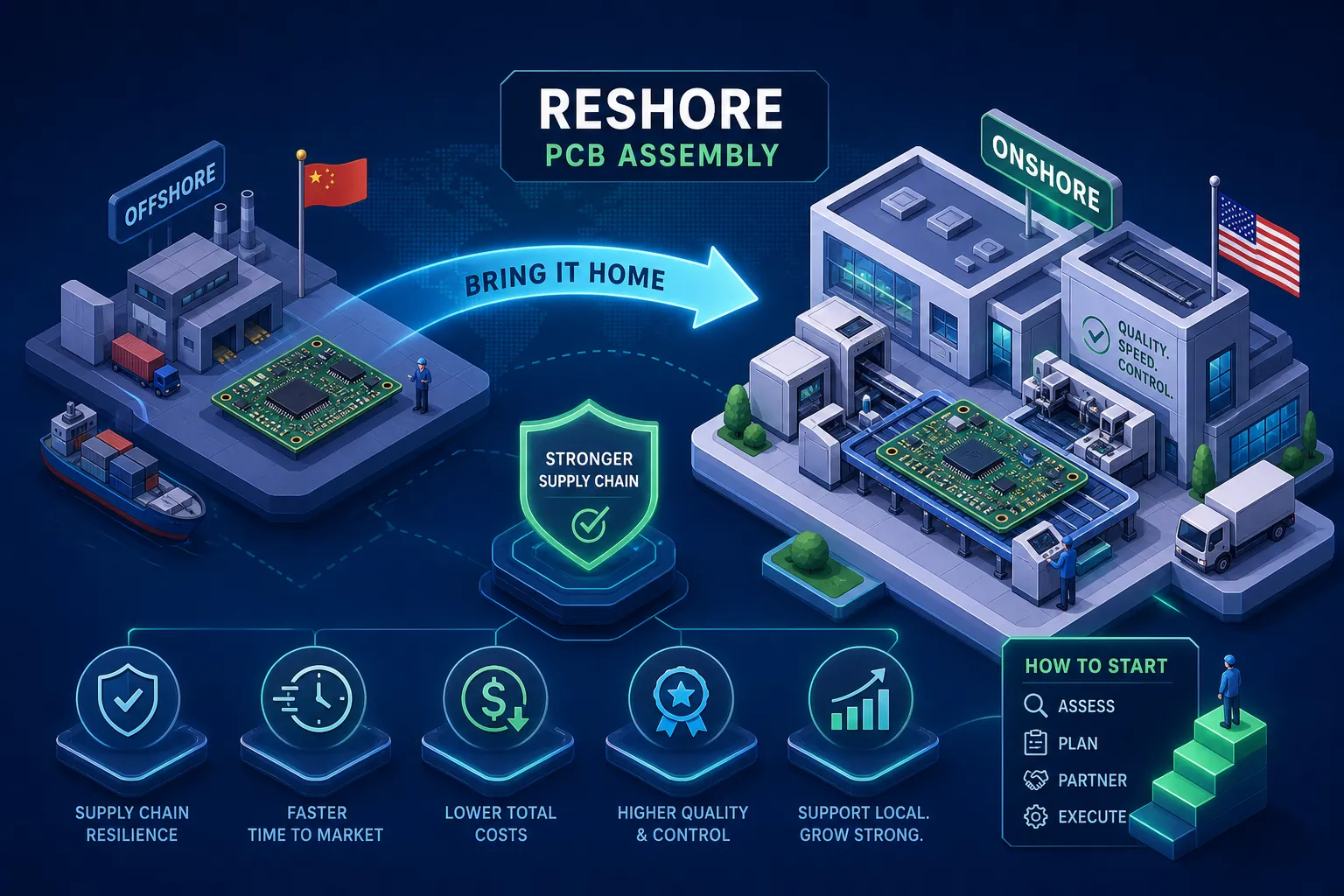
The 30, 50% unit-cost savings on offshore PCB assembly looked compelling in 2018. In 2026, after Section 301 tariffs, pandemic-era supply chain failures, 12-week lead times, and freight costs that have swallowed entire cost advantages, reshoring PCB assembly deserves a serious second look. The headline factory-gate price you got from an overseas supplier three years ago is not the number that shows up on your P&L today.
This article is not a pro-reshoring pep talk. It’s a framework for calculating whether bringing your PCB assembly back to North America makes financial and operational sense for your specific program. We’ll cover the real cost gap, the lead time and quality outcomes that matter, a total cost of ownership model you can actually use, and the incentives that could shift your break-even point. U.S. contract manufacturers like Amtech have built dedicated reshoring transition programs precisely because the calculation has shifted, and more OEMs are discovering that domestic PCB assembly pencils out when they run the full numbers.
Why reshoring PCB assembly is under real consideration in 2026
Tariffs, transit risk, and IP exposure are showing up in your cost model whether you’ve calculated them or not. The forces reshaping the offshore versus domestic decision are concrete and named, and they’ve moved far enough that ignoring them is itself a financial decision.
Section 301 tariffs on Chinese-origin PCBs effectively close the landed-cost gap that offshore assembly depends on. Complex boards, six-layer and up, flex, non-FR4, currently face a 35% total tariff burden from China. Even 2- and 4-layer rigid FR4 boards, which qualify for a current exclusion, still carry a 10% rate. That tariff exposure compresses the headline 30, 50% factory-gate savings down to 15, 25% for medium-to-large volume multi-layer builds, and the advantage disappears entirely for low-volume or prototype work. This is not a trade politics conversation; it’s a P&L conversation.
Offshore sourcing also introduces lead times exceeding 12 weeks door-to-door from Asia, and transit variability adds schedule risk that’s nearly impossible to hedge cheaply. When a quality issue surfaces after an ocean crossing, the production schedule has already been disrupted before you even know there’s a problem. The inventory buffers required to cover those lead times add carrying costs that rarely appear in the initial cost-comparison spreadsheet, but they are very real. For companies in industrial, defense-adjacent, or medical-adjacent sectors, the IP exposure that comes with sharing PCB designs overseas carries a dollar value that belongs in any reshoring ROI model.
The real cost gap for reshoring PCB assembly vs. offshore
The most common misconception in this evaluation is treating the factory-gate unit price as the total cost. It isn’t. Understanding where the real gap lives, and where it doesn’t, changes the decision significantly.
Where offshore still leads
For multi-layer boards at medium-to-large volume, offshore retains a cost advantage, but it’s closer to 15, 25% after freight and tariffs, not the 50% headline that drives most initial sourcing decisions. In a representative 4-layer quote comparison, domestic assembly runs roughly $35 per board versus $16 per board from China before fees, a gap that sounds alarming until you model what gets added on the way to your dock. For additional perspective on comparative sourcing economics, see a detailed China vs. U.S. PCB assembly comparison.
Where domestic wins clearly
For single-layer boards at low volume, domestic assembly is often cost-neutral or actually cheaper once logistics friction is included. International shipping, import fees, and minimum order requirements weigh heavily on small runs. Domestic assembly wins clearly in three specific scenarios:
- Prototype and quick-turn runs, where logistics friction and rework risk outweigh the unit-price premium
- Complex or high-reliability assemblies, where quality and cycle time advantages offset the cost difference
- Urgent or replenishment orders, where air freight from Asia erodes nearly all offshore savings on emergency buys
The carrying cost most OEMs skip
Offshore lead times of 12 or more weeks require higher safety stock levels. Inventory carrying costs typically run 20, 30% of inventory value annually. Add that line to your offshore program cost before you compare it to a domestic quote and the gap shrinks again. A complete total cost of ownership model for PCB supply chain security routinely cuts the offshore advantage by 40, 60% before you even factor in quality or lead time benefits.
Lead time and quality outcomes that go beyond the BOM
The operational case for domestic PCB assembly isn’t just theoretical. In programs where assembly has moved to domestic facilities with tighter process control and faster feedback loops, defect rates have dropped by as much as 60%, a yield improvement that flows directly to your cost structure and production schedule reliability.
U.S.-based quick-turn assembly commonly delivers prototypes in 24, 72 hours and production batches in 2, 7 days, compared to 12 or more weeks door-to-door from Asia. One reshoring case delivered a high-complexity rigid-flex build in 10 working days, saving the customer six weeks versus overseas alternatives, with zero assembly defects and a first-time clinical test pass. That compression isn’t just a scheduling convenience. It reduces minimum order quantities, lowers inventory requirements, and lets your team respond to demand changes without being locked into a build committed three months ago.
When a quality issue surfaces in a domestic run, your engineering team can be on-site within a day. When the same issue surfaces after a sea shipment, you’re looking at weeks of delay before any corrective action takes effect. Same time zone, no language barriers, and direct access to the production line also dramatically accelerate engineering change orders, first-article reviews, and production troubleshooting. These are real cycle time reductions, not soft benefits.
How to calculate the ROI of reshoring PCB assembly
A meaningful reshoring ROI analysis compares total offshore program cost to total domestic program cost over a 24-month horizon. You are not comparing unit prices. You’re comparing programs.
Reshoring PCB assembly: TCO categories
A complete total cost of ownership model for PCB assembly covers seven cost categories, grouped below by type:
Direct acquisition costs
- Unit price
- Inbound freight
- Tariff exposure (apply current Section 301 rates to your board type)
Logistics and inventory costs
- Safety stock value and annual carrying cost (use 20, 30% of inventory value)
- Expedite premium frequency, how often do you air-freight emergency orders?
Quality and engineering costs
- Rework and scrap rate difference
- Engineering iteration cost, including change orders and any engineering travel
If your assembly carries proprietary design elements, add a line for IP risk valuation. That number is subjective, but it belongs in the model. For most mid-market OEMs, the reshoring PCB assembly break-even on a program with 3,000 or more annual units is achievable within 12, 18 months once carrying costs and tariff exposure are properly modeled. The programs where domestic assembly becomes clearly competitive are those with medium-to-high complexity, meaningful tariff exposure, or a history of emergency air-freight spend that shows up in your logistics budget every quarter.
A practical roadmap to evaluate and execute the transition
Evaluating a U.S. contract manufacturing partner for a reshoring PCB assembly transition starts with certifications and quality systems. Look for ISO 9001 as a baseline, IPC-A-610 Class 2 or Class 3 compliance depending on your application, and ITAR registration if your design touches defense-adjacent territory. For high-reliability industrial or medical-adjacent programs, IPC-A-610 Class 3 paired with ISO 13485 is the appropriate expectation. A serious CM will also show documented traceability, IPC-trained inspectors, and a controlled rework and repair process.
DFM capability is non-negotiable, and it’s where most transitions succeed or stall. A strong contract manufacturing partner reviews your design before quoting, flags producibility issues, and recommends changes that reduce assembly cost and defect risk before the first board is built. That upfront review prevents the most expensive kind of problem: discovering a design issue after tooling is built and production has started.
Amtech’s On/Re-Shoring program is built specifically to address the three barriers OEMs encounter most often: cost competitiveness, PCB supply chain security, and production readiness. Amtech’s Design for Volatility program builds a tariff-mitigating approved vendor list and alternate sourcing strategy into the transition plan from day one, so you’re not trading one supply chain risk for another. The transition runs in phases: DFM review and producibility assessment, alternate sourcing and AVL development, first-article builds and qualification, and then full production ramp. That structure keeps the transition predictable and avoids the most common delay, incomplete documentation from the outgoing supplier.
A well-managed reshoring transition for a moderately complex PCB assembly program typically runs 8, 16 weeks from first engagement to qualified production. Plan for a design review and BOM cleanup phase before the first domestic build begins. Programs that move quickly through that phase are the ones where the outgoing supplier relationship is still intact and documentation is current.
Federal and state incentives that improve the numbers
The incentive landscape has shifted meaningfully in favor of domestic electronics manufacturing, and these programs belong in your ROI model before you finalize a decision.
At the federal level, the CHIPS and Science Act created semiconductor manufacturing grants, R&D support, and the Section 48D advanced manufacturing investment tax credit, which carries relevance to PCB supply chains tied to semiconductor production. The advanced manufacturing investment credit increased from 25% to 35% under recent legislation, strengthening the economics for qualifying capital investment.
The most directly actionable proposed legislation for OEMs evaluating onshoring PCB assembly is the Protecting Circuit Boards and Substrates Act (S.4569 / H.R. 3597), which would provide a 25% tax credit on purchases of American-made PCBs and a $3 billion grant program for U.S. PCB manufacturers. As of 2026, S.4569 has been introduced and referred to the Senate Finance Committee but has not advanced beyond committee. OEMs planning multi-year programs should track its progress, if enacted, it would be the first direct federal incentive specifically targeting PCB reshoring.
At the state level, the strongest combinations of incentives, industrial power costs, and advanced manufacturing clusters currently sit in Texas, Arizona, North Carolina, Ohio, Indiana, and South Carolina. These packages are typically project-specific and negotiated rather than published, which means they’re accessible but require direct engagement with state economic development offices. If you’re evaluating a facility investment alongside a nearshoring PCB production strategy, those conversations are worth starting early.
Making the call: is reshoring PCB assembly right for your program?
Reshoring PCB assembly isn’t the right move for every program. High-volume, lower-complexity assemblies with stable demand and long planning horizons may still favor offshore production on a total cost basis. But domestic assembly is no longer the economically unrealistic option it appeared to be five years ago, and the gap continues to narrow as tariff exposure grows and automation reduces the labor-cost disadvantage.
The decision reduces to four inputs: total landed cost rather than unit cost, lead time compression and quality improvement values, inventory carrying costs, and tariff exposure on your current program. For programs with 3,000 or more annual units, medium-to-high complexity, significant tariff exposure, or a pattern of emergency expedite spend, the numbers support a serious evaluation of domestic assembly. The programs that remain clearly offshore are high-volume commodity builds with no IP sensitivity, stable long-lead demand, and minimal complexity.
If you’re ready to run the numbers on your specific program, Amtech’s reshoring transition team will walk through a total cost of ownership analysis with you and show you exactly where the break-even lives for your production profile. For most programs with meaningful complexity or tariff exposure, that number is closer than the factory-gate price suggests.