
Selecting the right US-based contract manufacturer is one of the highest-stakes sourcing decisions a hardware team makes, and the consequences of getting it wrong rarely surface during the pitch. They surface during early production, when schedules slip, a quality audit fails, or the engineering contact stops responding. By then, you’re holding tooling costs, committed inventory, and a launch timeline that’s already broken.
Tariff exposure, lead time risk, and supply chain visibility have made onshore manufacturing the logical choice for a growing number of hardware programs. The harder problem is figuring out which U.S. contract manufacturer actually deserves the business. This checklist covers exactly that: the criteria to run every candidate through before you sign a purchase order.
By the end, you’ll know how to screen for certifications that matter, verify real production capacity, test communication before it counts, and narrow your list to 3, 5 qualified vendors. We’ll also run Amtech, an ISO-certified Michigan electronics manufacturer, through this same checklist to show what a qualified domestic partner looks like in practice.
What certifications actually tell you about a domestic electronics manufacturer
Certifications aren’t wall decorations. They signal what quality system a manufacturer operates under, what regulatory requirements they’ve committed to meeting, and what third-party audits they’ve already passed on your behalf. Requesting and cross-checking certificate numbers against a registrar takes minutes and eliminates a significant category of risk. For practical guidance on auditing and verifying certificates, see this practical guide on how to audit electronic manufacturers.
ISO 9001:2015 is the minimum baseline for any serious contract manufacturer. It confirms the facility operates a documented quality management system with consistent processes and corrective action protocols. What it doesn’t confirm is industry-specific competency. ISO 9001 alone isn’t sufficient for medical, aerospace, or defense electronics programs, it tells you how the facility manages quality in general, not whether they’ve ever built a Class II medical device or processed an ITAR-controlled assembly.
Additional certifications become hard requirements depending on your end market. ISO 13485 is mandatory for medical device manufacturing, covering device-specific quality and traceability requirements beyond ISO 9001. AS9100 is required for aerospace. ITAR registration is non-negotiable for any program touching defense-adjacent electronics or export-controlled technology. When verifying these, don’t accept verbal confirmation. Request the current certificate and check the expiration date. A lapsed certification is worse than no certification at all because it suggests the manufacturer allowed their compliance posture to lapse without disclosure.
How to vet a US-based contract manufacturer on production capacity
A manufacturer can pass every certification check and still be the wrong fit if their actual production capabilities don’t match your program. The scope of in-house services determines whether your product gets built cleanly or gets subcontracted out to an unknown third party operating under a different quality system.
Not every American contract manufacturer is configured for both high-mix low-volume production and volume scaling. High-mix environments require flexible SMT line configurations, short changeover times, and engineering staff who can handle a wide range of board types without sacrificing yield. Volume scaling requires a different kind of discipline: process control, cycle time optimization, and inventory management. Assess whether the facility can handle your product at 50 units and again at 5,000. If the answer changes at scale, you’ll be switching partners mid-program.
Map the full manufacturing stack and identify every outsourced step. A complete electronics manufacturing capability includes PCB assembly, wire harnessing, low-pressure overmolding, functional test, and box build. When any of these are subcontracted, the manufacturer adds a dependency that sits outside their quality and schedule control. Ask directly what processes leave the building, a manufacturer unwilling to disclose subcontracted steps should be treated as a risk, and you should require that information in writing during the audit phase. For more on how contract electronics manufacturing can address supply chain fragility, review How Contract Electronics Manufacturing Mitigates Supply Chain Risks, Amtech.
Lead times, MOQs, and the real math on domestic production costs
The most persistent sourcing myth is that offshore is always cheaper. It’s cheaper at the line-item level. Once you account for total landed cost, that comparison changes significantly, and in 2026, it’s changed more than most sourcing teams have updated their models to reflect.
Domestic PCB assembly and production runs at qualified US contract manufacturing operations typically run 10, 15 working days for low-to-medium volume builds and 14, 20 working days for larger production runs. Compare that to semiconductor lead times of 30 to 42 weeks that offshore-dependent supply chains are still navigating, figures consistent with EMS industry benchmarking from the 2024, 2025 cycle. These extended chip timelines are discussed in industry analysis on semiconductor lead times moving toward 42 weeks, and similar market-level context is available in the United States contract manufacturing services market reports. Domestic lead times don’t just move parts faster. They give your program actual schedule control, which translates directly into launch date certainty and reduced inventory carrying costs.
On total cost: offshore gross savings of 60, 75% commonly shrink to a net 40, 52% once project management overhead, 24, 48 hour communication delays, and rework costs are factored in. Failed offshore programs can reach 150, 250% of equivalent onshore cost, a figure consistent with cost modeling published by EMS industry analysts examining reshoring economics. That’s not a patriotism argument. It’s a risk-adjusted cost argument. For programs under 10,000 units annually, onshore total landed cost is frequently neutral or lower once current tariff schedules on PCBs and semiconductors, freight volatility, and quality rework are included in the model. Model the full cost, not the per-unit quote.
Communication practices and engineering depth as qualifying criteria
Responsiveness is a measurable qualification criterion. The way a manufacturer handles pre-sales communication tells you exactly how they’ll handle a production issue at 4 PM on a Friday. If getting a detailed answer before the contract requires three follow-up emails and an account manager relay, that pattern doesn’t improve after the PO is signed.
Run a simple pre-qualification test: send a technical inquiry that requires a thoughtful reply, not just a quote form submission. Ask something specific about your design or your production requirements. Time the response. Evaluate whether the reply is generic or specific to your product. Strong US contract manufacturing services providers assign an engineering contact early, not just a sales representative. Reaching an engineer before the deal closes is a reliable indicator that you’ll have one available when something goes wrong during production.
DFM support is a differentiator worth screening for explicitly. Genuine design for manufacturability review isn’t a quick pass/fail on your Gerber files. It’s a structured analysis of component placement, testability, solderability, and BOM risk that produces a formal deliverable. The difference between a manufacturer that flags problems and one that co-engineers solutions shows up in first-pass yield and time-to-production. Ask whether DFM review is a formal service with documented output, or whether it’s an informal opinion offered as a courtesy. If you want a framework for production ramp and readiness, look at Start of Production Readiness: Why It’s the New Secret Weapon, Amtech.
The shortlisting checklist: 8 questions to ask every US contract manufacturer
These are the exact questions to put to every candidate before a facility review or final vendor decision.
Certification and facility audit questions
- Which certifications do you hold, and can you provide current certificates? Request documentation, not verbal confirmation. Verify expiration dates against the issuing registrar.
- When was your last third-party audit, and what were the findings? Ask for the corrective action summary. A manufacturer who’s never had a finding isn’t more trustworthy, they probably haven’t been audited rigorously.
- Are all manufacturing processes performed in-house, or do you subcontract? Get a specific list of any outsourced steps and ask who performs them.
- What is your IP protection policy, and how is it enforced on the shop floor? Ask about physical access controls, NDA requirements for subcontractors, and data handling for design files.
Production readiness and supply chain questions
- What is your standard lead time for a first production run at our projected volume? Ask for a realistic range, not a best-case scenario.
- What is your minimum order quantity, and how does pricing scale? Understand the MOQ structure and whether it’s compatible with your early-stage volumes.
- Do you provide DFM review before production begins, and is it a formal deliverable? Distinguish between an informal look and a documented engineering analysis.
- Can you provide 2, 3 customer references from programs similar in complexity and volume to ours? References from a different industry or volume tier are not meaningful comparisons.
Why Amtech’s Michigan facility clears every item on this list
Amtech is an ISO-certified electronics contract manufacturer based in Michigan, built specifically for the types of programs this checklist was designed to qualify: mid-complexity electronics, hardware startups scaling to production, and OEMs reshoring from offshore supply chains that have become too fragile to rely on. For companies evaluating reshoring case studies and playbooks, see Onshoring Electronics Manufacturing: The U.S. Playbook, Amtech.
On certifications and full-scope in-house capability: Amtech maintains active ISO certification and operates a complete manufacturing stack, PCB assembly, wire harnessing, low-pressure overmolding, functional test, and box build, all under one roof. Optical inspection and process automation are integrated into production workflows to reduce manual handling and improve yield consistency across runs. The 3R Promise, Reliable, Robust, Responsive, is the operational answer to the communication and responsiveness criteria covered earlier in this article, representing a defined set of service commitments rather than a positioning statement.
DFM and supply chain resilience are built into every program from day one. Amtech’s DFM and DFA process produces formal documented deliverables. The Design for Volatility program incorporates alternate sourcing strategies, approved vendor list development, and lifecycle planning into every production program before the first unit ships. That means your BOM isn’t just optimized for today’s component availability, it’s structured to absorb supply shocks, end-of-life events, and tariff exposure without stopping your line. If you want a deeper look at how contract manufacturing can mitigate those supply risks, read How Contract Electronics Manufacturing Mitigates Supply Chain Risks, Amtech for more detail.
The engagement model is designed to meet you where you are. Whether you need a co-development partner at the prototype stage, a production ramp partner scaling from low to high volume, or a reshoring partner transitioning a program from Asia, Amtech operates across all three without requiring a handoff to a new vendor. Request a facility review, submit a design for DFM evaluation, or get a quote for a first production run at amtechelectronics.com.
Start your shortlist with the right criteria
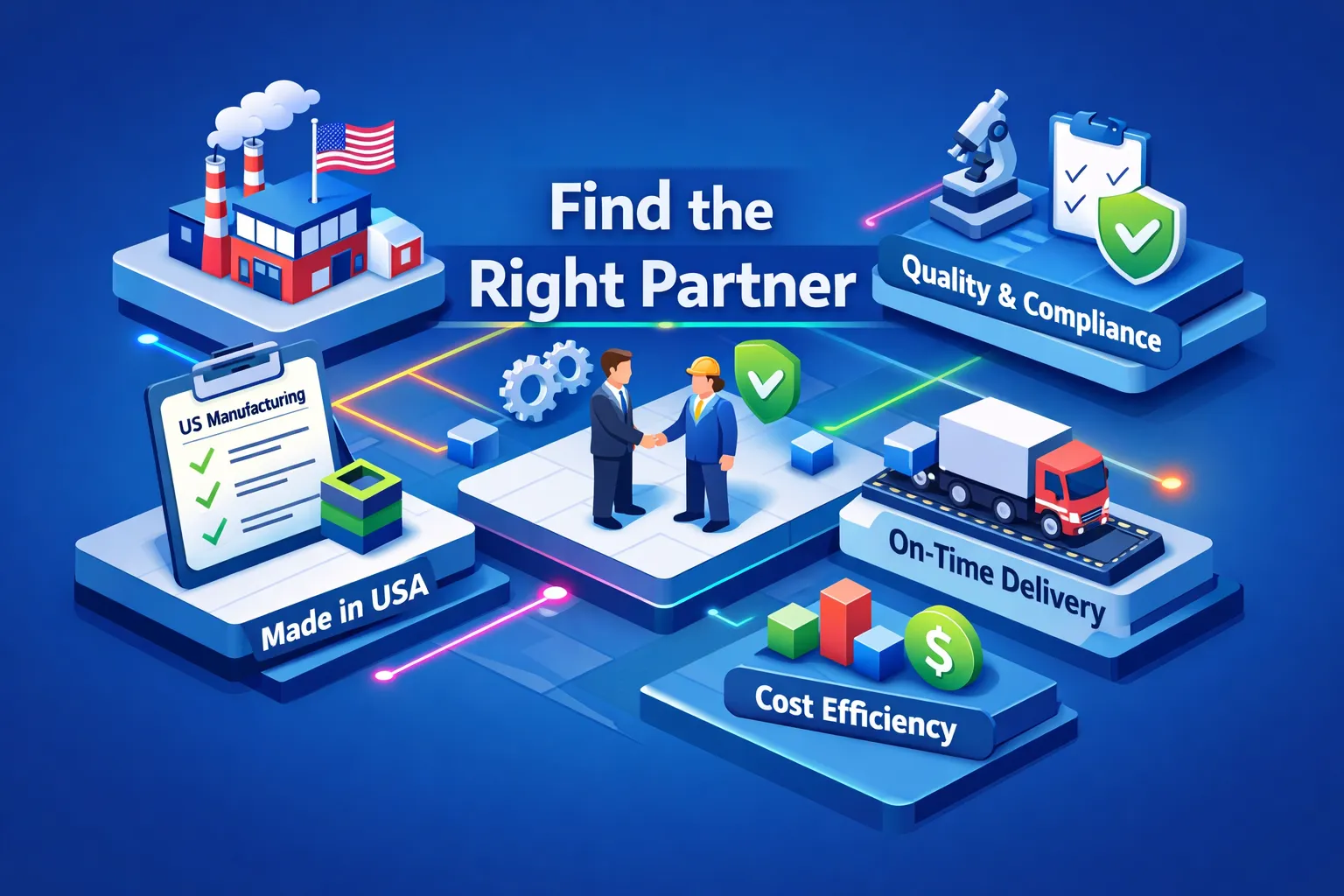
Five criteria separate a qualified domestic contract manufacturing partner from a vendor who just happens to be located in the United States: active certifications matched to your product category, full in-house capabilities without hidden subcontract dependencies, a cost model that reflects total landed cost rather than line-item pricing, engineering-depth communication from day one, and formal DFM support that produces a real deliverable.
Picking the wrong onshore manufacturer costs more than staying offshore. Picking the right one accelerates everything that matters: time to market, supply chain stability, first-pass yield, and long-term scalability without the disruption of switching partners mid-program. If you’re still evaluating vendors, studies and practical advice on picking an electronics contract manufacturer provide useful selection heuristics and questions to add to your checklist.
Use the 8-question checklist above to narrow your candidates to 3, 5 qualified manufacturers, then put each one through a facility review before you commit. Choosing the right US-based contract manufacturer comes down to how well a vendor performs against these criteria, not how well they present during the sales process. If one of those candidates is an ISO-certified Michigan facility with end-to-end capabilities, a formal DFM process, and more than two decades of production experience, Amtech is ready for that conversation.