
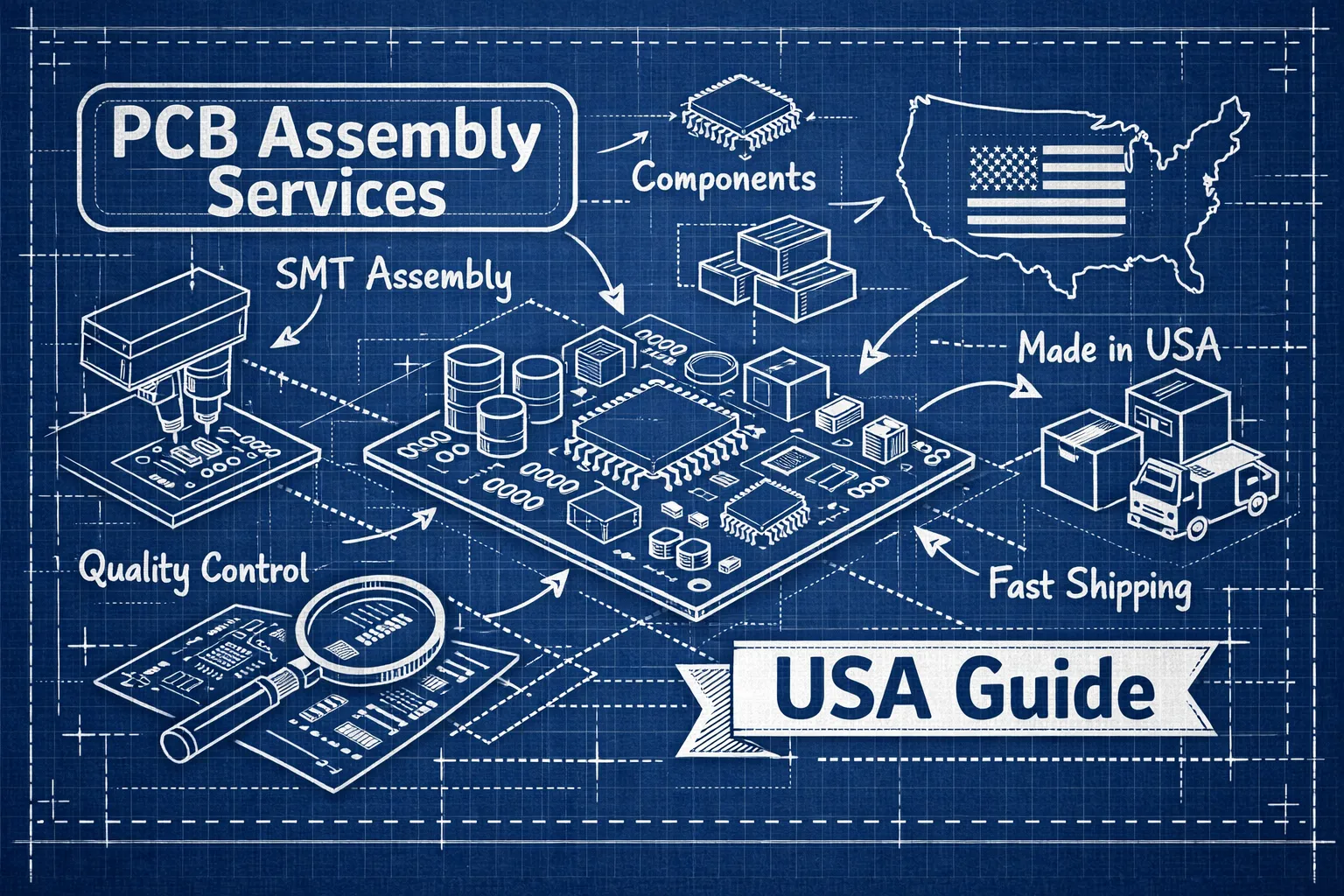
Choosing a PCB assembly partner in the United States isn’t a simple vendor search. It’s a risk management decision with real consequences for your schedule, your yield, and your product’s long-term cost structure. In practice, most buyers don’t get burned by picking an obviously bad assembler, they get burned by picking one whose actual capabilities don’t match their project’s phase, quality requirements, or scale trajectory.
This guide gives you a practical framework for evaluating domestic PCB assembly providers, whether you’re building ten prototype boards or ramping to production volume. We’ll cover what lead times and MOQs actually look like at each stage, which certifications are non-negotiable, what a credible inspection stack includes, and how to write an RFQ that gets you comparable, accurate quotes. If you’re evaluating full-service domestic PCBA partners alongside this guide, Amtech belongs on your shortlist.
Why domestic PCB assembly makes more strategic sense than it used to
The business case for U.S.-based assembly has shifted considerably in 2026. Tariff pressure, supply chain visibility requirements, and iteration speed at the prototype stage have all tilted the math toward domestic manufacturing in ways that weren’t as clear a few years ago. Reshoring momentum, once mainly a risk-mitigation narrative, now has hard cost data behind it.
Lead time alone can justify the decision. Typical U.S. prototype turnarounds run 24 hours to 7 days with in-stock components, compared to several weeks offshore once you factor in shipping and customs delays, a gap that can easily stretch to a month or more depending on the provider and service tier. At the prototype stage, that time difference directly affects how many design iterations you can complete in a quarter. Faster DFM feedback loops and quicker revision cycles compress your development timeline in ways that show up on the bottom line.
On the tariff side, the stacked cost of China-origin PCBs has risen sharply. Section 301 imposes a 25% base tariff on most PCB categories, and when layered with IEEPA-based measures, effective landed rates currently reach approximately 20% for standard 2- and 4-layer FR4 boards and 45% for 6-layer, flex, and non-FR4 assemblies depending on applicable exemptions and classification. That landed cost unpredictability makes offshore assembly harder to budget and harder to justify when domestic options are increasingly cost-competitive. For ITAR-sensitive, defense-adjacent, or high-reliability programs, the regulatory case for domestic assembly isn’t a preference, it’s a legal requirement.
Lead times, MOQs, and the prototype-to-production spectrum
One of the most common mismatches in PCBA partner selection is choosing a provider whose service tiers don’t align with your current project phase. A shop optimized for high-volume runs won’t serve your prototype needs well. A quick-turn prototype house may not have the process discipline to handle a production ramp. Understanding the realistic numbers at each stage helps you filter faster.
For prototype quantities, one to ten boards, expect 24 to 72 hours for assembly when components are in stock and design files are complete. Add one to three days if the assembler needs to source components. Low-volume runs in the ten to one thousand board range typically land in the one to three week window under standard scheduling, with quick-turn tiers available at a premium. Production ramps are more variable: three to five or more weeks depending on volume, board complexity, and test requirements.
For practical benchmarks on turnaround expectations and typical assembly timelines, see this PCB assembly timeline guide.
MOQ flexibility tells you a lot about how a partner is actually set up. Credible U.S. assemblers start from a single board with no hard MOQ floor for prototypes. Providers that impose high minimums on standard runs are generally not built for mixed-volume programs, meaning they’ll struggle if your product needs to flex between low-volume specialty runs and production quantities. Per-unit pricing drops as volume scales, but not linearly, understanding where the tier breakpoints fall in a quote is essential for projecting program costs accurately as you grow.
On engagement model, turnkey assembly, where the assembler handles procurement, population, and test, reduces your project management burden but requires confidence in that partner’s sourcing discipline. Consigned or kitted assembly gives you more component control at the cost of putting supply risk back on your team. Hybrid models are common for programs with long-lead or sole-source parts, where the buyer kits the critical items and the assembler sources the rest.
Quality certifications that should be on your checklist
Certification requirements vary by industry, but there’s a baseline every serious U.S. assembler should meet, and then there are the additions that become non-negotiable depending on your application. Knowing the difference prevents you from over-specifying on simple programs or under-specifying on high-reliability ones.
ISO 9001 is the baseline: it confirms a structured quality management system is in place. Necessary, but not sufficient. IPC-A-610 classification matters more for day-to-day assembly quality. Class 2 is appropriate for commercial and industrial electronics where extended life is desired but failure isn’t catastrophic. Class 3 is mandatory for aerospace, medical, defense, and any application where equipment failure creates safety risk or mission-critical consequences. Class 3 requires tighter tolerances, 100% inspection coverage via AOI and X-ray, and detailed traceability records, it typically adds 20 to 40% to assembly cost compared to Class 2. RoHS compliance is standard for any product going to commercial markets or international distribution.
For a concise comparison of IPC Class 2 versus Class 3 requirements and practical implications for assembly standards, consult this IPC A-610 Class 2 vs Class 3 overview.
Beyond the baseline, industry and application-specific certifications become legally or contractually required. ITAR registration is mandatory for any project touching U.S. defense articles or controlled technical data, there is no workaround. Aerospace programs require AS9100. Medical device programs require ISO 13485. Automotive electronics production requires IATF 16949.
When evaluating a potential partner, ask for documentation rather than verbal confirmation. A credible assembler can produce current certificates on request without hesitation. If there’s a delay or an excuse, that’s useful information.
Testing and inspection: where yield is won or lost
The inspection stack a provider runs directly determines first-pass yield rates and the probability of field failures reaching your customers. This is where the difference between a serious assembly operation and a commodity shop becomes visible.
A complete inspection sequence integrates four interdependent capabilities. Automated optical inspection (AOI) catches surface-level defects post-SMT: missing components, solder bridges, polarity errors, tombstoning. It’s fast, non-destructive, and should be standard on any modern SMT line. X-ray inspection goes further, revealing BGA and hidden solder joint defects, voids, bridging, incomplete reflow, that AOI physically cannot detect. For any board with BGA packages, X-ray is essential; for QFN and other bottom-terminated components, it is strongly recommended. In-circuit test verifies electrical performance at the component level before functional test, isolating failures by component rather than by board. Functional test simulates end-use operating conditions and serves as the final gate before shipment.
For a practical look at how AOI systems improve quality and efficiency in PCB manufacturing, see this discussion of automated optical inspection in PCB manufacturing.
In-house testing adds 10 to 30% to upfront assembly cost, but the math works in your favor. First-pass yield rates on lines with full inspection stacks are substantially higher than on lines relying on visual or sampling-only methods. Rework cycles are expensive, field failures are more expensive, and warranty returns are the most expensive outcome of all. When evaluating a potential partner, ask them to describe their inspection sequence and decision logic, not just list the equipment they own. The sequence and integration of inspection steps matters as much as the capability itself.
What a full-service U.S. PCB assembly partner actually looks like
The criteria above describe a minimum bar. A genuinely strong domestic partner clears that bar and adds capabilities that make programs run better from the first prototype through volume production.
Amtech is an example of what that looks like in practice. Amtech’s model begins upstream from assembly: co-engineering starts at the design phase, which means programs arrive at the assembly line already optimized for yield and schedule rather than being corrected after tooling and component procurement are already committed. DFM reviews at the front end catch manufacturability issues that would otherwise surface as costly surprises mid-build. That upstream engagement is the difference between a transactional assembler and a genuine manufacturing partner. For a deeper dive into how electronics assembly services should be structured, see the Electronics Assembly Services Buyer’s Guide.
On the production floor, proprietary robotics and AI-driven optical inspection reduce false failures and improve consistency across high-mix production runs. Amtech’s AI-enabled AOI achieves defect detection accuracy above 95% in SMT applications, with first-pass yield improvements from the 85% range to above 95% on lines where it’s fully deployed. For buyers running mixed assemblies or complex boards, that consistency directly affects cost-per-unit and schedule reliability.
Supply chain resilience is built into the program from day one, not added reactively when a shortage hits. Amtech’s Design for Volatility approach includes alternate sourcing strategies, tariff-mitigating approved vendor list development, and end-of-life lifecycle planning structured into the initial program. For buyers planning to scale, this matters enormously. The assembler who builds supply chain resilience at the prototype stage is the one who won’t become a bottleneck when you’re trying to hit a production ramp.
How to write a strong RFQ and evaluate what comes back
A well-constructed RFQ package is the difference between getting a useful, comparable quote and getting a ballpark number that falls apart once the assembler sees the actual files. Submit everything the assembler needs to price accurately, and specify requirements rather than leaving them to assumption.
Your RFQ package should include Gerber files (or ODB++ data), a complete BOM with approved manufacturer part numbers and alternates where they exist, a pick-and-place/centroid file for accurate machine setup and pricing, assembly drawings, and a clear IPC class requirement. Specify your inspection and test requirements explicitly, don’t assume the assembler defaults to your standard. Include quantity tiers covering prototype, pilot, and production volume so you receive scalable pricing in a single response rather than needing multiple quote cycles as your program evolves. For additional RFQ best practices and a detailed checklist to improve quote accuracy, review this How to Choose a PCB Assembly Company guidance.
When comparing quotes, unit price is a starting point, not the whole picture. Look at the following:
- Lead time as a commitment, not an estimate; ask whether it’s contractual
- First-pass yield data from comparable programs, not general marketing claims
- Communication model: dedicated program manager versus a shared ticketing queue
- Component sourcing approach and whether alternates are pre-qualified
Before committing to full production, request a DFM review. This step costs little and reveals more about how a partner actually engages with your design than any sales conversation will. A partner who provides detailed, actionable DFM feedback is demonstrating the engineering depth that protects you through the entire program lifecycle. One who provides a generic checklist response is showing you exactly what the relationship will look like when problems arise.
Build your shortlist the right way
The partners worth serious consideration are the ones who engage before the build starts, at the DFM stage, at the sourcing stage, and at the certification level your application actually requires. That upstream discipline is what separates assemblers who can quote a board from partners who can own a program.
The right partner clears the certification and inspection bar, engages at the DFM stage, and brings supply chain resilience into the program before you need it. That combination keeps programs on schedule from prototype through production volume without requiring you to switch partners as complexity increases.
Amtech is a full-service U.S. PCB assembly and product development partner built around exactly this model. If you’re building your shortlist of domestic PCBA providers, it’s worth starting there. Request a quote or DFM review to see how the approach applies to your specific program. For additional perspective on selecting manufacturing partners as your program scales, you can also review guidance on How to Select a new PCB Assembly manufacturer.