
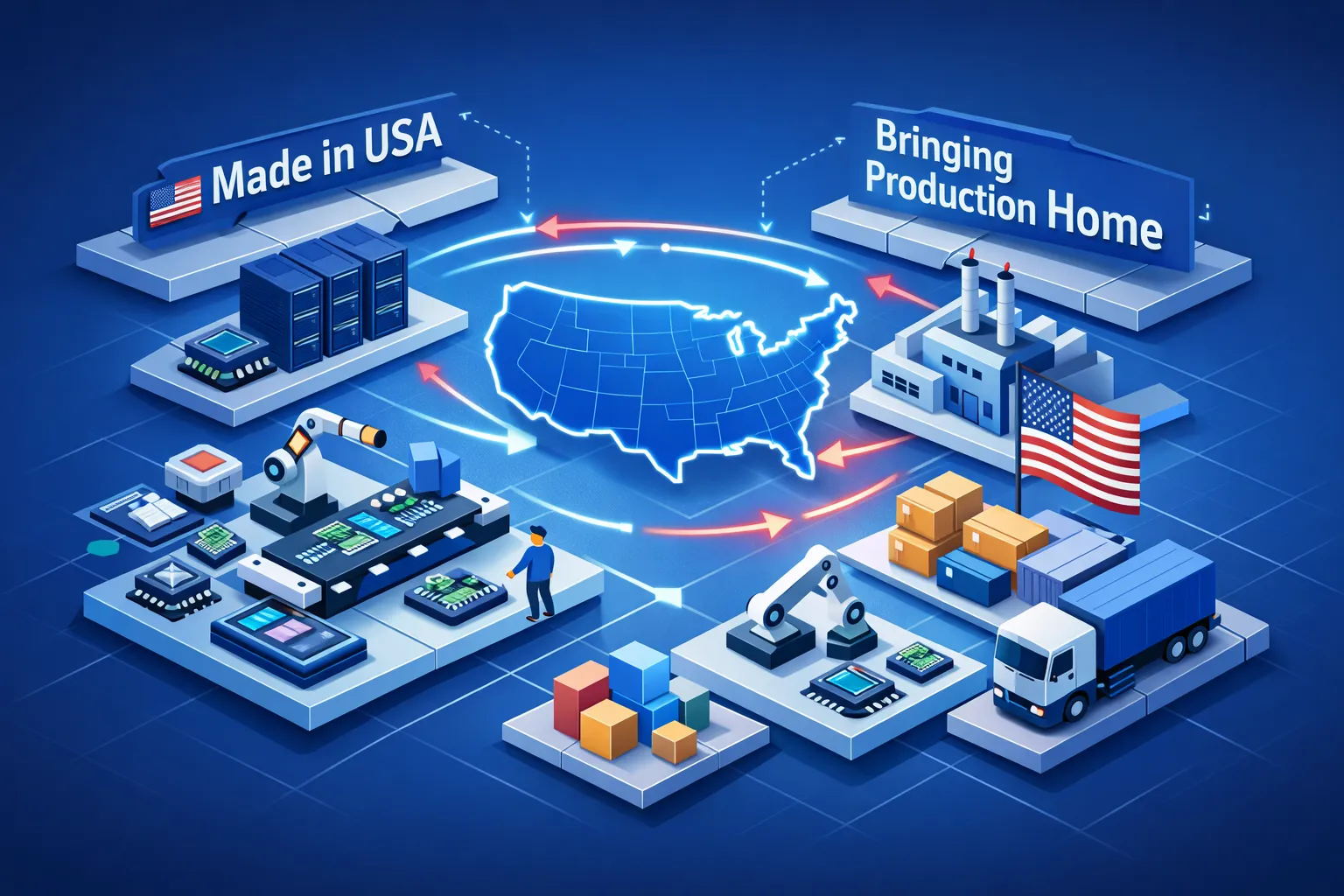
Tariffs, lead times, and supply chain exposure have made offshore electronics production increasingly risky and expensive. The math has changed in a way that can’t be ignored. Onshoring electronics manufacturing to the U.S. is no longer a patriotic statement; it’s a competitive calculation, and for a growing number of mid-market OEMs, the numbers are finally starting to point home.
Companies that once assumed domestic production was cost-prohibitive are now discovering that tariff stacking, hidden logistics costs, and supply chain opacity were propping up a model that no longer holds up. The offshore premium that looked attractive in a stable trade environment has eroded under compounding duties, freight volatility, and the real cost of being unable to respond to market changes in real time.
U.S.-based contract manufacturers like Amtech have been building their infrastructure specifically around this transition, not just to handle production, but to support the full operational shift: tariff strategy, production readiness, DFM review, and supply chain resilience. This article is a practical roadmap for operations leaders and OEMs asking: “Is this the right move for us, and how do we execute it without disrupting what’s already running?”
Why the Onshoring Window Is Open Right Now
2026 marks a genuine inflection point for domestic electronics manufacturing. The regulatory and cost environment has shifted in ways that make onshoring electronics manufacturing to the U.S. more compelling than at any point in the past two decades. This isn’t driven by sentiment. It’s driven by math that finance teams are finally being forced to model correctly.
How the Tariff Stack Is Changing Landed Cost Math
A China-origin PCBA now faces a compounding duty structure that few companies fully accounted for when their offshore programs were originally costed. Section 301 tariffs add 25% for most Chinese electronics. Section 232 semiconductor duties add another 25% for assemblies containing qualifying chips or derivatives. The Section 122 global surcharge, effective February 24, 2026, layers on an additional 10% for non-Section 232 goods. Stack those on top of base MFN rates, and a standard telecom PCBA sourced from China carries an effective duty burden of 35% or more. For assemblies with significant copper or semiconductor content, that number can climb well above 50%.
For manufacturers seeking practical approaches to manage these levies, Reshoring as a Tariff Mitigation Strategy outlines how relocating production can materially reduce duty exposure. The federal government has also recently taken new steps on semiconductor import policy that directly affect landed cost calculations; see the official announcement on adjustments to semiconductor imports for the most current guidance (adjusting imports of semiconductors).
Add freight volatility, port delays, and the minimum order quantity constraints typical of Chinese contract manufacturers, and the offshore premium shrinks faster than most finance teams have modeled. A $100,000 shipment of telecom PCBAs now generates $35,000 in duties alone, before a single dollar of freight or customs brokerage is accounted for. That’s not a rounding error, it’s a structural cost that domestic production eliminates entirely.
Supply Chain Visibility as a Competitive Edge
Beyond cost, visibility is the underrated driver of this shift. Offshore production means 14 to 20+ week order-to-delivery cycles, limited real-time insight into production status, and compressed windows to respond to design changes or component shortages. When a quality issue surfaces, the feedback loop spans weeks and sometimes requires international travel to resolve.
Companies that have moved to domestic production report faster response cycles and tighter quality feedback loops. Same-time-zone coordination eliminates 12-hour communication lags. Real-time monitoring of long-lead components allows proactive alternate sourcing before a shortage becomes a line stoppage. Shorter. These are structural advantages offshore production simply cannot replicate, regardless of how well the relationship is managed. For a deeper exploration of why supply chain resilience matters specifically in electronics manufacturing, see Why Supply Chain Resilience Matters in Electronics Manufacturing.
The Honest Cost Comparison: Onshoring Electronics Manufacturing USA vs. Offshore
The unit cost gap is real, and acknowledging it upfront is the only way to build a credible onshoring business case. U.S. PCB assembly and EMS costs are higher on a per-unit basis, especially at high volumes. But the comparison most companies run is incomplete: they compare their China unit cost to a U.S. quote without accounting for the full cost-of-ownership picture.
Where the Unit Cost Gap Actually Lives
At volumes above 100,000 units annually, offshore production still holds a cost advantage driven by multi-shift labor, integrated component supply chains, and scale. China’s continuous production operations spread fixed costs across millions of units in a way that U.S. facilities can’t match at equivalent volume. That advantage is real and shouldn’t be dismissed.
At low-to-medium volumes, typically under 10,000 units, the gap compresses significantly. U.S. setup labor, tooling, and overhead get spread across fewer units in either geography. Domestic production eliminates freight costs, customs brokerage fees, currency exposure, and tariff liability in a single move. For high-mix, low-volume programs, onshore PCB assembly is often cost-neutral or better once the full cost picture is modeled. For context on how PCB unit economics differ between China and the U.S., see this analysis of why PCBs can cost less in China (why PCBs cost less in China than in the USA).
Hidden Costs That Offshore Sourcing Rarely Surfaces
Most total cost of ownership analyses miss several significant cost categories. Safety stock carrying costs are among the largest: manufacturers sourcing offshore routinely hold months of buffer inventory to cover long lead times, tying up working capital and warehouse space that never appears on a per-unit invoice. The cost of delayed engineering changes is another: when a design revision requires scrapping an in-transit or in-production run, the financial impact can erase months of per-unit savings.
Air freight premiums during supply disruptions, quality escapes discovered only after goods clear customs, and the management burden of remote production oversight add further costs that rarely surface in a standard procurement analysis. These costs show up in working capital reports, program delays, and quality spend. The companies that build the most accurate onshoring business case are the ones that quantify these items before comparing a domestic quote to an offshore invoice.
Federal and State Incentives That Strengthen the Business Case
The policy environment is actively subsidizing the move to domestic production. The incentive landscape is more substantial than most operations leaders realize, and understanding what’s actually available is what separates manufacturers who capture it from those who leave it on the table.
What CHIPS Act, IRA, and Permanent Tax Provisions Fund
The CHIPS Act’s $52 billion is primarily directed at semiconductor fabrication, with $39 billion in direct subsidies for fab construction or expansion and $13 billion for research and workforce development. Downstream, the Supporting American Printed Circuit Boards (SAPCB) Act extends policy support toward domestic PCB manufacturing, reflecting congressional recognition that the semiconductor supply chain requires a domestic substrate to assemble on. For a concise breakdown of the CHIPS Act and how it affects industry incentives, see this CHIPS Act overview (CHIPS Act: what it funds).
The Inflation Reduction Act provides grants, credits, and loans for emissions-reducing manufacturing investments, with applicability to electronics facilities modernizing their processes. The permanent 21% corporate tax rate and immediate expensing for facility construction, rather than long-term depreciation schedules, significantly improve the ROI profile of building or expanding domestic production capacity. These provisions are available now; they’re structural advantages of manufacturing in the U.S. that many operations teams haven’t fully modeled into their reshoring analysis.
State Programs, MEP Grants, and How to Find Them
NIST’s Hollings Manufacturing Extension Partnership (MEP) funds cooperative agreements for small and mid-sized manufacturers across the country. States like Illinois and New York have received substantial MEP allocations, with FY2026 awards totaling tens of millions in manufacturing support. Most states also maintain economic development organizations that offer tailored incentives for manufacturers relocating or expanding domestically, from tax abatements to workforce training grants.
The Reshoring Initiative maintains a downloadable incentive database and an Import Substitution Program that helps manufacturers identify major importers of products they could produce domestically, a useful market-entry tool alongside incentive research. For an accessible guide to available grants and incentives for manufacturers, see this resource on grants and incentives for manufacturers. The practical starting point is to contact your state’s economic development office and the regional MEP Center simultaneously; these organizations exist specifically to help manufacturers navigate available programs and identify what applies to their situation.
Nearshoring vs. Onshoring: Choosing the Right Model for U.S. Electronics Manufacturing
Some manufacturers consider nearshoring, moving production to Mexico or Canada, as a middle path between full offshore and domestic production. Nearshoring can reduce transit times and tariff exposure on certain goods under USMCA, but it doesn’t eliminate the visibility gaps, communication friction, or duty complexity that make offshore production expensive to manage. For electronics programs subject to ITAR, defense supply chain requirements, or domestic content mandates, nearshoring typically doesn’t qualify. Onshoring electronics manufacturing to the U.S. remains the only path that addresses all of these requirements simultaneously while fully capturing available federal and state incentives.
How to Structure a Phased U.S. Onshoring Electronics Manufacturing Transition
The mistake most companies make is treating the move as a binary switch: shut down the overseas program and start the domestic one. A phased transition reduces risk, preserves production continuity, and gives the new domestic partner time to get up to speed on your product before full volume depends on them. A realistic timeline for a mid-market OEM runs 12 to 24 months from partner selection to full-volume domestic production.
Starting with Production Readiness and DFM Review
Before a single component ships to a U.S. contract manufacturer, the product needs a production readiness review. This means a DFM audit to identify design choices that were optimized for offshore tooling or processes and may need adjustment for U.S. production methods. It also means BOM scrubbing: validating that components are available through domestic or tariff-favorable distributors, and building an alternate vendor list that reflects current supply chain realities rather than the sourcing assumptions made when the product was originally designed.
Skipping this step is the most common transition pitfall. Yield issues discovered six weeks into production, because the design was never reviewed for domestic manufacturability, cost more in rework cycles than the review itself. The DFM review determines whether the transition delivers on its timeline and cost projections or spends the first quarter correcting avoidable problems.
Phased Cut-Over vs. Full Transition: Choosing Your Path
For companies with high SKU counts or complex assemblies, a phased approach makes sense. Start by onshoring one product line or subassembly, validate the partner’s quality and process capability over 90 to 180 days, then migrate additional programs with confidence built from demonstrated performance. Running parallel domestic and offshore production during the ramp period, starting with 20% domestic volume and scaling up, keeps supply continuity intact while the new partner stabilizes.
For companies with a single core product or those facing acute tariff exposure, a full transition may deliver ROI faster. The decision hinges on production complexity, SKU mix, BOM risk concentration, and the domestic partner’s demonstrated capacity at your volume range. A partner that can’t clearly articulate their capacity ceiling and quality process for your specific product type is not the right partner for a full-transition strategy.
What to Look for in a U.S. Electronics Manufacturing Partner
Choosing a domestic EMS partner is not a sourcing decision, it’s a long-term operational relationship. The wrong partner will create the same supply chain fragility you were trying to escape, just closer to home. The evaluation criteria that matter are not the ones most prominently featured in a capability brochure.
Capabilities That Go Beyond Certifications
ISO 9001, AS9100, and ITAR compliance are table stakes, not differentiators. Every serious EMS provider will have them. What actually matters is whether the partner offers DFM and DFA support, or whether they simply build to print without flagging design risks. Can they handle the full product scope, SMT assembly, wire harnessing, functional test, and box build, or will you need multiple partners to cover a single program? Do they operate proprietary automation that controls unit costs at your volume range, or are they competing on labor rates alone?
Supply chain infrastructure is the other critical variable. Does the partner have the capability to develop tariff-mitigating AVLs and alternate sourcing strategies, or will they hand that work back to you? Can they proactively flag component lifecycle events, end-of-life notices, long-lead situations, before they become production risks? The partners that deliver real onshoring value are the ones that participate in program risk management, not just production execution.
How Amtech Is Built Specifically for This Transition
Amtech has structured its entire service model around the onshoring transition. The Design for Volatility program builds tariff-mitigating AVLs and alternate sourcing strategies into every program from day one, addressing the component risk exposure that causes the most expensive surprises during a transition. DFM and DFA support bridges the gap between a design optimized for overseas production and one that’s production-ready for domestic manufacturing methods, and it’s a standard part of every onshoring engagement, not an add-on.
Proprietary robotics and automation give Amtech cost competitiveness at volumes where many U.S. EMS providers struggle to pencil out. The flexible engagement model, Tech Facilitator, ODM-style collaboration, or Production Partner, means a company can start at prototype and scale to full production without changing partners at each stage. The 3R Promise (Reliable, Robust, Responsive) is backed by 20+ years of leadership experience and direct engagement with U.S. manufacturing policy, giving customers a partner that understands both the factory floor and the regulatory environment shaping the industry around it.
Measuring ROI and Supply Chain Gains After the Move
The transition isn’t complete when the first domestic shipment arrives. The operational gains from moving to domestic production compound over the first year, and tracking the right metrics is what separates a transition that delivers on its business case from one that gets quietly re-evaluated.
Lead Time and Visibility Benchmarks to Track in Year One
Domestic electronics production should deliver order-to-delivery lead times of 4 to 8 weeks for standard production runs, compared to 14 to 20+ weeks for offshore. Track on-time delivery rate against that new baseline, not the offshore benchmark. Visibility metrics to monitor include real-time production status access, days to respond to an engineering change request, and time from a quality flag to root cause response. These are the operational gains that accumulate over time, gains that offshore production structurally cannot match regardless of relationship quality.
ROI Checkpoints That Signal the Transition Is Working
Set review gates at 90 days, 6 months, and 12 months with defined criteria at each. At 90 days: validate that unit cost is landing within 10% of projection and that any DFM-driven yield issues have been identified and resolved. At 6 months: compare total cost of ownership, including working capital freed from buffer stock reduction, against the pre-transition baseline. The inventory carrying cost reduction alone, from eliminating the safety stock that long offshore lead times required, often represents a significant working capital recovery that never shows up in per-unit cost comparisons.
At 12 months: calculate the tariff liability eliminated, any incentive credits received, and the freight and customs spend removed from the P&L. Most companies that execute the transition correctly find the ROI case strengthens through the first year as the embedded costs of offshore sourcing stop accumulating. The 12-month review is also the point to evaluate whether additional programs are ready to migrate, using the data and partner confidence built during the first cycle.
The Production Model That Holds Up Under Pressure
Onshoring electronics manufacturing to the U.S. is not about going backward, it’s about building a production model that’s resilient against the variables that have caused the most damage over the past several years. Tariffs, extended lead times, and supply chain opacity are structural problems embedded in offshore production. No efficiency improvement or relationship investment will solve them; they’re products of geography and the trade environment, not execution.
Implementing continuous improvement and lean production methods is a natural complement to onshoring; for guidance on applying lean principles specifically to electronics manufacturing services, see Implementing Lean in Electronics Manufacturing Services: A Strategic Approach. The incentives are real, the math has shifted, and the domestic manufacturing infrastructure to support the transition exists and is being built out further every year. The companies that move now, with a structured approach and the right manufacturing partner, will have established domestic production programs with fully stabilized costs and suppliers while competitors are still building the business case.
For companies ready to evaluate the move, Amtech’s onshoring transition support, from DFM review and tariff strategy to scalable production, is designed to make the shift executable without disrupting current operations. Talk to Amtech’s team about your onshoring roadmap and get a clear picture of what the transition looks like for your specific program.