
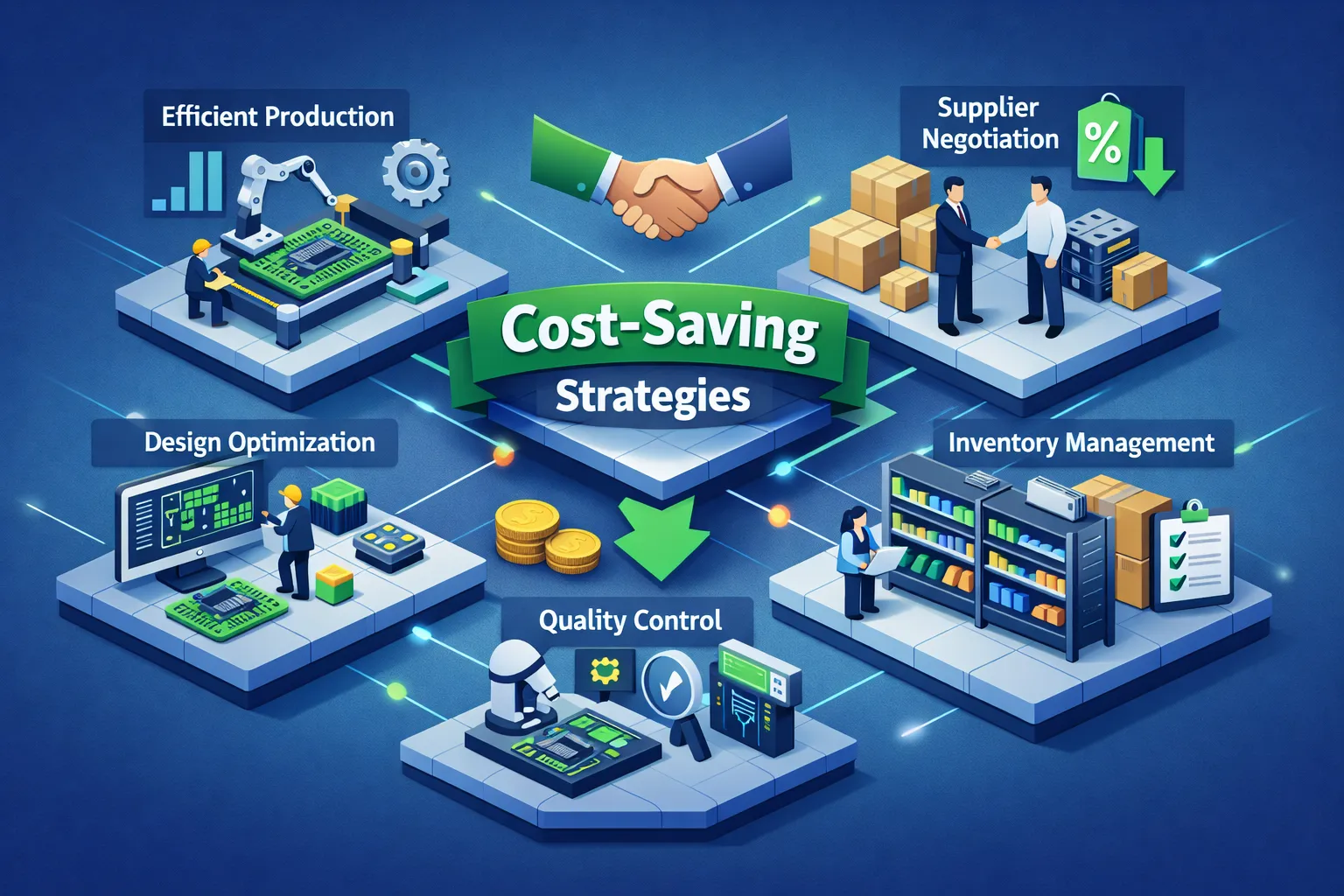
Low to mid volume electronics manufacturing doesn't have to drain your margin. Learn 5 proven strategies to cut costs, control lead times, and scale short runs with confidence.
<p>Low to mid volume electronics manufacturing carries the same fixed overhead as high-volume work, but spreads it across far fewer units. That structural cost problem hits every hardware team running somewhere between 50 and 5,000 units, and it shows up immediately in the numbers. Per-unit costs for low-volume PCB assembly typically run $50 to $400. Move into mid-volume territory and that range drops to $10 to $80 per board. The gap is real, but it’s not inevitable.</p>
<p>Most of the cost premium in short runs doesn’t come from some unavoidable law of manufacturing economics. It comes from design decisions made too late, process mismatches on the production floor, sourcing friction that stalls entire builds, and the wrong manufacturing partner accepting your order reluctantly. The infrastructure exists to handle this well. You just need the right approach, and the right partner.</p>
<p>The five strategies below address each lever in sequence: design, production process, testing, sourcing, and partner selection. Work through all five and you change the economics of short-run production structurally, not just at the margins.</p>
<h2>Why Low to Mid Volume Electronics Manufacturing Is Different</h2>
<p>Short-run electronics manufacturing doesn’t fail because the technology is lacking. It fails because the cost structure, tooling assumptions, and sourcing dynamics are fundamentally different from high-volume production, and most manufacturers are optimized for volume. Fixed NRE and setup fees that are trivial at 50,000 units become a significant budget line at 500. Component suppliers prioritize large buyers. Testing strategies designed for statistical process control don’t translate to a 200-unit build. Understanding where those differences bite is the starting point for managing them.</p>
<h2>1. Nail Your DFM Before the First Unit Runs</h2>
<p>Most cost in short-run production is locked in at the design stage, not on the production floor. When NRE and setup fees run $100 to $500 per job, a single preventable design issue doesn’t just delay one run, it burns a disproportionate share of the program budget before a single board ships. The decisions you make about layer count, via types, component selection, and pad geometry carry far more relative weight in low volumes because there’s no high-volume run to amortize the rework.</p>
<h3>Minimize Layers and Standardize Your Drill Sizes</h3>
<p>Reducing layer count directly cuts fabrication cost per unit. Choosing four layers over six isn’t just an aesthetic engineering decision; it eliminates plating cycles, reduces material cost, and simplifies the fab process at every step. Standardizing drill sizes compounds that benefit. Each additional drill size requires a tool change, and in short-run fabrication, those changes hit per-unit cost hard. Consolidating to a single drill diameter where your design allows can reduce drilling costs by 5 to 10% per eliminated size. Based on fab quotes across typical NPI programs, well-optimized designs have achieved substantial total cost reductions from these two moves combined, though the exact figure depends on board complexity and layer configuration.</p>
<h3>Prioritize SMT and Simplify Through-Hole Placement</h3>
<p>Maximizing surface-mount placement over through-hole reduces manual labor and streamlines your reflow process. Where through-hole components are genuinely required, group them on one side of the board. That single layout decision enables wave soldering without multi-pass handling, which removes a meaningful chunk of assembly labor from your unit cost. The goal isn’t to eliminate THT components entirely; it’s to stop paying for the handling complexity that comes from scattering them across both sides of the board.</p>
<h3>Run a DFM Review Before Releasing to Production</h3>
<p>An early DFM check catches pad size issues, tight clearances, and footprint mismatches before they become production stops. The downstream impact is significant: across programs we’ve run, catching DFM issues pre-production consistently drives meaningful reductions in total program cost compared to finding them mid-run. When you’re building 200 units instead of 200,000, a production hold isn’t a yield curve problem, it’s a budget crisis. Fix it before it starts. For more on how early DFM reduces program cost, see the analysis on <a href=”https://www.global-imi.com/blog/how-dfm-reduces-costs-and-increases-profit” target=”_blank” rel=”nofollow”>how DFM reduces costs and increases profit</a>.</p>
<h2>2. Apply Lean Workflows and Flexible Tooling on the Production Floor</h2>
<p>Full automation pays off at hundreds of thousands of units annually. Below that threshold, flexible SMT lines with fast changeover are the right tool. The goal on the production floor for short-run work isn’t to replicate a high-volume configuration at smaller scale. It’s to eliminate setup waste without locking into fixed infrastructure that penalizes you for ordering the quantity you actually need. For practical perspectives on lean principles applied to manufacturing, see <a href=”https://buildamtech.com/podcast/lean-manufacturing-and-the-value-of-less/” target=”_blank”>Lean Manufacturing and the Value of Less</a>.</p>
<h3>Design Your SMT Line for Fast Changeover</h3>
<p>Quick-changeover SMT setups handle multiple small jobs per week without a cost penalty for the transitions. Machines in the 45,000 CPH range with programmable feeders allow efficient movement between product lines, which is exactly what makes high-mix, low-volume production economically viable. The per-job setup cost on a well-configured flexible line is fundamentally different from forcing a short run through equipment optimized for single-product, long-run campaigns. Strategies to <a href=”https://www.smtfactory.com/optimize-smt-line-capacity-speed-flexibility-cost.html” target=”_blank” rel=”nofollow”>optimize SMT line capacity, speed, and flexibility</a> are particularly useful when designing for fast changeover.</p>
<h3>Use Process Simulation for New Product Introduction</h3>
<p>Digital process preparation tools simulate solder paste deposition, placement logic, and reflow profiles before a single board is touched. This approach eliminates the trial runs that inflate NPI costs on short programs. When first-time-right production rates improve at the front end of a program, the cost benefit compounds across every unit in a small batch, because there’s no volume buffer to absorb the expense of repeated setup iterations. Digital twins and related simulation techniques are a growing source of advantage for high-mix, low-volume programs; see the discussion of <a href=”https://blogs.sw.siemens.com/electronics-semiconductors/2022/06/16/high-mix-low-volume-electronics-production-success-with-digital-twins/” target=”_blank” rel=”nofollow”>success with digital twins</a> for high-mix production.</p>
<h3>Match Tooling Flexibility to Your Volume Reality</h3>
<p>The relevant question isn’t whether automation is better than manual assembly in the abstract. It’s whether the automation you’re accessing is configured for your volume reality. Mid-capacity pick-and-place machines run $100,000 to $200,000; high-capacity systems at 100,000+ CPH can reach $700,000. For most runs under 10,000 units, <strong>scalable automation rather than full automation</strong> is the right answer. Semi-automated lines with programmable setups give you the consistency benefits of automation without locking capital into configurations that only pay off at volumes you may not reach.</p>
<h2>3. Testing Strategy for Low to Mid Volume Electronics Manufacturing</h2>
<p>Testing in low volumes requires a different philosophy than high-volume production. Statistical process control isn’t viable on a 200-unit run. The objective shifts: catch errors early, validate design intent, and surface system-level failures before they become expensive. You’re not managing yield curves across millions of boards. You’re protecting a small build from compounding defects and ensuring the design is right before you scale.</p>
<h3>AOI as Your Baseline Inspection Layer</h3>
<p>Automated Optical Inspection post-SMT should be non-negotiable, even on small batches. AOI detects solder joint defects, missing components, and polarity errors with consistent precision, and it pairs well with targeted manual verification to refine detection rules early in a program’s life. The setup cost is low relative to the defects it catches, and on a 100-unit build, a single undetected solder bridge can mean the difference between a clean delivery and a full rework cycle.</p>
<h3>When X-Ray and ICT Justify the Setup Cost</h3>
<p>X-ray inspection makes sense for boards with BGAs, underfill, or hidden joints where visual inspection fails. In-circuit test via bed-of-nails validates electrical integrity at the component level and adapts well to variant-heavy, high-mix programs. For complex or high-reliability applications in short runs, these aren’t optional add-ons, they’re the cost of a clean pilot. The fixture investment on ICT may feel heavy on a 300-unit run, but weighed against the cost of a field failure or a mid-program redesign, it’s the cheaper path.</p>
<h3>Use Functional Test to Validate Design Before You Scale</h3>
<p>Functional test simulates real operating conditions and surfaces system-level failures that component-level inspection misses. For prototype and pilot runs, <strong>this is where design issues get caught cheaply</strong>. Skipping functional test before a mid-volume ramp is the most expensive shortcut you can take. What costs a few hours of test fixture time on a 50-unit pilot costs weeks of rework and customer delays when it surfaces at 2,000 units. For practical assembly guidance, compare these tactics with the <a href=”https://buildamtech.com/top-5-electronics-assembly-best-practices-for-2026/” target=”_blank”>Top 5 Electronics Assembly Best Practices for 2026</a> to see how testing fits into a full-process playbook.</p>
<h2>4. Build a Resilient BOM to Protect Against Sourcing Delays</h2>
<p>Component sourcing is where short-run production gets punished hardest. Suppliers allocate stock to volume buyers first. Lead times on microcontrollers run 13 to 30 weeks. Memory and DRAM components are pushing 26 to 40 weeks. Power management ICs can stretch beyond 42 weeks in tight allocation cycles. Small-batch buyers sit at the back of the line by default, and a single missing part halts the entire run. A resilient BOM strategy changes that dynamic before purchase orders are placed.</p>
<h3>Identify Single-Source Risk in Your BOM Early</h3>
<p>Single-source dependency compounds in small-batch production. Even when a component appears available from multiple distributors, it may have only one manufacturer behind it, and that’s the level where allocation decisions are made. Flag these parts at BOM review, not after a shortage hits. A part that’s available today from four distributors can go to zero-stock allocation within a single quarter, and a 300-unit build doesn’t have the purchasing leverage to get prioritized. See approaches for <a href=”https://www.macrofab.com/blog/reducing-single-source-component-risk/” target=”_blank” rel=”nofollow”>reducing single-source component risk</a> when reviewing your BOM.</p>
<h3>Pre-Qualify Alternate Parts and Document Drop-Ins</h3>
<p>Identifying form-fit-function alternatives during the design phase protects production continuity without requiring PCB redesigns mid-program. EMS providers with strong component engineering capability can run qualification testing on alternates and document approved substitutes directly in the BOM. That documentation isn’t just a backup plan; it’s an active sourcing tool that gives your manufacturing partner options when primary stock tightens.</p>
<h3>Use Kitting and Consignment to Buffer Critical Stock</h3>
<p>Kitting, where you supply components for assembly, gives you direct cost control and ensures exact part specifications are met. Consignment works differently: your EMS partner holds pre-purchased stock for just-in-time use, which reduces the risk of allocation gaps and price spikes without requiring large upfront inventory commitments. For small-batch production with known repeat runs, <strong>consignment stock on high-risk components</strong> is one of the most effective ways to decouple your production schedule from spot-market volatility.</p>
<h2>5. Choose an EMS Partner Built for Short-Run Production</h2>
<p>Most contract manufacturers are optimized for volume. Their equipment configurations, customer service models, and quoting structures assume you’re ordering tens of thousands of units. If you’re running 50 to 2,000, you need a partner whose production infrastructure is actually designed for high-mix, short-run work, not one accepting your order as a favor between larger programs. The difference in outcome between these two scenarios is not subtle.</p>
<h3>Key Questions to Vet Any Short-Run CEM</h3>
<p>The questions that separate capable short-run partners from volume manufacturers reluctantly accepting small jobs are specific. Asking them directly before you send files reveals whether a manufacturer’s infrastructure actually supports what you need, or whether they’re simply willing to take the order.</p>
<ul>
<li>What’s your minimum order quantity, and what does per-unit pricing look like at 100, 500, and 1,000 units?</li>
<li>Do you offer DFM review before quoting, and is it documented feedback or a verbal pass?</li>
<li>How do you handle BOM gaps and alternate component substitutions?</li>
<li>What’s your NPI workflow from files to first article?</li>
<li>How do you document traceability and serialization for production runs?</li>
</ul>
<p>A manufacturer who fumbles these questions isn’t a short-run specialist. They’re a volume shop with a low-MOQ checkbox on their website.</p>
<h3>Look for Scalable Automation, Not Just Capacity</h3>
<p>The right partner invests in automation that flexes with volume. Semi-automated SMT lines, programmable pick-and-place, and AI-enabled inspection aren’t just for high-volume shops. They’re what makes consistent quality on a 100-unit run achievable without manual labor variability eating your yield. When a manufacturer can hold the same process discipline on 50 units as they apply to 5,000, that’s an engineering capability, and it shows up directly in your defect rates and delivery schedule.</p>
<h3>Why Amtech’s Michigan Facility Is Built for This</h3>
<p>Amtech’s Michigan facility was designed with this production envelope in mind. Production-ready assemblies start at 50 units, with the same DFM review, AOI, functional test, and supply-chain strategy applied whether the program is 50 boards or 5,000. Scalable automation holds tight quality standards across that entire range, and our co-development model means we’re working on BOM resilience and design trade-offs with you before your first unit runs. A 200-unit build isn’t a stepping stone to a bigger order here, it’s a program that gets the same engineering rigor as any other work on the floor. Our approach mirrors ideas in <a href=”https://buildamtech.com/how-agile-manufacturing-builds-a-sustainable-competitive-advantage-for-electronics-brands/” target=”_blank”>How Agile Manufacturing Builds a Sustainable Competitive Advantage for Electronics Brands</a>.</p>
<h2>The Five Strategies Work Together, Not in Isolation</h2>
<p>Low to mid volume electronics manufacturing carries inherent cost pressure, but most of that pressure responds to deliberate decisions made at the right stages. DFM reduces cost before production starts. Lean, flexible tooling keeps the floor efficient across multiple programs. Targeted testing protects yield without the overhead built for mass production. A resilient BOM absorbs supply disruptions before they halt your build. And a partner who specializes in short-run electronics manufacturing closes the gap between what these programs cost and what they should cost.</p>
<p>These five strategies aren’t a checklist you run through once. They’re an integrated approach where each decision reinforces the next. A clean DFM feeds into faster floor setup. Resilient sourcing prevents the kind of mid-run component scramble that turns a tight program into an expensive one. The right test strategy validates your design before you commit to volume. Together, they shift the unit economics of low-to-mid-volume EMS from something you manage around to something you control. For a concise implementation roadmap, compare these ideas with the <a href=”https://buildamtech.com/top-5-electronics-assembly-best-practices-for-2026/” target=”_blank”>Top 5 Electronics Assembly Best Practices for 2026</a>.</p>
<p>If you’re planning a run between 50 and 5,000 units and want a partner who treats your program with the same rigor as a high-volume build, talk to the Amtech team. Share your BOM and design files and we’ll give you a clear picture of where the cost risk lives and where the sourcing exposure is, before your first unit runs.</p>
Related Posts