
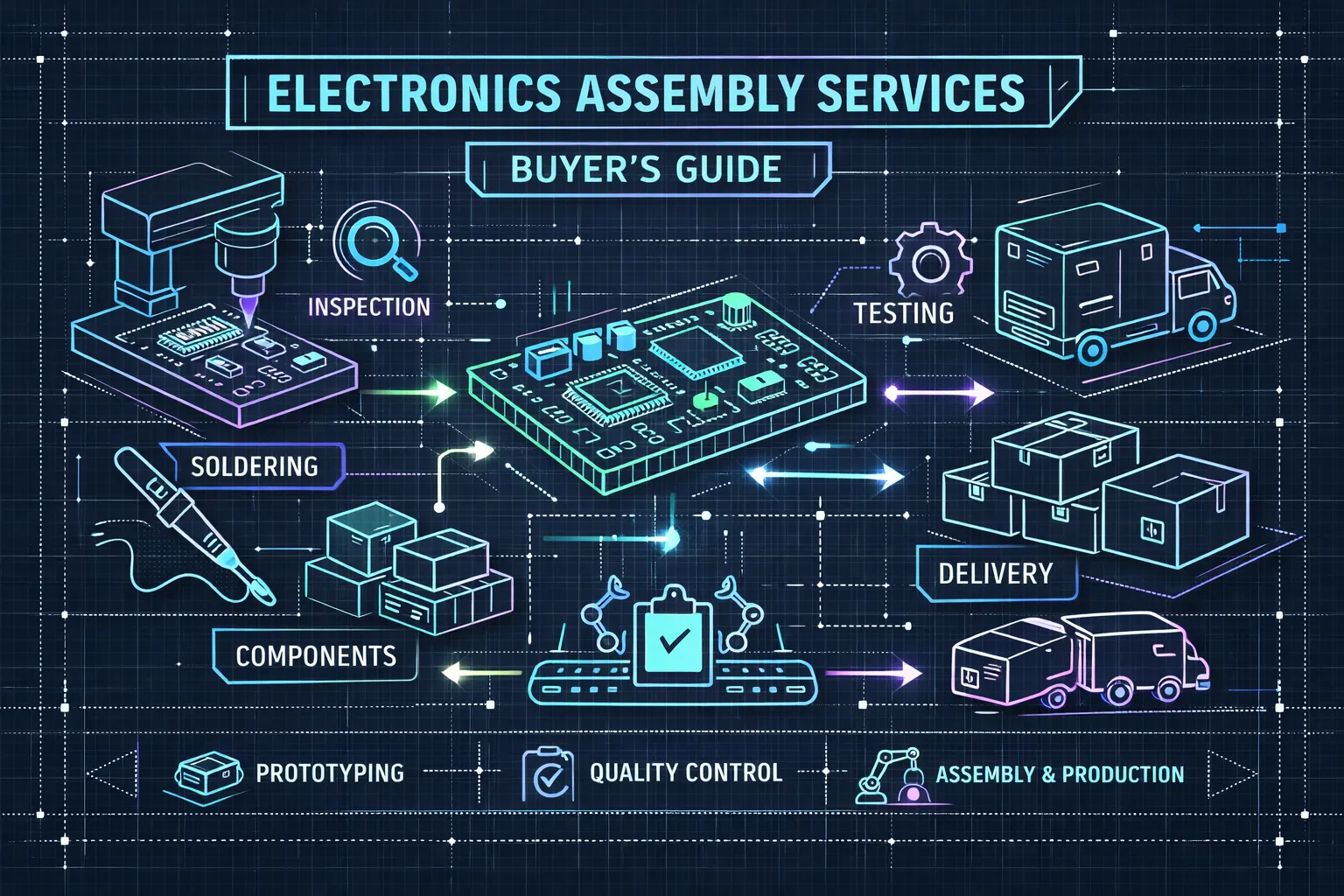
Whether a product launch succeeds or stalls often comes down to electronics assembly services. A capable EMS partner provides PCB assembly that scales from quick prototypes to high-volume PCBA, plus turnkey electronics manufacturing and full system integration. A poor contract manufacturer can create delayed shipments, repeated rework, and hidden costs. This buyer’s guide explains SMT and through-hole assembly, BGA and fine-pitch handling, and the differences between prototype and low-volume workflows so you can vet partners with confidence.
This guide covers the processes that matter and the questions to ask before you sign a PO. Inspectors and buyers should confirm core capabilities, including surface-mount and through-hole assembly, BGA and fine-pitch handling, conformal coating, and box-build, so your EMS can deliver fully tested, integrated products. Confirming those capabilities early prevents late surprises in integration and testing. Use the sections below to compare equipment indicators, quality controls, and service models so you can select a partner that delivers on time and on spec.
Key takeaways
- Verify certifications: check ISO 9001, IPC/WHMA-A-620, and traceable test records to identify reliable suppliers.
- Confirm technical capabilities: validate NPI-capable pick-and-place, zone-controlled reflow ovens, BGA rework stations, and harness practices before issuing a PO.
- Run DFM/DFA early: reduce NRE, lower per-board cost, and avoid costly rework during ramp-up.
- Execute a pilot: a 10-100 board pilot with defined yield and pass metrics exposes issues before full production.
- Prioritize integration: favor partners offering box-build, firmware load, serialization, and onshoring to shorten time to market.
What electronics assembly services include
Electronics assembly services cover PCB-level work and system-level integration so you receive finished, testable products rather than loose boards and parts. A full-service EMS typically handles surface-mount and through-hole assembly, BGA and fine-pitch placement, conformal coating, wire-harness fabrication, and box-build under one roof; these capabilities scale from prototype PCB assembly to turnkey volume manufacturing.
On the PCB side, standard SMT workflows include solder-paste stencil printing, automated pick-and-place, reflow ovens, and inline inspection. Through-hole options include selective soldering for mixed-technology boards and wave soldering for higher-volume THT work, while BGA and fine-pitch placement require specialized heads and rework stations. Prototype work favors flexibility and manual touchups, whereas volume production relies on higher-speed feeders, automated inspection, and tighter traceability to protect yield.
System integration covers automated wire-harness cutting, stripping and crimping with WHMA-A-620 compliance, continuity and hi-pot testing, conformal coating or potting for environmental protection, and full box-build including chassis assembly, panel wiring, mechanical fastening, firmware load, and final functional test. Using a single vendor for box-build reduces handoffs, centralizes accountability for integration issues, and simplifies labeling, serialization, and packaging for shipment. Below we break down inspection, test strategy, and how to choose quality gates for your product.
How to evaluate technical capabilities and certifications
When you source electronics assembly services, certifications and traceable test capability quickly narrow the field. Start with ISO 9001 as the baseline for quality management, then match additional approvals to your product’s regulatory needs such as AS9100 for aerospace, ISO 13485 for medical devices, or ITAR registration for controlled-technology work. Also confirm the provider supports core PCB processes like SMT and through-hole assembly so you avoid downstream process gaps.
Key certifications to request include:
- AS9100 for aerospace and avionics
- ISO 13485 for medical device manufacturing
- IPC-A-610 for workmanship and acceptance criteria
- ITAR registration for defense or controlled-technology work
- RoHS and REACH documentation for hazardous-substance compliance
Ask for certificate copies, the scope page, and the most recent audit date so you can confirm coverage for the specific production line you will use. For a practical primer on AS9100 and electronics manufacturing, see what is AS9100 certification for electronics manufacturing.
Inspect and test capability should be layered and traceable rather than a single check at the end of the line. Expect automated optical inspection (AOI) for surface defects, AXI or X-ray for BGA and internal solder inspection, ICT or flying probe for nets and component values, functional test for system behavior, and burn-in for early-life failures. Some steps are mandatory for regulated products, while others are recommended for high-reliability applications. If you want a deeper look at comparing AOI and X-ray inspection trade-offs, this discussion on X-ray vs AOI — which defects are invisible to optical inspection is useful.
Request evidence such as scope pages, recent audit dates, sample inspection reports, and customer references for similar regulated products so you can evaluate common failure modes and yield trends. Confirm that claimed certifications cover the production cell or plant where your boards will be built rather than only a corporate head office. Equipment, lead times, and DFM practices are the next factors to compare when choosing a partner.
Pricing, lead times and volume strategies
Pricing generally breaks into a per-board variable cost plus fixed setup fees. Per-board charges cover components and placement/assembly, while non-recurring engineering (NRE) or setup fees pay for stencils, programming, and test-fixture builds. As an example, a $600 setup is $0.60 per board at 1,000 boards and $60 per board at 10 boards, which shows how volume dilutes NRE. Spread NRE across volume to reduce unit cost.
Placement and sourcing are the other main cost levers. Placement costs commonly range from $0.005 to $0.03 per placement, so a 200-placement board typically adds roughly $1 to $6 in assembly labor. Turnkey BOM sourcing includes vendor markups, often 5–20% depending on part difficulty and lead time, while consignment BOMs shift sourcing cost and inventory risk back to the customer and often lower the per-board price. Prototype reels, short packs, and cut tape cost more per component than full reels, so small runs carry higher parts overhead.
Expect realistic lead times: simple prototype quick-turn runs can be 24-72 hours, though 3-7 days is more common once parts and test requirements are included. Low-volume runs typically take 1-3 weeks, and mass production commonly targets 3-6 weeks. Component availability, design complexity (fine-pitch, BGA), test requirements, and shop capacity drive calendar time far more than the bare assembly step. For planning around realistic timelines, read this guide on PCB lead time — what to expect and how to plan.
Use practical levers to shorten both cost and timeline: pre-kitted parts or consignment stock, DFM to specify parts with available lead times, and onshoring or dual sourcing to avoid long freight lanes and regional shortages. These moves reduce surprises, lower purchase premiums, and accelerate ramp. Test strategy and quality controls are the next line of defense as volumes increase.
How to pick and qualify an electronics assembly services partner
Picking the right partner starts with a fast, repeatable vetting routine you can run in about 15 minutes. Use a short checklist to separate suppliers who can execute from those who will create risk; the goal is to validate core capabilities and identify deal breakers before you invest time in detailed quotes. Your target partner should be able to handle PCB assembly services and act as a reliable EMS for your product roadmap. For actionable, step-by-step supplier selection guidance, see How to Select a new PCB Assembly manufacturer – Amtech.
Run these 10 quick checks, marking yes/no for each so you end up with a scorecard to share internally. The checklist moves you from gut feel to objective comparison:
- Capability matrix: SMT, through-hole, BGA/fine-pitch, conformal coating, system-level assembly, harness fabrication
- Certifications: ISO 9001, IPC, AS9100 or ISO 13485 where applicable
- Test coverage: AOI, X-ray/AXI, ICT or flying probe, functional test plans
- Equipment age and line capacity (placements/hr, oven zones)
- Traceability and MSL handling (lot tracking, material records)
- Sample AOI/X-ray and first-article reports on similar boards
- Lead-time history for prototypes and typical volumes
- Price transparency: BOM visibility, NRE/tooling, volume breaks
- NPI/engineering support: DFM feedback, fixture/test build
- References for similar products and pilot outcomes
Red flags that should stop the conversation include no traceability, no documented BGA test plan, or vague warranty and returns language. Use copy-and-paste RFP questions when soliciting bids: list equipment and line speeds, provide IPC-A-610 class and certifications, attach a sample functional test plan, state standard and expedited lead times, list tool and NRE fees, explain component sourcing policy, and describe warranty terms and your return/repair process. Clear RFPs shorten evaluation and surface hidden costs early.
For scoring, weight cost 30%, quality and certification 25%, lead time 15%, test coverage 15%, engineering support 10%, and capacity 5%. Require an overall score of at least 70% with minimum quality and test thresholds of 80% for pilot acceptance, and target pilot yield of 95% or higher. Use the scorecard to decide whether to run an on-site audit or move directly to a pilot run.
Negotiation, pilot runs and the onshore advantage
Run a defined pilot before signing full production terms. Plan a pilot lot of 10-100 boards depending on complexity and expected variation, and document acceptance metrics up front: target yield, functional pass rate, and maximum rework allowed. Agree on test fixtures, boundary-scan or functional test plans, and traceability methods so every board in the pilot is measurable and a formal acceptance review locks in go/no-go criteria. For guidance on cost-optimized prototype workflows, consider A Smarter Way to Prototype: Cost-Optimized Development for PCB Assemblies – Amtech.
Use pilot data to finalize commercial and technical decisions. Analyze scrap and rework to amortize tooling and fixture costs into your per-unit price, quantify process capability to decide whether to invest in additional automation or rework stations, and feed assembly findings into DFM iterations: move stubborn components, adjust footprint clearances, or change solder-mask openings to raise initial yields. Treat the pilot as the last cost-effective opportunity to change the design because the savings compound quickly at scale.
An onshore, ISO-certified EMS partner often shortens the path from pilot to scale by lowering lead-time variability, improving IP control, and simplifying logistics for high-mix products while providing systems you can audit. Amtech operates onshore production lines with robotics, automation, AI-enabled optical inspection, and hands-on DFM support through prototype PCB assembly and medium-volume ramps. If you need shorter lead times and closer engineering collaboration, include Amtech in your shortlist and add a pilot plan to your RFP. See a practical guide on How to Choose a PCB Assembly Company – Amtech.
Final thoughts and next steps for choosing electronics assembly services
Choosing the right electronics assembly services means checking capability, compliance, and continuity. Evaluate suppliers by their PCB-to-system integration experience, certifications, and demonstrable test capability so you know they can meet product and regulatory demands. Keep pricing and lead-time strategies in view, but weigh them against DFM feedback and supply-chain resilience to avoid surprises during scale-up. A partner that offers onshoring, DFM/DFA support, and AI-enabled quality controls will help keep your launch on schedule.
Two practical next steps: first, verify certifications and test traces to separate competent suppliers from risky ones; second, prioritize manufacturability and alternate sourcing to protect lead times and margins. Upload your BOM or prototype files to request a focused DFM/DFA review and a realistic lead-time and cost estimate for production readiness.